Byroglyphics is the artistic name associated with British illustrator and visual artist Russ Mills, whose work combines drawing, digital manipulation, surreal imagery, and contemporary graphic techniques. His artwork is particularly recognizable for expressive human faces, distorted forms, energetic marks, layered compositions, and unexpected animal elements.
Mills developed a visual language that sits somewhere between illustration, contemporary graphics, urban art, and surrealism. Rather than choosing between traditional drawing and digital production, he combines the two. His process can begin with a simple pen sketch before moving into digital manipulation and eventually becoming a finished print or physical artwork.
That combination is one of the main reasons Byroglyphics remains an interesting name in contemporary illustration and art.
What Is Byroglyphics?
Byroglyphics is the artistic name used by Russ Mills, a British artist and illustrator known for combining traditional drawing with digital processing.
The name should not normally be confused with ancient Egyptian hieroglyphics. Hieroglyphics refers to a historical writing system associated with ancient Egypt, while Byroglyphics is an artist identity connected with Mills’ contemporary artwork.
Mills’ work is built around the collision of different visual elements. Hand-drawn figures can be combined with digital textures, abstract marks, animal forms, paint-like effects, and distorted shapes.
His Behance profile describes his practice as existing between urban fine art and contemporary graphics, with illustration and drawing forming an important foundation.
The result is artwork that can look chaotic at first glance while still having a carefully constructed central subject.
Who Is Russ Mills?
Russ Mills is a British artist and illustrator associated with the Byroglyphics name.
Available artist biographies identify Mills as being born in Exeter, Devon, in 1971. He studied Graphic Art and Design at Leeds Metropolitan University, specializing in Experimental Film and Animation, and later developed a career spanning illustration, digital art, gallery exhibitions, and printmaking.
His career developed through a mixture of freelance creative work and personal experimentation. Over time, his artwork became increasingly recognizable for its combination of traditional marks and digitally constructed imagery.
Mills has also worked in publishing and entertainment and has exhibited through galleries in the United Kingdom and elsewhere. His work has appeared in both gallery contexts and limited-edition print releases.
Why Does Russ Mills Use the Name Byroglyphics?
The name Byroglyphics is closely connected to Mills’ use of the biro, or ballpoint pen, in his drawing process.
A biography from Union Art specifically connects the name with Mills’ preference for inexpensive Bic biro pens. Other descriptions of his process explain that his illustrations can begin as ink sketches before being transferred into a digital environment for further manipulation.
This makes the name particularly appropriate to his artistic identity. It points toward one of the most basic elements of his process: drawing with a pen before building a much more complex image through digital techniques.
The important point is that Byroglyphics is not simply a random label. It has a relationship with the physical drawing methods that helped shape Mills’ visual style.
What Kind of Art Does Byroglyphics Create?
Byroglyphics is best understood through a combination of several artistic approaches rather than one strict category.
Mills’ work has been described in connection with:
- Contemporary illustration
- Urban art
- Pop surrealism
- Mixed-media aesthetics
- Digital art
- Portraiture
- Graphic art
- Experimental visual composition
His subjects frequently include human faces and bodies, while animal imagery and abstract forms can become part of the same composition.
This creates a visual tension between recognizable and unfamiliar forms. A viewer might immediately identify a face but then notice that the face has been interrupted by geometric marks, flowing shapes, animal features, or digital textures.
That tension is central to the appeal of his work.
The Signature Byroglyphics Style
Human Faces and Figures
The human form is one of the most important elements in Mills’ artwork.
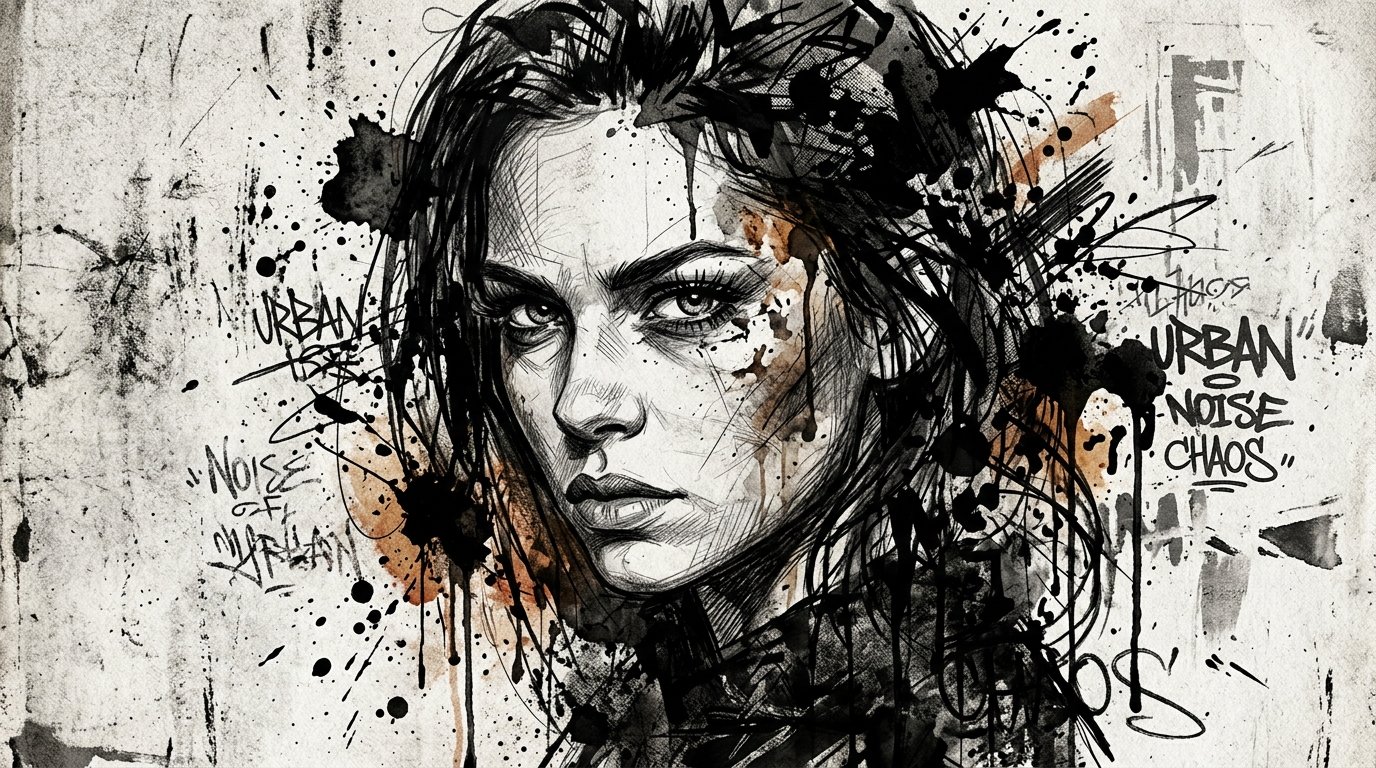
Faces can act as the visual anchor of a composition while surrounding marks create movement and disruption. Instead of presenting a portrait as a simple realistic representation, Mills often alters its surrounding environment or integrates other forms into it.
This gives his portraits an expressive rather than purely photographic quality.
Animal Imagery
Animals are another recurring element.
Artist biographies have noted the appearance of animal heads and other animal-related imagery within his compositions. These elements can appear almost like masks or extensions of the human subject.
The effect is often surreal without completely abandoning the recognizable human figure.
A portrait may therefore feel simultaneously human, animal, humorous, strange, and slightly unsettling.
Abstract Shapes and Movement
Another defining feature is movement.
Brush-like marks, lines, fragments, textures, and abstract shapes can appear to flow around the main subject. Instead of placing every element inside a clean boundary, Mills often allows forms to overlap.
This creates the impression that the image is moving or changing.
The technique is particularly effective when combined with a relatively recognizable face. The viewer has something familiar to focus on while the surrounding composition creates visual uncertainty.
Urban and Pop-Surreal Influences
Mills’ work has often been placed within the broader world of urban and contemporary art.
His visual language also incorporates influences from popular culture. An earlier description of his work discussed the collision of different pieces of popular culture and highlighted his interest in Japanese popular culture and Harajuku.
The result is not a straightforward reproduction of any one artistic tradition.
Instead, Mills combines influences and techniques into a personal visual vocabulary.
How Russ Mills Creates Byroglyphics Artwork
One of the most interesting parts of Byroglyphics is the relationship between traditional drawing and digital technology.
Initial Pen and Ink Drawing
Mills has described starting his illustrations as sketches made with ink.
The Bic fine pen has been particularly important to this process. In a description of his workflow, he explained that the drawing begins with the pen before being moved into a computer environment.
This matters because the final artwork does not begin as a purely digital image.
The physical drawing provides an imperfect foundation.
Digital Processing
After creating the initial drawing, Mills moves the artwork into digital software.
Photoshop becomes part of the process, allowing him to manipulate the illustration, experiment with layers, alter shapes, introduce textures, and combine visual elements.
This is where the original drawing can become much more complex.
A simple pen drawing can evolve into an image with multiple layers, textures, colors, distortions, and graphic effects.
Layering and Composition
Layering is particularly important to the Byroglyphics aesthetic.
Instead of treating a portrait as a single isolated object, Mills can build several visual levels around it.
The viewer may see:
- A central face or figure
- Hand-drawn lines
- Abstract marks
- Animal imagery
- Digital textures
- Color or tonal changes
- Background elements
These components create depth without requiring traditional realistic perspective.
Moving From Digital Work to Physical Art
Digital processing is not necessarily the end of the process.
Mills has described taking digitally developed illustrations toward larger physical canvases. Historical descriptions of his work also document mixed-media and acrylic works appearing in the art market.
This gives the work an important dual identity.
It is digital enough to benefit from software-based experimentation but remains connected to drawing and physical artmaking.
Themes Behind Byroglyphics Artwork
The visual style is only part of what makes the work interesting.
Mills’ biographies and portfolio descriptions have connected his work with themes including human behavior, superficiality, isolation, emotional characteristics, and broader social or psychological ideas.
These themes help explain why the distorted faces and unusual combinations can feel more meaningful than simple decorative graphics.
A face may look beautiful at first while simultaneously appearing fragmented or uncomfortable.
That contrast allows the artwork to explore the tension between appearance and emotion.
Byroglyphics and Pop Surrealism
Byroglyphics is often discussed alongside surreal and contemporary art.
Surrealism generally challenges ordinary relationships between objects, people, and environments. Mills’ work shares this tendency through combinations that would not normally appear together.
A human portrait can become connected to an animal form. Traditional drawing can coexist with digital manipulation. Realistic facial features can sit inside highly abstract surroundings.
This does not mean every Byroglyphics piece should be classified as pure surrealism.
It is more accurate to describe the work as occupying a space where illustration, contemporary graphics, urban art, and surreal visual ideas overlap.
Notable Byroglyphics Works and Print Releases
Mills has produced numerous individual artworks and limited-edition prints throughout his career.
One documented example is Aeonium, an early edition that Mills later described as having sold out in its original edition of 25 before being reissued as a larger print.
Another example is Planet Caravan, released as a limited-edition print through Red Propeller Gallery in 2011. Mills described the piece as being inspired by the Black Sabbath song of the same name and noted its combination of traditional and digital media.
His later work also includes Madré, a large-format limited print released through Red Propeller Gallery in 2013. The artist’s Behance entry describes the print as being produced on 310gsm cotton rag paper, with the initial copies hand-finished.
These examples show how the Byroglyphics identity has extended beyond online illustration into physical printmaking and collectible art.
Byroglyphics Exhibitions and Art Career
Mills’ work has appeared in gallery exhibitions, particularly within the British urban and contemporary art scene.
One important exhibition was Domestic Science, a Byroglyphics solo show presented at Signal Gallery in London in 2009. Contemporary documentation describes the exhibition as featuring new images and original canvases.
Byroglyphics also appeared in the Mash Media exhibition at Weapon of Choice Gallery in Bristol in 2009 alongside James Baker and TRXTR.
His work later appeared in other contexts, including an Adidas Urban Artist Series exhibition in Berlin in 2011. The exhibition included Russ Mills/Byroglyphics among an international group of artists.
These exhibitions demonstrate that the work was not limited to internet-based illustration.
Byroglyphics and Limited-Edition Prints
Limited-edition prints are an important part of the Byroglyphics story.
Some releases were produced in relatively small editions and became sought-after examples of Mills’ work. Historical records document signed and numbered prints connected with Red Propeller Gallery.
For collectors, several details can matter:
- Artist signature
- Edition number
- Edition size
- Certificate of authenticity
- Publisher or gallery
- Printing method
- Paper or canvas
- Condition
- Provenance
- Whether the release was an original edition or later reissue
These details can be more useful than simply judging an artwork by its visual appearance.
A print described as “Byroglyphics” is not automatically valuable simply because it carries the artist’s name. Collectors should verify the edition, provenance, condition, and authenticity before making a purchase.
Why Byroglyphics Artwork Stands Out
The biggest strength of Mills’ work is the combination of opposites.
His artwork can be:
- Traditional and digital
- Controlled and chaotic
- Human and animal
- Realistic and abstract
- Decorative and psychologically uncomfortable
- Graphic and painterly
That combination makes the images recognizable.
Many digital illustrations can look polished, but Byroglyphics retains evidence of drawing and physical mark-making. At the same time, the digital component allows Mills to manipulate those marks far beyond what a conventional pen drawing could achieve.
The result is a visual style that is difficult to reduce to one technique.
Byroglyphics vs. Hieroglyphics
The names sound similar, but the concepts are completely different.
| Byroglyphics | Ancient Egyptian hieroglyphics |
|---|---|
| Artist identity associated with Russ Mills | Historical Egyptian writing system |
| Contemporary art | Ancient writing |
| Primarily visual and artistic expression | Structured system used to represent language |
| Combines drawing and digital processing | Uses established hieroglyphic signs |
| Associated with illustration and contemporary art | Associated with ancient Egyptian culture |
| Modern artistic context | Historical and archaeological context |
This distinction is important because some online pages currently describe “Byroglyphics” as if it were a formal symbolic language. That interpretation does not align with the stronger artist-focused evidence surrounding the term. The available historical material consistently connects Byroglyphics with Russ Mills.
Where Can You Find Byroglyphics Artwork?
Byroglyphics artwork has appeared across several platforms and art-market contexts.
Russ Mills maintains a professional presence on Behance under the Byroglyphics identity, where his portfolio includes individual projects and artwork.
Artwork associated with Byroglyphics has also appeared through galleries, auction listings, art databases, and print marketplaces.
Because availability changes over time, anyone looking for a specific work should check the artwork title, edition number, publisher, and provenance rather than relying only on a search for the artist’s name.
Is Byroglyphics a Person or an Art Style?
Byroglyphics is primarily an artistic name associated with Russ Mills.
It can also be used informally when describing the distinctive visual style associated with his work, but it is more accurate to identify Byroglyphics as the artist name or identity rather than treating it as a formal art movement.
What Makes Russ Mills’ Artwork Different?
Mills’ work stands out because it does not completely separate traditional drawing from digital art.
The underlying drawing can retain the character of a pen sketch, while digital processing introduces new layers of texture, movement, color, and distortion.
That workflow gives the finished artwork a sense of both imperfection and precision.
The viewer can often recognize the hand-drawn foundation even after substantial digital transformation.
Why Is Byroglyphics Still Relevant?
The Byroglyphics approach remains interesting because the boundary between traditional and digital art has become increasingly fluid.
Artists today can draw by hand, scan or photograph their work, manipulate it digitally, combine multiple media, and produce both digital and physical editions.
Mills’ work demonstrates this hybrid approach in a particularly recognizable form.
His artwork also shows why a distinctive visual language can be more memorable than simply following a single established category.
Final Takeaway
Byroglyphics is the artistic identity associated with Russ Mills, a British illustrator and contemporary artist known for combining traditional drawing with digital processing.
His work frequently centers on human faces and figures while incorporating animal imagery, abstract forms, textures, and energetic marks. His creative process has been documented as beginning with pen-based drawing and continuing through digital manipulation, creating a distinctive hybrid between illustration and contemporary art.
The name Byroglyphics is therefore best understood in the context of Russ Mills and his artwork, not as another name for ancient Egyptian hieroglyphics.
For anyone interested in contemporary illustration, urban art, pop-surreal imagery, or the relationship between hand-drawn and digital techniques, Mills’ work offers a useful example of how those disciplines can be combined into one recognizable artistic language.
FAQ Section
What does Byroglyphics mean?
Byroglyphics is the artistic name associated with British artist and illustrator Russ Mills. The name is connected with his use of the biro or ballpoint pen as part of his drawing process.
Who is the Byroglyphics artist?
The artist behind Byroglyphics is Russ Mills, a British illustrator and visual artist whose work combines traditional drawing, digital processing, contemporary graphics, and surreal imagery.
What style is Byroglyphics?
Byroglyphics is associated with a hybrid visual style combining illustration, urban art, contemporary graphics, mixed-media aesthetics, and surreal or pop-surreal elements.
How does Russ Mills create his artwork?
Mills has described beginning with ink drawings, including work made with a Bic fine pen, before moving the artwork into a digital environment for manipulation and development.
Is Byroglyphics the same as hieroglyphics?
No. Byroglyphics is associated with Russ Mills and contemporary artwork, while hieroglyphics refers to historical Egyptian writing.
Does Byroglyphics make prints?
Yes. Mills has released limited-edition prints through gallery and print channels, including documented releases associated with Red Propeller Gallery.
What subjects appear in Byroglyphics artwork?
Human faces and figures are major subjects, often combined with animal imagery, abstract shapes, textures, and other visual elements.
Where can I see Russ Mills’ artwork?
His portfolio has been represented online through platforms such as Behance, while his work has also appeared through galleries, exhibitions, auctions, and print releases.
Are Byroglyphics prints valuable?
Some limited editions can have collector interest, but value varies considerably. Edition size, authenticity, condition, provenance, demand, and the specific work all matter.
Is Byroglyphics a formal art movement?
No. It is more accurate to describe Byroglyphics as Russ Mills’ artistic identity rather than a formally established art movement.
See also: Give Me Customer Stories for Cavallo.com