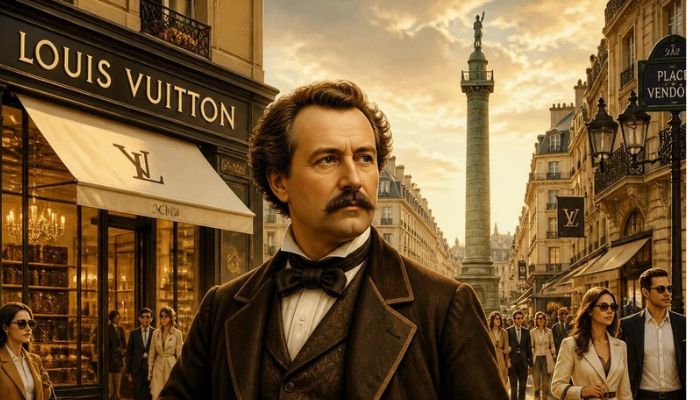
Louis Vuitton is one of the most recognizable names in luxury fashion, but the story behind the name began with something much more practical than handbags or runway collections. It began with travel, craftsmanship, packing, and the making of trunks.
Louis Vuitton: The Illustrated World of a Fashion Icon by Megan Hess explores that story through an illustrated biography of Louis Vuitton and the fashion house that grew from his work. Published by Hardie Grant in 2025, the 192-page book combines biography, fashion history, luxury design, travel, and fashion illustration.
What makes the book especially interesting is its approach. Instead of treating Louis Vuitton simply as a modern luxury label, it takes readers back to the person behind the name and follows the ideas, craftsmanship, and family legacy that helped turn a Parisian trunkmaking business into an internationally recognized fashion house.
What Is Louis Vuitton: The Illustrated World of a Fashion Icon?
Louis Vuitton: The Illustrated World of a Fashion Icon is an illustrated biography written and illustrated by fashion illustrator Megan Hess.
The book focuses on the life and career of Louis Vuitton and the origins of the brand that carries his name. It looks at his difficult journey to Paris, his training in trunkmaking and packing, the establishment of his own business, and the innovations that helped distinguish his products.
The story then expands beyond Louis Vuitton himself. It follows the development of the family business, the growth of its travel products, the importance of the Monogram, the emergence of handbags, and the eventual transformation of Louis Vuitton into a major fashion house.
The book contains 192 pages and belongs to the biography, fashion, design, and fashion-history categories.
That makes it different from a purely commercial product catalog. Its central subject is not simply what Louis Vuitton sells today. It is the story of how the house developed and why its visual identity has remained so recognizable.
Who Is Megan Hess?
Megan Hess is an internationally known fashion illustrator and author whose career has included work connected with major fashion and luxury names.
Her professional background makes her a natural choice for a project that needs both historical storytelling and strong visual presentation.
Hess is known for a distinctive illustration style that focuses on fashion, figures, clothing, accessories, and luxury environments. Her previous books have explored major names and subjects in fashion, including fashion houses and designers.
For this Louis Vuitton book, her role is especially important because the subject itself is highly visual.
Louis Vuitton’s history is filled with objects that can be understood through shape, material, pattern, architecture, clothing, travel, and craftsmanship. A conventional biography can explain those things, but illustration offers another way to experience them.
What Is the Book About?
At its core, the book is about transformation.
Louis Vuitton began with a specialized craft connected to travel. His early career involved learning how to pack and protect the belongings of wealthy travelers. Over time, that practical knowledge became the foundation for his own business.
His journey is one of the central elements of the story.
Louis Vuitton arrived in Paris as a teenager and spent years learning the trade before establishing his own workshop. His experience helped him understand what travelers needed at a time when transportation was changing rapidly.
The book uses this personal story to explain the origins of the Louis Vuitton brand.
Rather than beginning with the famous LV Monogram, it begins with Louis Vuitton himself.
That distinction matters.
The modern Louis Vuitton identity is dominated by recognizable bags, luggage, clothing, jewelry, accessories, campaigns, stores, and runway collections. The original business was much more closely connected with craftsmanship and travel.
Understanding that foundation makes the later evolution of the brand easier to understand.
Louis Vuitton’s Journey From Apprentice to Trunkmaker
Louis Vuitton’s early life was not an obvious path toward luxury fashion.
According to Louis Vuitton’s own historical account, he arrived in Paris on foot as a teenager in 1837 and began working as an apprentice for Monsieur Maréchal.
At that time, travel depended heavily on horse-drawn carriages, boats, and trains. Baggage was handled roughly, creating demand for craftsmen who could pack and protect valuable possessions.
Vuitton spent many years developing this specialized knowledge.
This experience became important because he was not simply learning how to make boxes. He was learning how people traveled and how their belongings could be organized, protected, and transported.
That practical understanding eventually became part of his competitive advantage.
In 1854, Louis Vuitton opened his own workshop and business in Paris.
The location near the Place Vendôme placed him in an area associated with wealthy clientele and luxury craftsmanship.
The story is therefore not simply about an ambitious designer creating fashionable products. It is about an artisan identifying a problem and developing products around the needs of travelers.
How Travel Shaped the Louis Vuitton Brand
Travel is one of the most important themes in Louis Vuitton’s history.
The early products were designed for movement. Trunks needed to protect clothing and personal belongings while remaining practical enough to transport.
One of Vuitton’s important innovations was the flat-topped trunk.
Traditional trunks often had rounded tops. A flat design offered a major practical advantage because trunks could be stacked more easily.
The change may seem simple today, but it reflects an important principle that continued throughout the brand’s history: luxury could be functional.
Louis Vuitton’s products were not created simply to look expensive. They were designed to solve problems associated with travel.
This connection between travel and design became one of the strongest parts of the brand’s identity.
Even as Louis Vuitton expanded into handbags, clothing, accessories, fragrances, jewelry, and other categories, the idea of movement and exploration remained connected to the house.
The Birth of the Louis Vuitton Maison
Louis Vuitton established his own business in 1854.
A few years later, the company expanded its operations to Asnières-sur-Seine, where a workshop became an important part of the family’s business and production history.
Asnières remains closely associated with Louis Vuitton craftsmanship.
The early years established several principles that would become important to the brand:
- Skilled craftsmanship
- Customization
- Travel functionality
- Durable materials
- Innovation
- Attention to detail
- Personal service
These principles helped distinguish Louis Vuitton from ordinary luggage manufacturers.
The company was building a reputation around both function and craftsmanship.
That combination would eventually become central to the luxury positioning of the brand.
Why the Monogram Became So Important
Few fashion symbols are as recognizable as the Louis Vuitton Monogram.
The pattern was created by Georges Vuitton in 1896 as a tribute to his father, Louis Vuitton.
Its design combined the LV initials with stylized floral motifs. The pattern became an important visual signature for the house and eventually developed into one of the most recognizable symbols in luxury fashion.
The Monogram was not simply decorative.
It also addressed a practical business problem.
The Vuitton family faced imitation of its products, and creating a distinctive visual signature helped identify the company’s creations.
Over time, the Monogram became much more than a mark of origin. It became a major part of the visual language of the brand.
In 2026, Louis Vuitton is marking the 130th anniversary of the Monogram, highlighting the continued importance of this design in the house’s identity.
That anniversary gives the history covered in Megan Hess’s book an especially relevant modern context.
From Trunks to Handbags and Fashion
One of the most interesting parts of Louis Vuitton’s history is the movement from specialized travel trunks into fashion.
The transition did not happen overnight.
The house continued to develop luggage and leather goods while gradually expanding its range.
Handbags became increasingly important, helping Louis Vuitton move beyond its original role as a trunkmaker.
The house’s association with prominent clients and cultural figures also strengthened its position within luxury.
Over time, Louis Vuitton products became recognizable not only because of their construction but also because of their relationship with fashion, celebrity, travel, and popular culture.
The transformation shows how a company can build a new category around an existing heritage.
Louis Vuitton did not abandon its trunkmaking origins.
Instead, those origins became part of the story used to give newer products a sense of continuity.
How Louis Vuitton Became a Modern Fashion House
The major transformation into modern fashion accelerated in the late 20th century.
In 1997, Louis Vuitton appointed Marc Jacobs as Artistic Director of the men’s and women’s collections with the goal of expanding the house into ready-to-wear and accessories.
Jacobs’ arrival represented a significant change.
Louis Vuitton already had a powerful reputation for leather goods and luggage. Ready-to-wear introduced another creative language and gave the house a stronger presence in contemporary fashion.
His period at Louis Vuitton also became associated with major artistic collaborations.
The house worked with artists including Stephen Sprouse, Takashi Murakami, and Richard Prince.
These collaborations helped demonstrate that Louis Vuitton could treat its historic visual codes as material for experimentation rather than as something that had to remain unchanged.
This became a recurring feature of the brand.
From Marc Jacobs to Nicolas Ghesquière
After Marc Jacobs, Louis Vuitton entered another major creative period under Nicolas Ghesquière.
Ghesquière became Artistic Director of the women’s collections in 2013.
His approach emphasized modern silhouettes, architectural shapes, and reinterpretations of Louis Vuitton’s established codes.
This period illustrates an important characteristic of the house: heritage does not necessarily mean repeating old designs.
A heritage brand can take familiar elements and reinterpret them for a new generation.
The same principle can be seen in the Monogram, trunks, handbags, stores, runway collections, and collaborations.
The historical foundation stays recognizable while the visual expression changes.
The Virgil Abloh Chapter
Louis Vuitton’s modern story also includes Virgil Abloh, who became Men’s Artistic Director in 2018.
Abloh brought a different cultural perspective to the house, connecting traditional luxury with contemporary streetwear, music, art, and youth culture.
His work demonstrated how far the original Louis Vuitton concept had traveled.
A company that began with trunks for travelers could now communicate with global audiences through runway shows, sneakers, bags, streetwear influences, collaborations, and cultural events.
Abloh remained in the position until his death in November 2021.
His contribution remains an important part of the modern history of Louis Vuitton.
Pharrell Williams and the Continuing Evolution
Pharrell Williams became Louis Vuitton’s Men’s Creative Director in 2023.
His appointment continued the house’s tradition of bringing influential figures from different creative fields into fashion.
Williams’ first Louis Vuitton men’s collection was presented in Paris in June 2023.
The collection incorporated elements of Louis Vuitton’s heritage while introducing Williams’ own cultural references.
This is another example of the way Louis Vuitton continues to reinterpret its historical identity.
The brand’s evolution is therefore not a straight line from trunks to handbags to clothing.
It is a continuous conversation between heritage and contemporary culture.
Why Megan Hess Uses Illustration to Tell the Story
Illustration is not simply decoration in this book.
It changes how the story is experienced.
Louis Vuitton’s history contains many visually distinctive subjects:
- Historic trunks
- Parisian workshops
- Travel scenes
- Luxury interiors
- Fashion
- Handbags
- Monogram patterns
- Architectural spaces
- Runway culture
- Designers
- Celebrities
- Artistic collaborations
A photographic archive can document these subjects, but illustration can interpret them.
Megan Hess’s fashion-illustration style allows the book to present historical figures and objects through a consistent visual language.
That gives the book a different personality from a traditional academic history.
It is designed to be read, but it is also designed to be looked at.
What Makes This Book Different From a Traditional Fashion History Book?
The most important difference is scale and approach.
A large fashion-history reference can devote hundreds of pages to runway collections, designers, garments, dates, and detailed fashion analysis.
For example, Louis Vuitton Catwalk takes a much more extensive collection-based approach and runs to more than 600 pages.
Megan Hess’s book is considerably shorter at 192 pages.
That does not make it less useful. It means the purpose is different.
The Illustrated World of a Fashion Icon works as an accessible visual biography.
It is particularly suited to readers who want to understand:
- Who Louis Vuitton was
- How his company began
- Why his trunks mattered
- How the family developed the business
- Why the Monogram became iconic
- How the house entered modern fashion
- How heritage became part of the brand’s identity
Readers looking for a complete catalog of every Louis Vuitton runway collection would need a different type of reference.
Readers who want a visually engaging introduction to the man and the house are closer to the book’s natural audience.
Who Should Read Louis Vuitton: The Illustrated World of a Fashion Icon?
The book is a strong fit for several audiences.
Fashion lovers
Anyone interested in fashion history can use the book as an accessible introduction to one of the industry’s most recognizable names.
Louis Vuitton enthusiasts
People who already know the bags and Monogram may enjoy learning about the history behind them.
Luxury-brand enthusiasts
The story provides an interesting example of how craftsmanship, heritage, visual identity, and innovation can combine to create a long-lasting luxury brand.
Readers interested in design
The book connects product design with travel, materials, craftsmanship, illustration, and visual identity.
Coffee-table book collectors
Because illustration is central to the experience, the book also has appeal as a visual display piece rather than simply a conventional biography.
Gift buyers
Its combination of fashion history and illustration makes it a natural gift option for someone interested in fashion, luxury, design, or Louis Vuitton.
Is the Book Worth Reading?
For the right reader, yes.
The strongest reason to read it is not simply the Louis Vuitton name.
It is the connection between a person’s life, a practical craft, and the eventual development of a global luxury identity.
The story also gives useful context for understanding why Louis Vuitton continues to rely so heavily on its heritage.
The Monogram, trunks, travel references, craftsmanship, and family history are not random elements of the brand’s image. They connect the modern fashion house to its origins.
Megan Hess’s illustrations add another reason to choose this particular book.
Readers looking for a highly academic or exhaustive history may want a more detailed reference work. But readers looking for a visually engaging biography that connects Louis Vuitton’s personal story with the development of the house should find the format appealing.
Louis Vuitton’s Visual Legacy
One of Louis Vuitton’s greatest strengths has always been its ability to create recognizable visual codes.
The Monogram is the most obvious example, but it is not the only one.
The trunk silhouette, travel imagery, luggage construction, leather goods, Damier pattern, hardware, typography, packaging, stores, and runway presentations all contribute to the identity of the house.
This is why an illustrated biography is particularly appropriate for Louis Vuitton.
The brand’s history is not only a written story.
It is a visual story.
The objects themselves communicate ideas about travel, status, craftsmanship, design, and luxury.
Why the Book Remains Relevant in 2026
The book was published in 2025, but its subject continues to evolve.
In 2026, Louis Vuitton is celebrating 130 years of its Monogram, placing one of the house’s most recognizable historical elements back in the spotlight.
The anniversary includes renewed attention to iconic Monogram products and new interpretations of the historic motif.
That creates an interesting connection between the book’s historical subject and the brand’s current direction.
Louis Vuitton continues to demonstrate that heritage can be treated as an active design resource rather than a static museum piece.
That idea is one of the most useful ways to understand the house today.
Final Takeaway
Louis Vuitton: The Illustrated World of a Fashion Icon is more than a book about expensive handbags.
It is a visual biography of the person whose name became one of the most recognizable identities in luxury fashion.
Louis Vuitton’s journey began with craftsmanship, packing, trunks, and travel. His family expanded that foundation, developed distinctive visual signatures, and helped establish a legacy that later creative directors could reinterpret for new generations.
Megan Hess presents that journey through illustration, making the book particularly attractive to readers who appreciate fashion history but also want a strong visual experience.
For someone discovering Louis Vuitton for the first time, it offers a concise introduction to the story behind the name. For longtime fans, it provides another way to look at the heritage behind the Monogram, trunks, handbags, and modern fashion house.
The most important lesson is simple: Louis Vuitton became a fashion icon because the brand repeatedly turned practical craftsmanship into recognizable design, and then allowed that design language to evolve with changing ideas about travel, culture, and fashion.
FAQ Section
What is Louis Vuitton: The Illustrated World of a Fashion Icon about?
It is an illustrated biography by Megan Hess covering Louis Vuitton’s life, his career as a trunkmaker, the founding of his business, and the development of the fashion house that carries his name.
Who wrote Louis Vuitton: The Illustrated World of a Fashion Icon?
The book was written and illustrated by Australian fashion illustrator and author Megan Hess.
When was the Louis Vuitton illustrated book published?
The book was published in 2025 by Hardie Grant Books. Bibliographic listings identify it as a 192-page illustrated biography.
How many pages does the book have?
The book has 192 pages.
Is the book mainly about Louis Vuitton or the Louis Vuitton brand?
It covers both, but the starting point is Louis Vuitton himself. His early life, journey to Paris, trunkmaking career, and business provide the foundation for understanding the later development of the brand.
Does the book cover the Louis Vuitton Monogram?
Yes. The Monogram is an important part of Louis Vuitton’s visual history. It was created by Georges Vuitton in 1896 as a tribute to his father.
Is this a good book for someone interested in fashion history?
Yes. It is especially suitable for readers who want an accessible combination of biography, fashion history, craftsmanship, luxury branding, and illustration.
Is it an academic Louis Vuitton history book?
Not primarily. It is better understood as an illustrated biography and visual fashion-history book. Readers seeking an exhaustive study of every Louis Vuitton runway collection may prefer a much larger fashion reference.
Why is Louis Vuitton’s trunkmaking history important?
Trunkmaking explains the foundation of the house. Louis Vuitton developed his reputation through the practical needs of travelers before the brand expanded into handbags, accessories, ready-to-wear, and other luxury categories.
Why is Megan Hess a good fit for this book?
Hess specializes in fashion illustration and has worked with major fashion and luxury names. Her visual approach allows the history of Louis Vuitton to be presented as both a biography and a visual fashion story.
See also: Maxwinexch Review