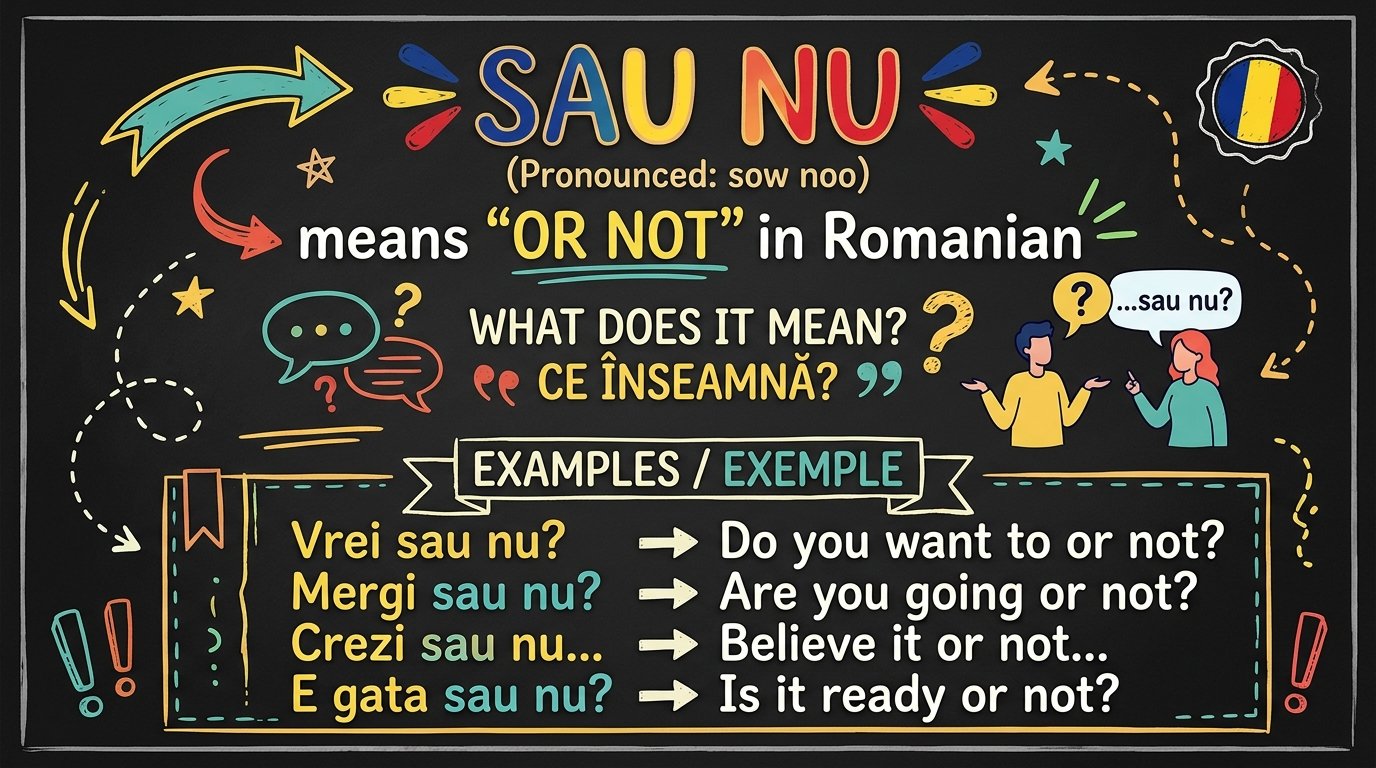
The phrase “sau nu” is a Romanian expression that generally translates to “or not” in English. Its precise meaning depends on the sentence in which it appears. People use this expression when discussing alternatives, asking questions, or expressing uncertainty about whether something is true or will happen.
Understanding “sau nu” becomes easier when you examine complete sentences rather than translating the words individually. This guide explains its meaning, grammar, common uses, and practical examples for English-speaking readers.
What Does “Sau Nu” Mean?
“Sau nu” generally means “or not” in English. It combines two Romanian words: “sau,” meaning “or,” and “nu,” meaning “no” or “not,” depending on the grammatical context.
Together, these words can express a choice between an action happening and not happening.
For example, a Romanian speaker might use “sau nu” when asking whether someone plans to attend an event. In English, the natural translation could be “or not” or “whether or not,” depending on the sentence structure.
The phrase does not always have one fixed English equivalent. Context determines the most accurate translation.
How Is “Sau Nu” Used in Romanian?
The expression can appear in questions and statements. Its function depends on the surrounding words and the speaker’s intended meaning.
1. Asking about an alternative
A speaker may use the phrase to distinguish between two possibilities.
For example, someone might ask whether a person wants to participate or not. In this situation, the expression helps present both possible outcomes.
2. Expressing uncertainty
The phrase can also appear when someone does not know whether something is true.
In English, similar sentences include “I don’t know whether it will happen or not” and “We need to find out whether she agrees or not.”
The Romanian wording may vary according to the sentence, so a complete translation should consider the entire statement.
3. Discussing a decision
When a person is considering a choice, the expression can help communicate that an action may or may not take place.
For example, a conversation about attending a meeting could involve deciding whether to go or stay home.
“Sau Nu” Translation Examples
The following examples illustrate the English meaning of the expression. They are illustrative translations rather than verified quotations from Romanian speakers.
| English expression | Meaning |
|---|---|
| Or not | Presents an alternative or negation |
| Whether or not | Introduces two possible outcomes |
| Yes or no | Requests a direct answer when the context calls for it |
| Whether it happens or not | Describes an event that may or may not occur |
These English expressions are related, but they are not interchangeable in every situation.
For instance, “or not” can work at the end of a question, while “whether or not” often fits naturally within a longer statement.
What Is the Difference Between “Sau” and “Nu”?
Understanding the individual words makes the full expression easier to recognize.
Sau generally means “or.” It connects alternatives, such as two choices, actions, or possibilities.
Nu generally expresses negation, meaning “no” or “not,” depending on how it is used.
When combined, “sau nu” can communicate the idea of an alternative involving a negative possibility.
However, Romanian grammar depends on sentence structure. Translating the words separately may produce an awkward English sentence, so it is better to translate the complete thought.
How to Translate “Sau Nu” Naturally Into English
Follow these steps when translating a sentence containing the phrase.
Step 1: Read the complete sentence
Do not translate “sau nu” in isolation if the surrounding words are available. The sentence may contain clues about whether the phrase expresses a question, uncertainty, or a choice.
Step 2: Identify the intended meaning
Ask yourself whether the speaker is presenting alternatives, requesting a decision, or discussing an uncertain outcome.
Step 3: Choose natural English wording
Depending on the context, “or not,” “whether or not,” or another English construction may communicate the intended meaning more clearly.
Step 4: Check the grammar
A direct word-for-word translation may not preserve natural English word order. Adjust the sentence while keeping the original meaning.
Step 5: Review the context
If the phrase comes from a song, conversation, social media post, or longer passage, surrounding sentences may change how it should be interpreted.
Common Mistakes When Translating “Sau Nu”
English speakers unfamiliar with Romanian may encounter several translation problems.
Translating without context: A two-word expression may have different natural translations in different sentences.
Confusing “no” with “not”: English uses these words differently. “No” can stand alone as an answer, while “not” usually negates a word, phrase, or clause.
Using “yes or no” in every situation: Although this can express a related idea, it does not automatically replace “or not.”
Ignoring sentence structure: A grammatically correct Romanian sentence may require a different word order in English.
Assuming it is a name: The words may also appear as part of a title, username, brand, or other proper noun. In such cases, the intended meaning should be checked before translating.
Is “Sau Nu” a Romanian Slang Expression?
The phrase itself is a normal Romanian expression rather than necessarily being slang. Its tone depends on the surrounding sentence and the situation in which it is used.
A casual conversation may use it informally, while a more formal statement may contain the same words in a grammatically structured sentence.
If you encountered “sau nu” in a social media caption, music title, or online discussion, it is worth checking the complete context. A title or username may have a special meaning that differs from the ordinary Romanian translation.
Why Context Matters in Translation
Translation involves more than matching individual words between languages. A good translation preserves meaning, tone, and the relationship between ideas.
Consider the English difference between these statements:
-
“Are you coming or not?”
-
“I don’t know whether you are coming or not.”
-
“Whether you come or not, we will begin at noon.”
All three involve the idea of an action happening or not happening, but each sentence serves a different purpose.
The first asks for a decision. The second expresses uncertainty. The third says that the outcome will not change what happens next.
This is why a translator should examine the whole sentence before selecting an English equivalent for “sau nu.”
12. Frequently Asked Questions
What does “sau nu” mean in English?
“Sau nu” generally translates to “or not” in English. Its exact meaning depends on the sentence and may be expressed more naturally as “whether or not.”
What language is “sau nu”?
The phrase is Romanian. The word “sau” generally means “or,” while “nu” can mean “no” or “not.”
Does “sau nu” mean “yes or no”?
Not necessarily. “Yes or no” is a related expression in certain contexts, but “sau nu” more directly corresponds to “or not.” The full sentence determines the best translation.
How do you use “sau nu” in a sentence?
It can appear in sentences that present alternatives or discuss uncertainty. To use it correctly in Romanian, consider the complete sentence and its grammatical structure.
Is “sau nu” formal or informal?
The expression is not inherently slang. It can appear in ordinary conversation and other types of communication, depending on the sentence.
Can “sau nu” have different meanings?
Yes. Its natural English translation may vary with context. It can express an alternative, a negative possibility, or uncertainty about an outcome.
How can I translate “sau nu” accurately?
Read the entire sentence, identify the intended meaning, and choose the English construction that sounds natural while preserving the original message.
13. Conclusion
“Sau nu” is a Romanian expression that generally means “or not” in English. Although its basic meaning is straightforward, its most natural translation depends on sentence structure and context.
By understanding the difference between “sau,” “nu,” and related English expressions, readers can interpret the phrase more accurately. When translating a sentence, always consider the complete message rather than relying on a word-for-word interpretation.
Explore More: Anime9: Features, Safety, Legality, and Alternatives