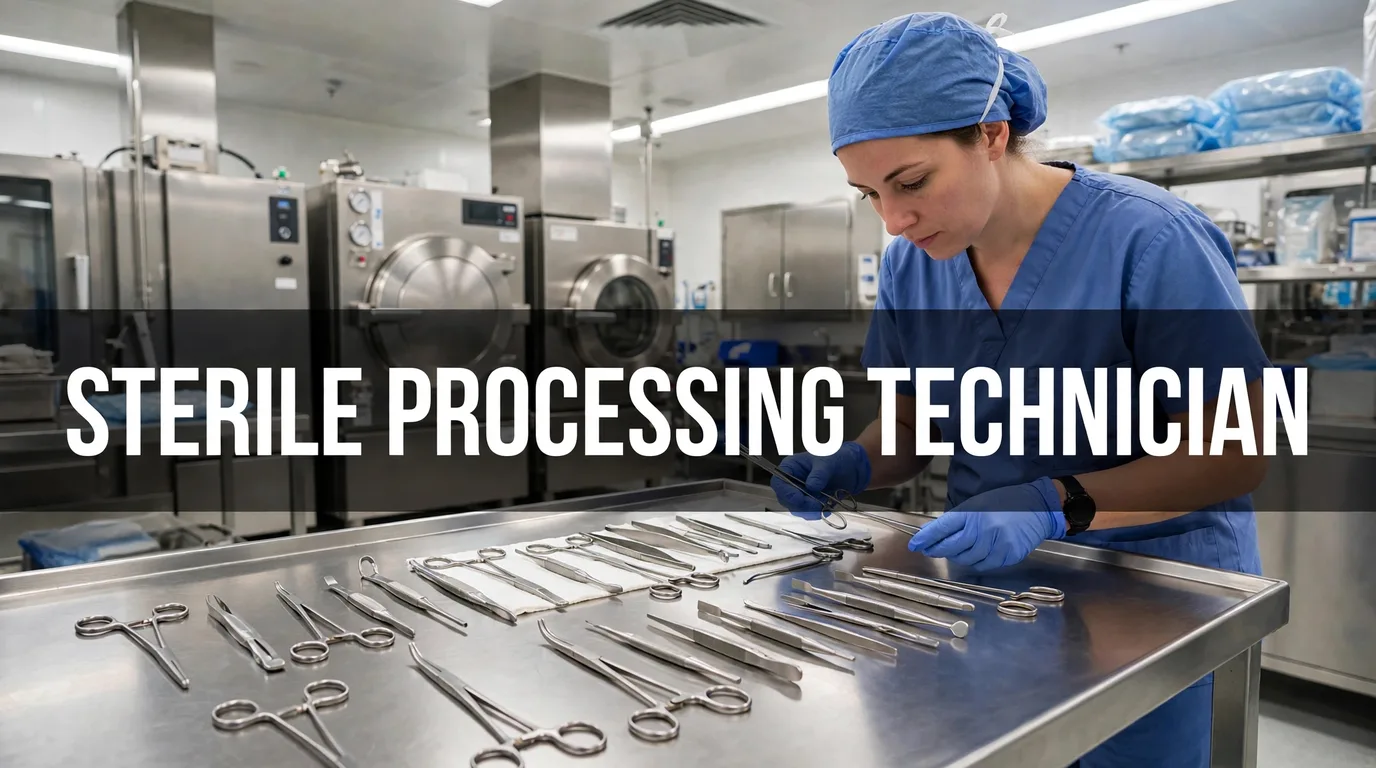
Every surgery depends on instruments that are perfectly clean, sterile, and ready at the exact moment they are needed — and making that happen is the job of a sterile processing technician. You will rarely see these professionals in a hospital drama, yet an operating room cannot run safely without them. This guide explains what the job actually involves, how much it pays, what certification you need, and how to get started if the work sounds right for you.
What Does a Sterile Processing Technician Do?
A sterile processing technician works in a hospital’s sterile processing department (SPD), sometimes called central service or central sterile supply. Their job is to take used surgical instruments through a strict cycle of cleaning, inspection, sterilisation, and storage, then deliver complete, sterile instrument sets to operating rooms and clinics.
It is detailed, physical, behind-the-scenes work. Technicians handle everything from simple forceps to complex robotic surgery instruments worth thousands of dollars, and every single item has to be processed exactly according to instructions. There is no “close enough” in this job, because a mistake can mean a postponed surgery — or a patient infection.
The Daily Workflow, Step by Step
Decontamination
The cycle starts in the decontamination area, the “dirty” side of the department. Used instruments arrive from operating rooms and clinics, and technicians — wearing protective equipment — sort them, open every hinged item, disassemble multi-part tools, and wash them using enzymatic detergents, ultrasonic cleaners, and washer-disinfectors. This stage removes blood and tissue and makes the instruments safe to handle.
Inspection and Assembly
On the clean side, each instrument is inspected under bright light, often with magnification. Technicians check for damage, stiffness, remaining soil, and proper function. Scissors must cut cleanly, clamps must lock evenly, and any instrument that fails inspection is sent for repair. Working instruments are then assembled into sets — a tray for a knee replacement, for example, may hold sixty or more specific items arranged in an exact order the surgical team expects.
Sterilisation
Assembled trays are wrapped or placed in rigid containers, labelled, and sterilised. The most common method is steam sterilisation in an autoclave, but heat-sensitive items go through low-temperature processes using hydrogen peroxide gas plasma or ethylene oxide. Every cycle is monitored with chemical and biological indicators to prove the load reached sterilising conditions.
Storage and Distribution
Sterile packs are stored in a controlled area and rotated so the oldest stock is used first. Throughout the day, the department fills requests from operating rooms, labour and delivery, emergency departments, and outpatient clinics. Many sterile processing technicians also manage case carts — picking every instrument set and supply needed for a specific scheduled surgery.
Why This Job Matters More Than People Think
Healthcare-associated infections are a serious risk, and contaminated instruments are one preventable cause. The sterile processing technician is the patient’s invisible line of defence: no surgeon, however skilled, can operate safely with a dirty or damaged instrument. Hospitals also depend on the department financially — a missing or unsterile tray can delay an operating room schedule that costs thousands of dollars per hour.
That responsibility is also why the role is becoming more professionalised. Instruments keep getting more complex, especially robotic and orthopaedic sets, and hospitals increasingly expect certified technicians who understand the science behind the process, not just the routine.
Sterile Processing Technician Salary and Job Outlook
Pay varies by region, hospital size, and experience, but in the United States a sterile processing technician typically earns somewhere in the range of $40,000 to $55,000 per year, with experienced technicians, evening or night-shift staff, and those in high-cost cities earning more. Certified technicians generally earn more than uncertified ones, and lead or supervisor roles pay more again.
Travelling sterile processing technicians — who take short contracts at hospitals around the country — can earn notably higher hourly rates, especially with several years of experience and certification. As for demand, the outlook is steady: surgical volumes grow as populations age, and every procedure needs processed instruments, which keeps the role in consistent demand in most regions.
Certification: CRCST and Other Credentials
Most employers prefer or require certification, and the best-known credential is the CRCST (Certified Registered Central Service Technician), offered by HSPA, the Healthcare Sterile Processing Association. To sit for the CRCST exam, you generally need a high school diploma and either completion of a sterile processing training programme or relevant work experience, plus a set number of hands-on hours in the department, which must be completed within a set period after passing.
Other options include the CSPDT credential from the CBSPD (Certification Board for Sterile Processing and Distribution). Some states have moved toward requiring certification by law, and many hospitals will hire you provisionally while you work toward it. Beyond the entry-level credential, there are advanced certifications in areas like endoscope reprocessing and instrument specialisation that help technicians move into lead roles.
How to Become a Sterile Processing Technician
Step 1: Meet the Basic Requirements
You need a high school diploma or equivalent. There is no degree requirement, which makes this one of the faster entry routes into hospital work. Being comfortable on your feet, able to lift instrument trays, and having strong attention to detail matters far more than academic background.
Step 2: Complete a Training Programme
Community colleges and vocational schools offer sterile processing programmes that run from a few months to about a year. They cover microbiology, infection control, decontamination, sterilisation methods, surgical instrument identification, and inventory management, and many include a clinical placement in a real hospital department. Online courses exist too, though you will still need hands-on hours for certification.
Step 3: Get Certified and Gain Experience
Pass the CRCST or CSPDT exam and complete your practical hours. If a hospital hires you without experience, expect to start in decontamination and rotate through each area of the department as you learn. The first year teaches you the instrument vocabulary — there are thousands of instruments, and recognising them quickly is the core skill of the job.
Step 4: Grow Your Career
Experienced technicians move into roles such as lead technician, department educator, supervisor, or instrument coordinator, and some transition into surgical technology, materials management, or vendor roles with instrument manufacturers. The knowledge you build about surgical procedures and instruments is valuable across the whole operating room ecosystem.
Skills That Make a Great Technician
The best sterile processing technicians share a few traits. Attention to detail is non-negotiable — a tray missing one instrument can stall a surgery. Physical stamina matters, because the job involves standing, lifting, and pushing heavy carts all shift. So does calm under pressure, since operating rooms sometimes need an instrument set turned around urgently. Finally, a genuine respect for process helps: the steps exist because each one protects a patient, and technicians who understand the “why” make fewer mistakes than those who just follow a checklist.
A Typical Shift: Hours and Work Environment
Sterile processing departments run around the clock, and a technician’s shift follows the rhythm of the operating rooms. Day-shift staff handle the heavy scheduled caseload — the steady flow of trays from elective surgeries — while evening teams process the day’s last cases and prepare the next morning’s first starts. Night shifts are smaller and focus on urgent turnovers, restocking, and getting ahead of the morning schedule.
The work environment is a study in contrasts. Decontamination is warm, wet, and noisy, with staff in full protective gear; the clean side is closer to a precision workshop, all bright light, magnifiers, and carefully laid-out trays. Most technicians rotate through both areas, plus steriliser loading, storage, and case-cart picking, so no two days are identical. Breaks matter in this job — concentration is a safety feature, and good departments protect it.
The Hard Parts of the Job
It would be dishonest to describe sterile processing as easy. The physical side is real: hours on your feet, heavy trays, and repetitive hand work. The mental side is just as demanding. A department may process thousands of instruments a day, and the standard is that every single one is right — there is no sampling, no “most of them were fine.”
There is also pressure that arrives without warning. A trauma case can send an urgent request down from the operating room mid-shift, and the whole department reorganises around it. Technicians who thrive learn to treat that pressure as part of the job’s meaning rather than an interruption of it: somewhere upstairs, a team is waiting on their work to help a patient. Many technicians say exactly that — the knowledge that their precision matters to a real person on a real table — is what keeps them in the field for decades.
Tools of the Trade: Machines You Will Work With
A sterile processing department runs on specialised equipment, and learning it is a big part of training. Washer-disinfectors are industrial machines that wash, thermally disinfect, and dry instrument sets in sealed cycles. Ultrasonic cleaners use high-frequency sound waves in a liquid bath to shake microscopic debris out of joints, hinges, and narrow channels that brushes cannot reach — watching a filthy instrument come out of an ultrasonic bath looking new is one of the job’s small satisfactions.
Steam sterilisers, or autoclaves, are the department’s workhorses, using pressurised steam at high temperature to kill all microbial life, including hardy bacterial spores. For delicate, heat-sensitive devices such as flexible endoscopes and camera equipment, technicians use low-temperature sterilisers based on vaporised hydrogen peroxide. Around these headline machines sits a support cast: heat sealers for pouches, water purification systems (water quality directly affects instrument staining and corrosion), drying cabinets, and computerised tracking systems that scan every tray’s barcode so the department knows exactly where each set is and when it expires. Modern departments are as much logistics operations as cleaning ones, and technicians who master the tracking software become especially valuable.
Working With the Operating Room Team
Sterile processing is sometimes described as a back-room job, but the department is in constant contact with the people upstairs. Technicians field calls from scrub nurses checking whether a set is ready, coordinate with surgical schedulers when the day’s case list changes, and flag damaged instruments to the operating room manager before they become a mid-surgery problem. When a surgeon adds an unexpected procedure, it is often a sterile processing technician who works out whether the instruments exist, are sterile, and can reach the room in time. Good communication is therefore a clinical skill in this department, not a soft extra — the technicians who build strong relationships with their operating room teams prevent more delays than any machine in the building.
Frequently Asked Questions
Is a sterile processing technician the same as a surgical technologist?
No. A surgical technologist works inside the operating room, passing instruments to the surgeon during procedures. A sterile processing technician works in the SPD, cleaning, sterilising, and preparing those instruments before and after surgery. The two roles work closely together but are trained separately.
How long does it take to become a sterile processing technician?
Most training programmes take between four months and one year. Including certification and required hands-on hours, most people are working in the role within about a year of starting.
Do sterile processing technicians work nights and weekends?
Often, yes. Hospitals operate around the clock, so departments run evening, night, and weekend shifts, and technicians may take on-call rotations for emergency surgeries. Shift differentials usually add extra pay for those hours.
Is the job physically demanding?
It can be. Expect to stand most of the shift, lift trays that can weigh up to roughly 25 pounds, and push loaded carts. Good footwear and proper lifting technique are part of the job.
Can you get hired without certification?
Some hospitals hire uncertified technicians and give them a deadline — commonly within the first year or two — to earn certification. Requirements vary by state and employer, and a few states mandate certification by law.
Final Thoughts
The sterile processing technician is one of healthcare’s most important invisible jobs: unglamorous, demanding, and absolutely essential to safe surgery. For someone who wants hospital work without a long degree, it offers a clear training path, a respected certification, steady demand, and room to grow. If you are careful, process-driven, and motivated by work that quietly protects people, it is a career well worth considering.
Read Also: Visual Effects Techniques: A Complete Beginner’s Guide