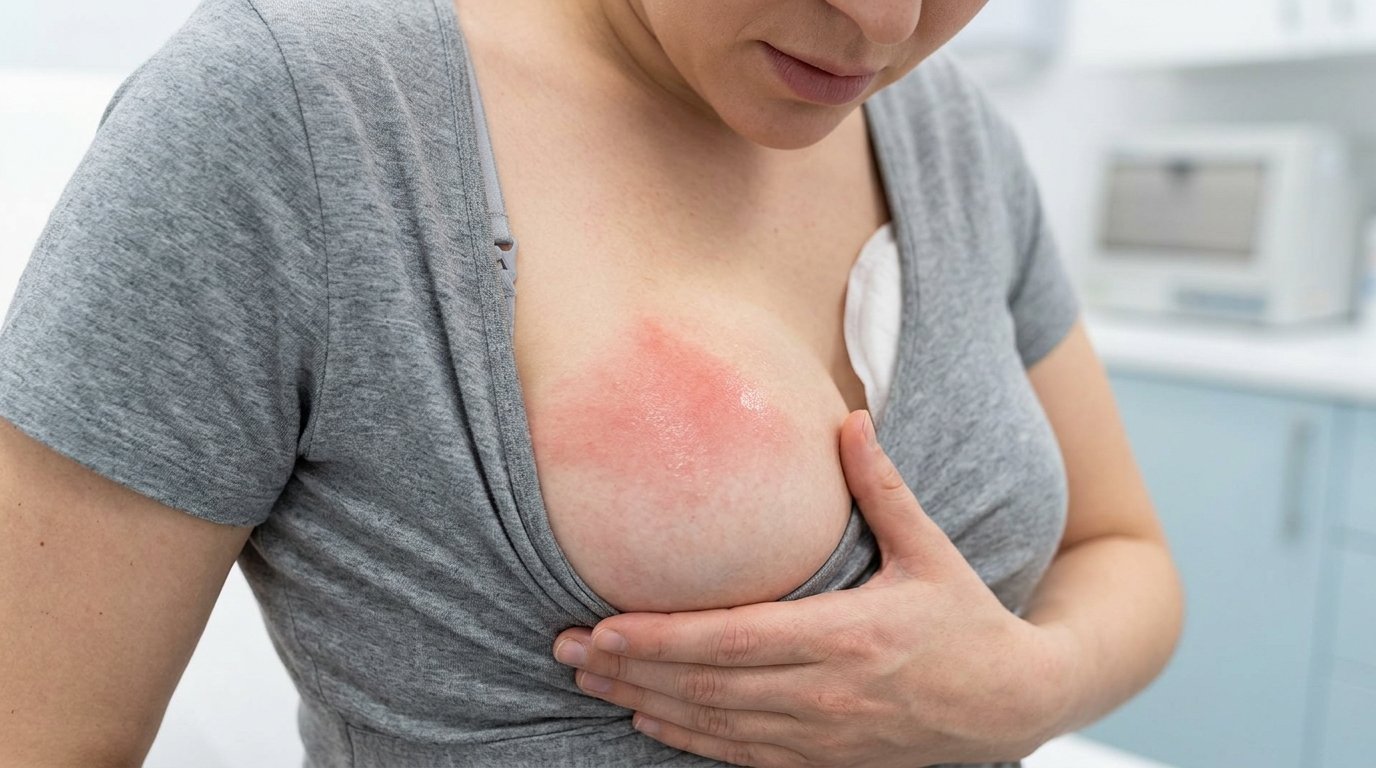
Mastitis is inflammation of breast tissue that most commonly occurs during breastfeeding. It can cause breast pain, swelling, warmth, redness, a firm or tender area, and sometimes fever or flu-like symptoms. Importantly, mastitis does not always mean there is a bacterial infection. Early inflammatory mastitis can sometimes improve with supportive care, while bacterial mastitis may require antibiotics.
Knowing the difference matters because some older approaches, such as aggressive breast massage or excessive pumping to “empty” the breast, can make inflammation worse. This guide explains what mastitis is, what causes it, how to manage symptoms, when antibiotics may be necessary, and which warning signs require medical evaluation.
What Is Mastitis?
Mastitis is inflammation of the breast. It is most common among people who are breastfeeding, particularly during periods when milk removal is disrupted or milk production exceeds what the baby needs.
Mastitis can involve inflammation without infection. In some cases, inflammation progresses to bacterial infection. This is why the term mastitis should not automatically be treated as a synonym for a breast infection.
The condition may affect one breast or, less commonly, both breasts. Symptoms can develop quickly and may range from a localized painful area to significant breast swelling accompanied by fever and feeling unwell.
Mastitis can also occur in people who are not breastfeeding, although the causes and evaluation can be different.
What Does Mastitis Feel Like?
Mastitis commonly causes a combination of breast and whole-body symptoms.
The affected breast may feel:
- Painful
- Warm
- Swollen
- Tender
- Firm or thickened
- Heavy
- Burning or uncomfortable during breastfeeding
You may also notice a red or discolored area. On darker skin tones, redness can be harder to see, so warmth, swelling, tenderness, and changes in texture can be important clues.
Some people develop systemic symptoms such as:
- Fever
- Chills
- Body aches
- Fatigue
- Feeling generally unwell
Mastitis symptoms can appear relatively suddenly.
What Are the Symptoms of Mastitis?
Common mastitis symptoms include:
| Symptom | What it may feel or look like |
|---|---|
| Breast pain | Localized tenderness, burning, or aching |
| Swelling | Part or all of the breast may feel swollen |
| Warmth | The affected area may feel noticeably warmer |
| Redness | A red or discolored patch may develop |
| Firm area | The breast may feel thickened or firm |
| Lump-like area | Inflammation can create a tender area that feels like a lump |
| Fever | Some people develop a fever |
| Chills | Flu-like chills can occur |
| Body aches | You may feel generally sick |
| Nipple discharge | Discharge can sometimes occur |
Not everyone experiences every symptom.
A painful breast without fever does not automatically mean mastitis, and fever does not prove that bacteria are responsible. A healthcare professional can assess the complete picture.
What Causes Mastitis?
Mastitis usually develops when inflammation occurs in breast tissue during lactation.
Several factors can contribute, including:
Milk production and removal becoming out of balance
When the breast produces more milk than is being removed, swelling and inflammation can develop. The surrounding tissue can compress the milk ducts and interfere with milk flow.
This can happen with oversupply, changes in feeding patterns, skipped feeds, or pumping more milk than the baby needs.
Latch problems
An ineffective latch can make breastfeeding painful and may interfere with comfortable milk removal.
If breastfeeding consistently hurts, a lactation consultant can assess positioning and attachment.
Nipple damage
Cracked or injured nipples can increase discomfort and may provide an opportunity for bacteria to enter damaged tissue.
Sudden changes in feeding
Longer gaps between feeds, abruptly reducing feeds, or suddenly stopping breastfeeding can contribute to breast fullness and inflammation.
Pressure on the breast
A tight bra or other sustained pressure can contribute to discomfort and interfere with normal milk flow.
Previous mastitis
People who have experienced mastitis before may have a higher risk of experiencing it again, especially when an underlying breastfeeding problem has not been addressed.
Is Mastitis Always an Infection?
No.
This is one of the most important points to understand.
Mastitis can begin as inflammation without a bacterial infection. The Academy of Breastfeeding Medicine describes a spectrum that includes ductal narrowing, inflammatory mastitis, bacterial mastitis, phlegmon, abscess, and other complications.
Inflammation can cause swelling around the milk ducts. That swelling can make milk flow more difficult, which may create a sensation that something is “blocked.”
This does not necessarily mean there is a solid plug of milk that needs to be forcefully pushed out.
If bacterial infection develops, antibiotics may be appropriate. The decision depends on symptoms, severity, duration, examination findings, and response to initial treatment.
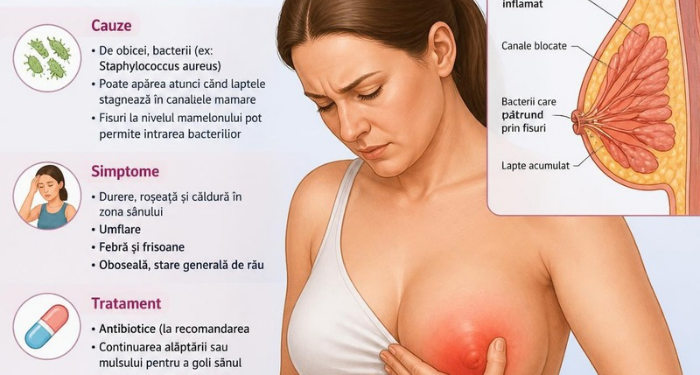
Mastitis vs. a Plugged Milk Duct vs. Engorgement
These conditions can feel similar, especially during breastfeeding.
| Condition | Typical features |
|---|---|
| Breast engorgement | General fullness, firmness, swelling, and discomfort |
| Ductal inflammation or “plugged” area | Localized tenderness or firm area caused by swelling around ducts |
| Inflammatory mastitis | More significant inflammation with pain, warmth, swelling, and sometimes systemic symptoms |
| Bacterial mastitis | Mastitis with suspected bacterial infection, often involving persistent or worsening systemic symptoms |
| Breast abscess | A collection of infected fluid or pus that may require drainage |
The boundaries are not always obvious without clinical assessment.
A common mistake is assuming that every painful lump is a milk plug that should be aggressively massaged. Current breastfeeding medicine guidance emphasizes reducing inflammation rather than forcefully trying to “break up” a plug.
How Is Mastitis Treated?
Treatment depends on whether the problem is primarily inflammatory or whether bacterial infection is suspected.
For inflammatory mastitis, the main goals are to reduce swelling, control pain, support normal breastfeeding, and avoid actions that stimulate unnecessary milk production or cause additional tissue injury.
Helpful measures may include:
- Continuing normal breastfeeding
- Using cold packs for swelling and pain
- Taking an appropriate over-the-counter pain reliever if it is safe for you
- Resting
- Drinking enough fluids
- Avoiding tight bras or pressure on the breast
- Getting professional help with latch or feeding technique when needed
If bacterial mastitis is suspected, a healthcare professional may prescribe antibiotics.
Do not start leftover antibiotics or someone else’s prescription. The appropriate medication depends on your medical history, allergies, local resistance patterns, and clinical findings.
What Can You Do for Mastitis at Home?
If symptoms are mild and you are otherwise well, supportive care may be reasonable while monitoring closely.
Continue normal breastfeeding
If you are breastfeeding, you generally do not need to stop simply because you have mastitis.
Feed your baby according to their normal needs rather than repeatedly feeding or pumping simply to “empty” the breast.
Use cold therapy
A cold pack wrapped in cloth can help reduce swelling and discomfort.
Avoid placing ice directly against the skin.
Avoid aggressive massage
Deep or forceful massage can injure breast tissue and increase inflammation.
If you touch the breast, use only gentle pressure.
Avoid unnecessary pumping
Extra pumping can stimulate additional milk production, potentially worsening oversupply.
Pump when needed for your baby’s feeding requirements or to replace a normal feeding, rather than repeatedly pumping to completely empty the breast.
Wear comfortable support
A supportive but non-restrictive bra may be more comfortable than a tight bra.
Rest
Mastitis can make you feel exhausted and unwell. Give your body time to recover.
Get breastfeeding help
If latch problems, oversupply, frequent pumping, or feeding patterns are contributing to repeated symptoms, a lactation consultant can help identify the underlying problem.
Should You Keep Breastfeeding With Mastitis?
In most cases, yes.
Mastitis itself is generally not a reason to stop breastfeeding. Continuing normal breastfeeding can help maintain milk supply and avoid sudden breast fullness.
Stopping breastfeeding abruptly can sometimes make breast inflammation and milk accumulation worse.
If you have a bacterial infection and are prescribed antibiotics, many commonly used antibiotics are compatible with breastfeeding. Your healthcare professional can confirm whether your specific medication is appropriate.
If you have a special situation, such as a premature infant, a baby in a neonatal intensive care unit, or a resistant infection such as MRSA, individualized medical advice is important.
When Are Antibiotics Needed?
Antibiotics are used when bacterial mastitis is suspected or when symptoms are not improving with appropriate supportive treatment.
Not every case of early mastitis requires immediate antibiotics.
A healthcare professional may consider factors such as:
- How severe the symptoms are
- How long symptoms have been present
- Whether symptoms are worsening
- Whether there is fever or significant systemic illness
- Whether supportive care has helped
- Whether there are signs of an abscess
- Whether the person has risk factors for resistant bacteria
- Whether mastitis has occurred repeatedly
If antibiotics are prescribed, take them exactly as directed and complete the prescribed course unless your clinician tells you otherwise.
If symptoms are not improving as expected, contact your healthcare professional rather than simply continuing the same treatment.
How Long Does Mastitis Last?
The duration varies depending on the cause and how quickly treatment begins.
Early inflammatory symptoms may improve substantially within a day or two with appropriate management. Bacterial mastitis may take longer and may require antibiotics.
If symptoms are getting worse rather than better, or if there is no meaningful improvement after a reasonable period of supportive care, contact a healthcare professional.
Do not assume that persistent breast inflammation is simply something you need to tolerate.
Can Mastitis Cause a Breast Abscess?
Yes.
An untreated or inadequately treated breast infection can sometimes progress to an abscess.
A breast abscess is a collection of infected fluid or pus within the breast. It may cause:
- A persistent painful lump
- Increasing swelling
- Continued fever
- Localized tenderness
- Symptoms that fail to improve with treatment
An abscess often requires imaging, usually an ultrasound, and drainage. Antibiotics may also be required.
If you have a painful lump that persists despite treatment, ask your healthcare professional whether an ultrasound is appropriate.
When Should You See a Doctor?
Contact a healthcare professional if you have symptoms that concern you, particularly if they are severe or worsening.
Seek medical advice if:
- You develop a significant fever
- You feel very unwell
- Breast redness or swelling is spreading
- Pain is becoming worse
- Symptoms do not improve with supportive care
- Symptoms continue after starting antibiotics
- You develop a persistent or enlarging lump
- You have repeated episodes of mastitis
- You are not breastfeeding but develop symptoms of mastitis
- You have a breast abscess or suspect one
- You notice unusual nipple discharge or another persistent breast change
Urgent medical evaluation may be needed if you have severe illness, rapidly worsening symptoms, confusion, fainting, difficulty breathing, or other signs of a serious systemic infection.
Can You Get Mastitis Without Breastfeeding?
Yes.
Although mastitis is most strongly associated with breastfeeding, it can occur in people who are not lactating.
Possible contributing factors can include nipple injury, nipple piercing, smoking, skin conditions, breast implants, or other causes of breast inflammation or infection.
Mastitis outside breastfeeding deserves medical evaluation because the possible causes are broader.
A healthcare professional may recommend imaging or other testing depending on the examination and symptoms.
How Can You Prevent Mastitis?
There is no guaranteed way to prevent every case, but several habits may reduce the risk.
Avoid unnecessary milk removal
Do not routinely pump extra milk simply to make the breasts feel completely empty unless there is a specific reason to do so.
Address latch problems
If breastfeeding hurts or your baby struggles to latch effectively, seek help early.
Avoid tight breast pressure
Choose bras and clothing that do not place excessive pressure on breast tissue.
Make feeding changes gradually
When reducing breastfeeding or pumping, gradual changes can help the body adjust.
Treat nipple damage
Persistent cracked or painful nipples should be assessed so the underlying cause can be addressed.
Get help with oversupply
If you consistently produce much more milk than your baby needs, work with a healthcare professional or lactation specialist rather than repeatedly pumping to manage fullness.
What Should You Do if Mastitis Keeps Coming Back?
Recurrent mastitis deserves more than repeated courses of antibiotics without looking for the underlying cause.
A healthcare professional or lactation consultant may review:
- Breastfeeding position
- Baby’s latch
- Feeding frequency
- Pumping frequency
- Pump settings and flange fit
- Oversupply
- Sudden changes in feeding
- Nipple damage
- Previous infections
- Possible bacterial resistance
- Whether imaging or milk culture is appropriate
Repeated inflammation can have an underlying trigger that needs to be corrected.
If episodes repeatedly occur in the same location, or a lump does not disappear between episodes, medical evaluation is especially important.
Mastitis and Inflammatory Breast Cancer
Mastitis and inflammatory breast cancer are different conditions, but some symptoms can overlap.
Inflammatory breast cancer is rare and can cause rapid breast swelling, redness or discoloration, skin changes resembling an orange peel, breast enlargement, heaviness, tenderness, or nipple inversion.
Persistent symptoms that do not respond as expected to mastitis treatment should therefore be evaluated.
This does not mean that most cases of mastitis are cancer. Mastitis is common during breastfeeding, while inflammatory breast cancer is rare. The important point is that persistent or unusual breast changes should not be ignored.
A healthcare professional may use a breast examination, ultrasound, mammogram, MRI, or biopsy depending on the situation.
A Simple Mastitis Action Plan
If you are breastfeeding and notice early mastitis symptoms, a practical approach is:
- Do not panic. Mastitis is common during breastfeeding and is treatable.
- Continue normal breastfeeding if you are able to do so.
- Avoid aggressive massage of the breast.
- Avoid unnecessary extra pumping.
- Use cold therapy to help with swelling and pain.
- Rest and stay hydrated.
- Check your baby’s latch and seek lactation support if needed.
- Monitor your symptoms.
- Contact a healthcare professional if symptoms are severe, worsening, persistent, or accompanied by significant systemic illness.
- Ask about an ultrasound if a persistent lump or abscess is suspected.
The key is to treat the inflammation without creating more breast tissue irritation or unnecessary milk production.
Frequently Asked Questions About Mastitis
Is mastitis the same as a breast infection?
No. Mastitis refers to inflammation of breast tissue, and inflammation can occur without bacterial infection. Some cases progress to bacterial mastitis and require antibiotics.
Can I breastfeed if I have mastitis?
In most cases, yes. Continuing normal breastfeeding is generally safe and can help maintain milk flow and supply. If you are taking medication, ask your healthcare professional whether the specific medicine is compatible with breastfeeding.
Can mastitis go away on its own?
Some early inflammatory cases can improve with supportive care. However, worsening symptoms, significant fever, persistent symptoms, or suspected bacterial infection require medical assessment.
Should I massage a breast with mastitis?
Avoid deep or aggressive massage. Forceful massage can cause additional tissue injury and may worsen inflammation. If any breast manipulation is recommended, it should be gentle.
Should I pump more when I have mastitis?
Not necessarily. Pumping more than your baby needs can stimulate additional milk production and potentially worsen oversupply. Follow your normal feeding or pumping pattern unless your healthcare professional recommends something different.
Can mastitis affect both breasts?
Yes, although mastitis often affects one breast at a time.
How do I know if mastitis has become an abscess?
A persistent or increasingly painful lump, continued swelling, fever, or symptoms that do not improve with treatment can indicate an abscess. An ultrasound may be needed to determine whether a fluid collection is present.
Can you get mastitis when you are not breastfeeding?
Yes. Non-lactational mastitis can occur, although it is less common. Because other conditions can cause similar symptoms, medical evaluation is important.
Does mastitis increase the risk of breast cancer?
Mastitis itself is not breast cancer. However, some breast cancers can produce symptoms that resemble mastitis. Persistent symptoms that do not resolve with appropriate treatment should be evaluated.
When should I worry about mastitis?
Seek medical advice if you have a high fever, feel significantly unwell, have rapidly worsening breast redness or swelling, develop a persistent lump, do not improve with treatment, or experience repeated episodes.
Conclusion
Mastitis is an inflammatory breast condition that most commonly occurs during breastfeeding. It can cause pain, swelling, warmth, redness, breast firmness, fever, and flu-like symptoms. Not every case is a bacterial infection, so treatment should focus on the actual cause and severity.
For early inflammatory symptoms, normal breastfeeding, cold therapy, rest, appropriate pain relief, and avoiding aggressive massage or unnecessary pumping may help. Bacterial mastitis may require antibiotics, while a breast abscess may require drainage.
If symptoms are severe, worsening, persistent, recurrent, or occurring without breastfeeding, medical evaluation is important. Prompt assessment can help identify infection, abscess, or another breast condition and ensure that the appropriate treatment is provided.
See also: Carpenter Shannon: Services, Details & Hiring Guide