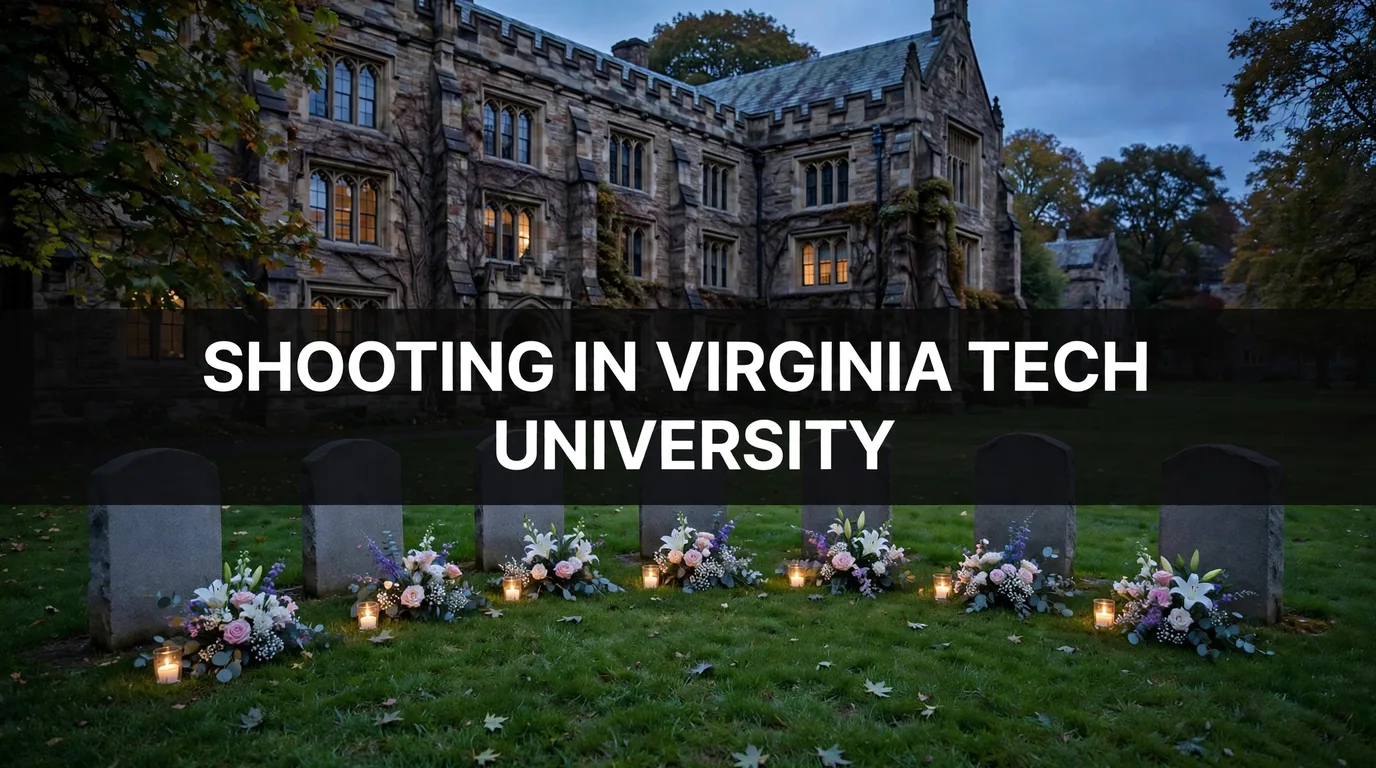
The shooting in Virginia Tech University on April 16, 2007 remains one of the darkest days in American education history. In the space of one morning, a single gunman killed 32 students and faculty members and wounded many others on the campus in Blacksburg, Virginia, before taking his own life. At the time, it was the deadliest mass shooting by a lone gunman in United States history. This article sets out, clearly and soberly, what happened that day, how the university and authorities responded, and what changed in the years that followed.
The Setting: Virginia Tech on a Spring Morning
Virginia Polytechnic Institute and State University — Virginia Tech — is a large public university in Blacksburg, a town in southwestern Virginia. In April 2007 the campus was home to more than 25,000 students. Monday, April 16 began as an ordinary, cold spring morning, with classes running as normal and students moving between dormitories and lecture halls.
The gunman was Seung-Hui Cho, a 23-year-old senior studying English who lived on campus. In the weeks before the attack he had legally purchased two handguns, a .22-calibre pistol and a 9mm pistol, passing the required background checks. Cho had a documented history of mental health difficulties and had previously been declared a danger to himself by a court, a fact that later became central to the national debate, because that information had not been entered into the background-check system in a way that would block the purchases.
The First Shooting: West Ambler Johnston Hall
At around 7:15 in the morning, Cho entered West Ambler Johnston Hall, a large co-ed residence hall, and went to the room of Emily Hilscher, a first-year student. He shot Hilscher and then Ryan Clark, a resident assistant who came to help after hearing the noise. Both died. Police initially treated the dormitory killings as an isolated, domestic-style incident and believed the shooter had likely left the campus. Classes were not cancelled at that point — a decision that would later be examined in detail by investigators and the official review panel.
During the roughly two hours that followed, Cho returned to his own dorm room, changed clothes, deleted emails, and mailed a package of writings, photographs, and videos to NBC News from the Blacksburg post office. He then walked across the Drillfield, the open green at the centre of campus, toward Norris Hall, carrying a backpack of ammunition and chains he used to lock the building’s doors from the inside.
The Second Shooting: Norris Hall
At about 9:40 a.m., the attack on Norris Hall, an engineering building filled with morning classes, began. Cho chained the main entrances shut, placed a note warning that a bomb would explode if the doors were opened, and moved through classrooms on the second floor. Over approximately ten minutes, he attacked several classrooms, killing students and professors who in many cases tried to barricade doors or shield their students.
The human stories from Norris Hall became the moral centre of the day’s memory. Professor Liviu Librescu, a 76-year-old Holocaust survivor, held his classroom door shut so his students could escape through the windows; he was killed doing so. In another room, students held a door closed together and kept the gunman out. Others escaped by jumping from second-floor windows. By the time police forced their way into the building — shooting open a locked door — Cho had taken his own life in one of the classrooms.
The final toll was 33 dead: 32 victims — 27 students and 5 faculty members — and the gunman. Seventeen people were wounded by gunfire, and several more were injured escaping, including students hurt jumping from windows.
The Emergency Response and the Alert Debate
As reports spread, the university sent its first campus-wide email alert about the dormitory shooting at around 9:26 a.m. — more than two hours after the first killings and only shortly before the Norris Hall attack began. That gap became the most criticised part of the institutional response. Students and families asked why the campus had not been locked down after the first shooting, while university officials pointed to the information they had at the time and the practical difficulty of securing an open campus of thousands of people in minutes.
The Virginia Tech Review Panel, appointed by the governor of Virginia, later examined these decisions in detail. Its report criticised aspects of the response and the handling of Cho’s mental health history, while also noting that no one could say with certainty that a different decision would have prevented the second attack. The tragedy pushed universities across the United States to adopt rapid mass-notification systems — text-message alerts, sirens, and lockdown procedures — that are now standard on American campuses.
The Victims and Remembrance
The 32 victims ranged in age from 18 to 76 and included first-year students just months into their studies, graduate students from several countries, and professors known internationally in their fields. Their names are read aloud every year at Virginia Tech’s Day of Remembrance, held each April 16, when classes are cancelled and the community gathers at the memorial on the Drillfield.
The permanent April 16 Memorial, dedicated in August 2007, consists of 32 engraved stones arranged in a semicircle — one for each victim — in front of Burruss Hall, facing Norris Hall across the green. The phrase “We Will Prevail” and the university’s rallying words “We are Virginia Tech,” from poet and professor Nikki Giovanni’s convocation address the day after the shooting, became defining expressions of the community’s response. The Hokie Spirit Memorial Fund, created in the days after the attack, distributed donations to victims’ families and survivors and later supported scholarships in the victims’ names.
What Changed Afterward
The shooting in Virginia Tech University reshaped policy in several concrete ways. In gun policy, attention focused on the background-check failure: Cho’s court-ordered mental health treatment should have disqualified him from buying firearms, but Virginia had not reported the record to the federal database. Congress responded with the NICS Improvement Amendments Act of 2007, signed in January 2008, which funded and pressured states to submit mental health records to the background-check system.
In campus safety, the changes were just as sweeping. Universities invested in emergency text and email alert systems, threat-assessment teams that review reports about troubled students, and clearer protocols for cancelling classes and locking down buildings. The shooting also intensified long-running debates — about gun access, about the privacy of student mental health records, and about how much warning a community can realistically receive — that continue in American public life today.
Legal and financial consequences followed as well. Virginia reached a settlement with most victims’ families, and the university was later fined by the U.S. Department of Education over the timeliness of its warnings, part of a long dispute about exactly when a “timely warning” was required under campus-safety law.
The Days After: A Community Responds
The morning after the shooting, thousands of students, staff, alumni, and residents gathered for a convocation at the university’s basketball arena, Cassell Coliseum, which was filled beyond capacity with an overflow crowd watching from the football stadium. It was there that Nikki Giovanni, a distinguished professor of English at the university, delivered the closing words that defined the community’s public grief: a chant of “We are Virginia Tech” that turned a ceremony of mourning into a statement of identity and resolve.
In the days that followed, the Drillfield filled with flowers, notes, flags, and 32 Hokie Stones — the limestone blocks that are a symbol of the university — placed by students as a spontaneous memorial, one for each victim. Donations arrived from around the world, classes were cancelled for the rest of the week, and students were given the option to end their semester early without academic penalty. Counsellors were brought in from across the country, and the university worked to return belongings, support families travelling to Blacksburg, and simply hold a traumatised campus together.
The Media Debate: The Package Sent to NBC
Between the two attacks, Cho had mailed a package to NBC News containing a long written statement, photographs of himself posing with weapons, and video clips. When NBC aired portions of the material, it triggered a fierce national argument about media responsibility: whether broadcasting a killer’s self-made propaganda rewarded the act and risked inspiring imitators, or whether the public had a right to see evidence central to understanding the crime.
Many victims’ families objected strongly, and some cancelled interviews with the network in protest. News organisations revisited their own guidelines as a result, and the episode is still taught in journalism schools as a case study in the ethics of covering mass violence. It also fed a broader movement, supported by many families and researchers, to minimise naming and glamorising attackers and to centre coverage on victims — a shift visible in how responsibly reported accounts of the day, including this one, are written.
Norris Hall Today
Norris Hall itself tells a story about how institutions live with memory. The building was closed after the attack and its future debated — some wanted it demolished, others preserved. In the end, the university renovated it, and in 2009 the second floor reopened as the home of the Center for Peace Studies and Violence Prevention, a programme dedicated to the study and prevention of violence, alongside other academic uses. Classrooms where students once hid returned to teaching, deliberately reclaimed for learning rather than abandoned to the event.
That choice — to remember on the Drillfield with the memorial, and to respond in Norris Hall with education — is widely seen as the university’s defining answer to April 16. Survivors and victims’ families remain part of campus life through scholarships, lectures, and the annual remembrance events, and the class of students who were freshmen that spring are now remembered as the generation that carried the university’s identity through its hardest test.
The Official Investigations
Several formal inquiries followed the attack. The Virginia Tech Review Panel, a group of experts appointed by Governor Tim Kaine, published its report in August 2007 after months of interviews and document review. It remains the most complete public account of the day, reconstructing Cho’s history, the two shootings, the police response, and the university’s decisions in detail, and it issued dozens of recommendations covering campus security, mental health care, privacy law, and gun purchase screening.
Separate reviews examined the university’s internal handling and the emergency response itself. Together, the reports avoided easy villains: they found dedicated people working with incomplete information inside systems — fragmented mental health records, unclear alert authority, privacy rules that discouraged information-sharing — that failed at several points at once. That systems-level conclusion is a large part of why the reforms that followed were structural rather than symbolic.
Frequently Asked Questions
How many people died in the Virginia Tech shooting?
Thirty-two victims — 27 students and 5 faculty members — were killed, and the gunman then took his own life, bringing the total death toll to 33. Seventeen people were wounded by gunfire, with others injured while escaping.
When did the shooting in Virginia Tech University happen?
It happened on Monday, April 16, 2007. The first shooting, in a residence hall, occurred at about 7:15 a.m.; the main attack in Norris Hall began at about 9:40 a.m.
Who was the Virginia Tech shooter?
The gunman was Seung-Hui Cho, a 23-year-old Virginia Tech senior majoring in English. He acted alone and died by suicide inside Norris Hall as police entered the building.
Why is there criticism of the university’s response?
Critics focus on the roughly two-hour gap between the first dormitory shooting and the university’s first campus-wide alert, and on the decision not to cancel classes after the first incident. An official review panel examined these decisions and made recommendations that reshaped campus emergency procedures nationwide.
How does Virginia Tech remember the victims today?
The university holds an annual Day of Remembrance on April 16, with a candlelight vigil and the reading of the 32 victims’ names. A permanent memorial of 32 engraved stones stands on the Drillfield in front of Burruss Hall.
Final Thoughts
Nearly two decades on, the shooting in Virginia Tech University is remembered on two levels: as a human tragedy carried by 32 families and a university community, and as a turning point that changed how American campuses warn, protect, and support their students. The memorial stones on the Drillfield keep the focus where the university has always insisted it belongs — not on the gunman, but on the students and teachers who were lost, and on the resolve summed up in four words: We are Virginia Tech.
Read Also: Badseed Tech: Honest Peripheral Reviews Worth Watching