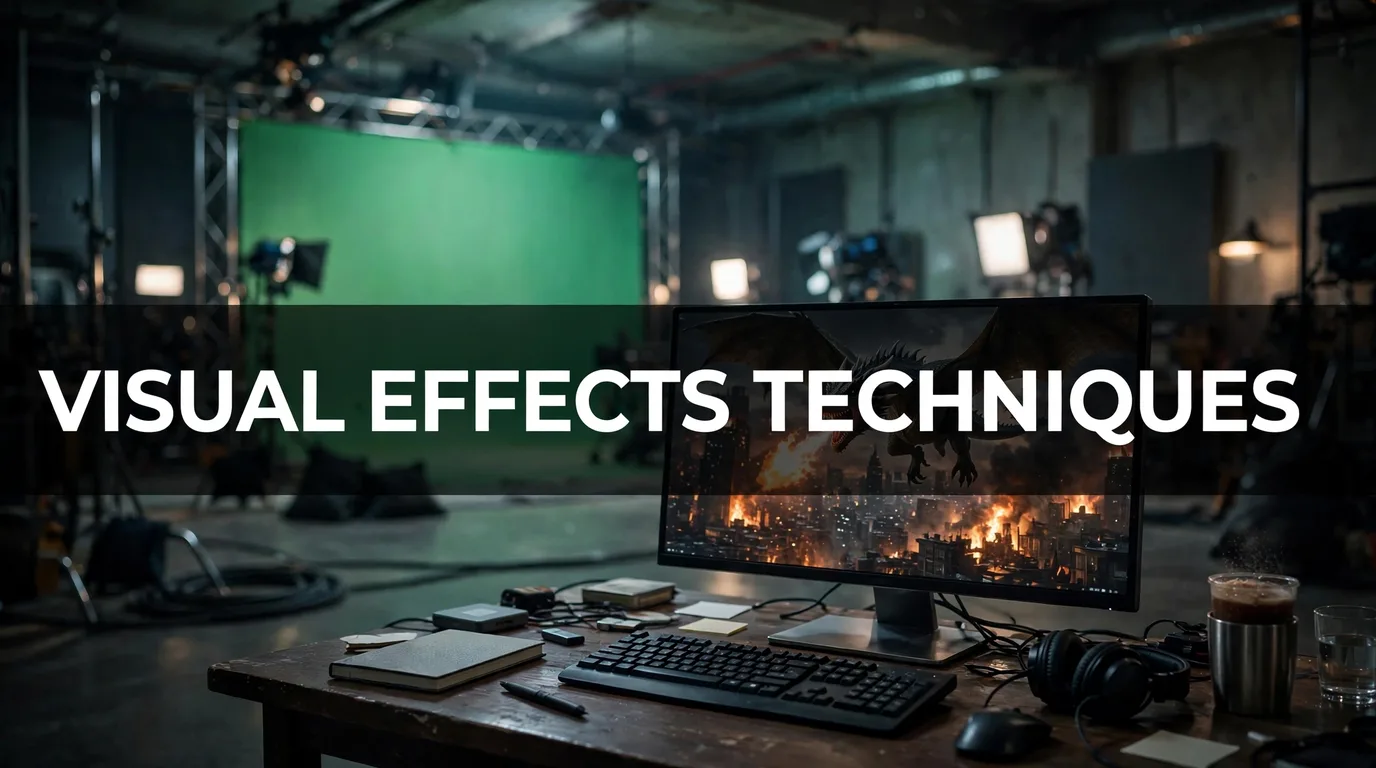
Visual effects techniques are the reason a superhero can level a city block, a dragon can feel as real as the actor riding it, and a quiet drama can quietly erase a modern street sign to place you in 1962. Most viewers know the magic when they see it, but far fewer know how many different crafts sit underneath a single finished shot. This guide walks through the major techniques one by one, in plain language, so you can start spotting them in the films and shows you already love.
What Are Visual Effects, Exactly?
Visual effects, usually shortened to VFX, are images that are created or changed after filming, in post-production. They are different from special effects, which happen live on set — real rain, real explosions, real prosthetic makeup. If a crew built it and the camera captured it, that is a special effect. If an artist built it later on a computer, or combined several filmed elements into one image, that is a visual effect.
The distinction matters because the two crafts work best together. A director might film a real car chase (special effects) and then ask VFX artists to remove the safety cables, replace the sky, and add a collapsing bridge the production could never afford to build. Nearly every modern production, from Marvel films to small indie dramas, uses this blend.
CGI: Building Worlds Inside a Computer
Computer-generated imagery is the technique most people picture when they hear “visual effects.” Artists build objects, creatures, or entire environments as 3D models, give them surfaces and textures, light them with virtual lights, and animate them frame by frame or with simulation software.
How CGI Is Made
A CGI asset starts as a wireframe model, a bit like a digital sculpture. Texture artists then paint its surface — skin pores, rust, scales — and riggers add a skeleton of controls so animators can move it. Lighting artists match the virtual light to the real light on set, which is the detail that sells the illusion. Finally, the scene is rendered, a process where computers calculate every pixel. A single second of film can take hours of render time.
Where You See It
Fully digital characters such as Gollum or Thanos are the famous examples, but the quieter uses are everywhere: digital crowds in stadium scenes, cars that never existed, buildings extended upward beyond what the set builders constructed, and de-aging that lets an actor play their younger self.
Compositing: The Art of Combining Images
If CGI creates the pieces, compositing is the technique that glues them together. A compositor layers many elements — the actors, the CGI creature, smoke, a new sky, falling rain — into one seamless image. It is less glamorous than creature design, but it is arguably the most important of all visual effects techniques, because every other technique passes through it.
Compositors handle the unglamorous details that decide whether a shot works: matching grain and colour between elements, softening edges, adding motion blur, and making sure shadows fall in the same direction. When a VFX shot looks “fake,” the failure is usually in the compositing, not in the model itself.
Green Screen and Chroma Key
Chroma key is the technique behind the famous green screen. Actors perform in front of a bright green (or sometimes blue) backdrop, and software removes that colour so a completely different background can be dropped in. Weather presenters use the same trick every day.
The colour is chosen because it clashes with skin tones, which makes it easy to remove cleanly. The hard part is not removing the green — modern software does that quickly — but dealing with “spill,” the green light that bounces onto actors’ hair and shoulders, and with fine details like glass, smoke, or flyaway hair. Skilled artists spend hours cleaning those edges.
A newer alternative is the LED volume, a giant curved wall of screens that displays the background in real time. Shows like The Mandalorian popularised it. The actors see the world around them, the light on their faces is correct, and far less green-screen cleanup is needed.
Motion Capture and Performance Capture
Motion capture records the movement of a real performer and transfers it onto a digital character. The performer wears a suit covered in reflective markers, cameras track those markers in 3D space, and software turns the data into the character’s skeleton in motion.
Performance capture goes further, adding facial cameras that record expressions. This is how Andy Serkis’s performances became Gollum and Caesar the ape: the acting is human, the body is digital. The technique has spread beyond film into video games, sports analysis, and even medicine.
Matte Painting and Digital Environments
One of the oldest visual effects techniques began with artists painting landscapes on glass and placing the painting between the camera and the set. Today’s matte paintings are digital, built in Photoshop and 3D software, but the idea is identical: most of what you see in a wide establishing shot was never really there.
When a camera moves through a painted environment, artists project the painting onto simple 3D geometry so it shifts with believable parallax. Castles, alien skylines, futuristic cities, and period streets are routinely built this way, at a fraction of the cost of building or travelling to them.
Practical Effects Enhanced by VFX
Some of the most convincing shots start with something real. Miniatures — detailed scale models filmed with high-speed cameras — gave us the starships of the original Star Wars era, and directors still use them because real light on a real object is hard to fake. Animatronics and prosthetics put a physical creature on set for actors to react to.
Modern productions often film the practical version and then use VFX to polish it: removing puppeteers and wires, smoothing a robotic movement, or extending a miniature with a digital background. The result keeps the weight of something real while hiding the strings.
Rotoscoping, Tracking and Cleanup
Not every technique is about adding things. Rotoscoping means cutting a moving subject out of its background by tracing it frame by frame — tedious work that modern AI-assisted tools have made faster but not obsolete. Camera tracking works out exactly how the real camera moved so digital objects sit still in the scene instead of sliding around.
Cleanup, or “invisible effects,” removes the modern world from period films: air conditioners, road markings, safety wires, crew reflections in windows. A historical drama might contain hundreds of VFX shots that no viewer ever notices, and that invisibility is the entire point.
Simulation: Fire, Water, Cloth and Destruction
Some things are too chaotic to animate by hand, so artists simulate them. Simulation software applies simplified physics to millions of digital particles or points, producing behaviour that emerges naturally: a building crumbling, an ocean storm, cloth rippling in wind, hair moving as a character turns.
Simulations are powerful but unpredictable, which is why effects supervisors run them again and again with adjusted settings until the chaos happens to look right. The sinking ship, the exploding spaceship, the superhero landing that cracks the pavement — most of those began as physics simulations.
How These Techniques Work Together in One Shot
A single ten-second shot in a modern blockbuster might use almost everything in this guide. Actors are filmed on a green screen stage (chroma key). One actor’s performance drives a digital creature (performance capture). The creature itself is CGI, its fur is a simulation, and the burning city behind them is a matte painting extended with 3D geometry. Compositors layer it all together, add simulated smoke, clean up the wire that held a stunt performer, and grade the colour so nothing looks pasted in.
That layering is why VFX credits run so long. A big film can involve thousands of artists across several studios and countries, each specialising in one narrow technique.
How Much Do Visual Effects Cost?
The honest answer is: anywhere from almost nothing to a fortune. A simple cleanup shot — removing a microphone boom that dipped into frame — might cost a studio a few hundred dollars. A hero shot of a digital creature fighting in a burning city can cost tens of thousands of dollars on its own, because dozens of specialists touch it over weeks or months.
On a large production, the VFX budget commonly runs into the tens of millions, and the biggest franchise films have hundreds or even thousands of individual effects shots. Costs climb with three things: complexity (water, fire, fur, and faces are the expensive four), screen time (a creature on screen for ten minutes costs far more than one in a quick cutaway), and changes. Every time a director asks for a different version, the meter starts running again, which is why experienced productions lock their designs early.
Smaller productions have more options than they used to. Affordable software, freelance artists working remotely, and stock effects libraries mean a low-budget film can now include shots that would have been impossible twenty years ago. The gap between amateur and professional work today is less about tools and more about time, taste, and compositing skill.
Getting Into VFX: Skills Worth Learning
If this guide has made you curious about the work itself, the good news is that the industry hires for skill, not for a specific degree. Artists usually specialise early — modelling, animation, effects simulation, lighting, or compositing — and build a showreel, a short video of their best work, which matters more to employers than any certificate.
The sensible starting path is to pick one discipline and one main tool: Blender is free and capable for 3D work, DaVinci Resolve’s Fusion page is a free route into compositing, and Houdini has a free apprentice version for simulation. Expect the learning curve to be measured in months, not weekends. The artists who succeed tend to share two habits: they study real-world reference obsessively (how light actually behaves, how objects actually break), and they finish projects instead of endlessly starting new ones. Studios notice both.
Frequently Asked Questions
What is the difference between VFX and CGI?
CGI is one technique inside the larger world of VFX. CGI means imagery generated by a computer; VFX is the whole process of creating or manipulating imagery in post-production, which also includes compositing, matte painting, cleanup, and more.
Are visual effects only used in action and sci-fi films?
No. Comedies use VFX to stitch together the best takes from two performances, dramas use them to recreate period settings, and almost every production removes modern objects from historical scenes. Invisible effects are now standard in films of every genre.
What software do VFX artists use?
Common tools include Houdini for simulations, Maya for 3D animation, Nuke for compositing, and ZBrush for digital sculpting. Studios also rely heavily on custom in-house software built for their own pipelines.
Is AI replacing VFX artists?
AI tools are speeding up specific tasks such as rotoscoping, cleanup, and generating background elements, but complex shots still need artists to direct, combine, and finish them. The job is changing shape rather than disappearing.
How long does one VFX shot take?
A simple cleanup shot might take a day. A hero creature shot can occupy a team for months. Large films plan VFX work a year or more in advance, and shots are revised many times before the director approves them.
Final Thoughts
Visual effects techniques are not a single trick but a toolbox: CGI builds, compositing combines, motion capture performs, matte painting expands, and simulation brings the chaos. Once you know the main tools, you start seeing films differently — not with the magic ruined, but with a new respect for the hundreds of invisible decisions inside every frame. The best effects are still the ones you never notice at all.
Read Also: Mai Tai: History, Recipe and the Tiki Classic Explained