If you have come across the Polish word telemetryczny, you may wonder what it means in English and why it appears in technical descriptions of devices, systems, vehicles, and remote monitoring. The simplest translation is “telemetric” or “related to telemetry.” Depending on the sentence, it can also be translated using terms such as “telemetered.”
The word describes something connected with telemetry, which is the collection of measurements or other data from a remote or distributed source and the transmission of that information to another location for monitoring, analysis, or recording. NIST defines telemetry around the measurement and transmission of quantities to a distant station, while IBM describes modern telemetry as automated collection and transmission of data from remote or distributed sources.
Understanding the word becomes easier when you look at how it is used. For example, system telemetryczny can be translated as “telemetry system,” while dane telemetryczne means “telemetry data.”
What Does Telemetryczny Mean?
Telemetryczny is a Polish adjective that means “telemetric” or “related to telemetry.”
It does not normally name a technology by itself. Instead, it describes a device, system, measurement, module, network, or other object associated with telemetry.
For example:
| Polish phrase | Natural English translation |
|---|---|
| system telemetryczny | telemetry system |
| dane telemetryczne | telemetry data |
| urządzenie telemetryczne | telemetry device |
| moduł telemetryczny | telemetry module |
| pomiar telemetryczny | telemetric measurement |
| sieć telemetryczna | telemetry network |
Polish-English translation resources identify telemetric and telemetered among the English equivalents of telemetryczny. The best translation depends on the noun and the surrounding sentence.
So, if you see the word on its own, think:
telemetryczny = telemetric / telemetry-related
Telemetryczny Translation in English
There is not always one perfect English translation.
The most common option is telemetric.
For example:
Polish:
moduł telemetryczny
English:
telemetry module or telemetric module
Another example is:
Polish:
system telemetryczny
English:
telemetry system
The English sentence usually sounds more natural when “telemetry” is used as a noun modifier rather than forcing the adjective “telemetric” into every phrase.
This distinction matters when translating technical Polish into natural American English.
Telemetric
“Telemetric” is an adjective describing something related to telemetry.
Example:
The vehicle uses a telemetric system to transmit performance data.
Telemetry-related
This is a broader and often more conversational alternative.
Example:
The company develops telemetry-related monitoring equipment.
Telemetered
“Telemetered” can describe information or measurements that have been collected and transmitted through telemetry.
The choice therefore depends on context rather than on a simple word-for-word substitution.
How Is Telemetryczny Used in Polish?
The word commonly appears in technical, engineering, industrial, automotive, medical, environmental, and information-technology contexts.
For example, a Polish technical document may refer to:
- a telemetry system
- a telemetry module
- telemetry data
- telemetry measurements
- telemetry equipment
- a telemetry network
- remote telemetry
- vehicle telemetry
Real-world Polish technology companies use telemetryczny for equipment that reads vehicle data, supports CAN or CAN FD communication, and sends information for monitoring.
The term can also describe systems used to collect measurements from distributed infrastructure. For example, Polish telemetry providers describe systems that combine measuring devices, communication modules, and software for remote monitoring of water and heat consumption.
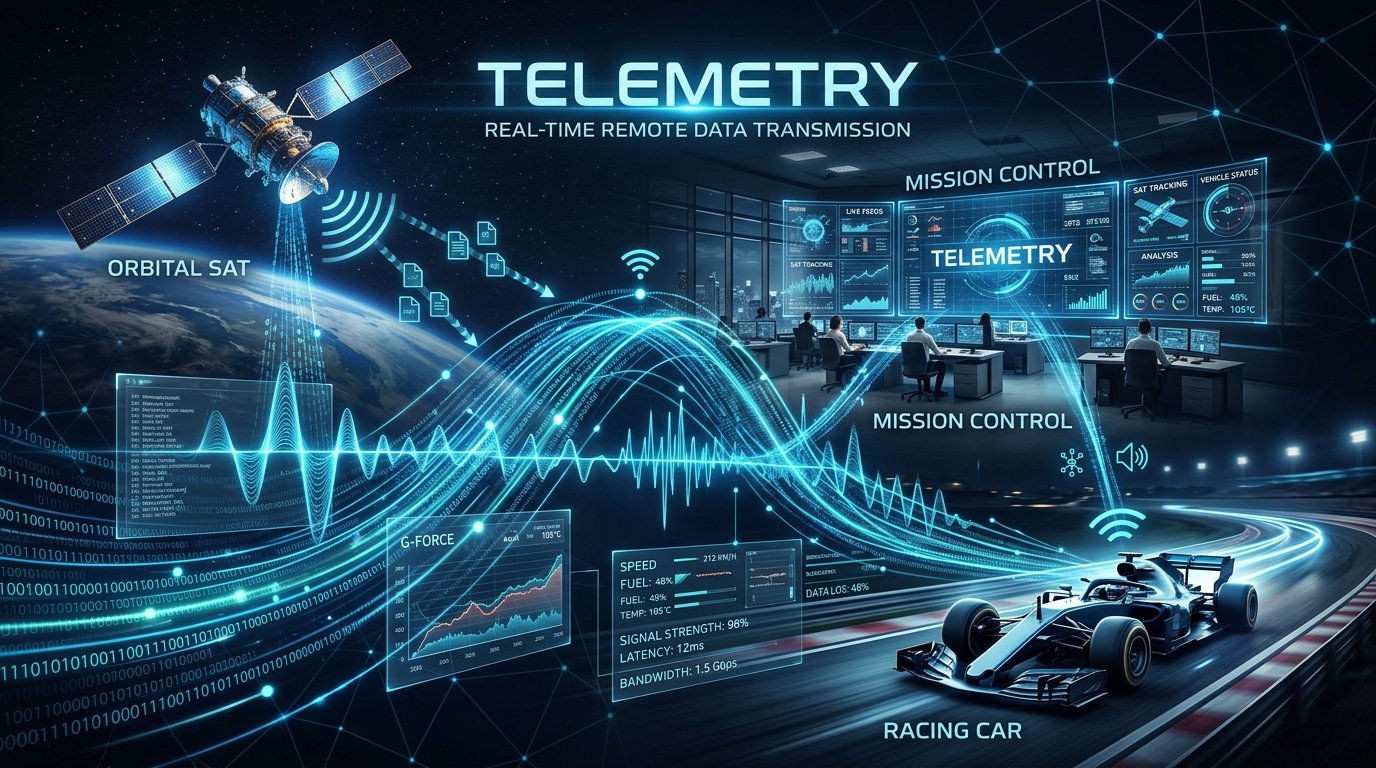
What Is Telemetry?
Telemetry is the broader technology behind the adjective telemetryczny.
In simple terms, telemetry allows a system to:
- Measure something.
- Collect the measurement.
- Send the information somewhere else.
- Store or process the data.
- Display or analyze the results.
The source being monitored may be nearby, remote, mobile, underground, airborne, or otherwise difficult to access directly.
NIST describes telemetry as the science of measuring quantities, transmitting the results to a distant location, and interpreting, displaying, or recording them.
Modern telemetry can involve physical sensors, embedded devices, communication networks, software agents, databases, and analytics platforms.
How Does a Telemetry System Work?
A basic telemetry system can be understood as a chain:
Source → Sensor → Communication → Central System → Analysis
Each part performs a different job.
1. Data Collection
The system first needs something to measure.
A sensor or software component may collect information such as:
- temperature
- pressure
- speed
- location
- fuel level
- battery status
- machine vibration
- network traffic
- CPU usage
- application response time
- system events
The type of measurement depends on the application.
A vehicle telemetry system, for example, may collect information from vehicle electronics. A cloud application may instead produce software metrics, logs, and traces.
2. Data Transmission
The collected information must travel from the source to another system.
Depending on the application, transmission can use:
- cellular networks
- Wi-Fi
- Ethernet
- radio
- satellite communication
- specialized industrial communication networks
- other wired or wireless technologies
IBM notes that telemetry can use communication methods such as Wi-Fi, satellite, radio, and other transmission mechanisms.
3. Data Processing
Raw measurements are not always immediately useful.
A receiving system may organize, transform, filter, aggregate, or enrich the information before it is analyzed.
For example, a fleet platform might turn individual vehicle readings into dashboards showing:
- vehicle location
- fuel consumption
- speed
- engine information
- operating hours
- alerts
4. Storage
Telemetry data may need to be stored so organizations can review historical behavior.
Modern systems can use databases, data warehouses, data lakes, or specialized time-series storage depending on the scale and requirements.
5. Analysis and Visualization
Finally, users need a practical way to understand the information.
This may involve:
- dashboards
- charts
- reports
- alerts
- anomaly detection
- historical comparisons
- automated actions
The purpose is not simply to collect data. The useful part is turning measurements into information that people or software can act on.
What Types of Data Can Telemetry Collect?
Telemetry is not limited to one specific type of information.
Physical measurements
Sensors can collect:
- temperature
- pressure
- humidity
- vibration
- motion
- light
- fluid levels
Vehicle information
Depending on the vehicle and equipment, telemetry may include:
- speed
- location
- fuel consumption
- battery information
- engine parameters
- operating time
- diagnostic information
For example, commercial vehicle telemetry equipment can read vehicle parameters through interfaces such as CAN and J1708.
Software telemetry
Modern IT systems generate another category of telemetry.
Common examples include:
- metrics
- logs
- traces
- events
IBM describes metrics, events, logs, and traces as major forms of IT telemetry, while Google Cloud documentation identifies logs, metrics, and traces as core telemetry data used for understanding application health and performance.
Application metrics
Metrics are numerical measurements.
Examples include:
- CPU utilization
- memory usage
- request rate
- response latency
- error rate
- network throughput
Metrics are useful for identifying changes in system performance over time.
Logs
Logs are records of events or activity.
They can help answer questions such as:
- What happened?
- When did it happen?
- Which component produced the event?
- What error occurred?
Traces
Traces show how a request moves through different components of a distributed application.
They can help developers understand latency and follow a transaction across multiple services.
Where Are Telemetry Systems Used?
Telemetry is used across many industries because organizations often need information from equipment or systems that cannot be observed manually all the time.
Vehicle and Transportation Telemetry
Modern vehicles can generate large amounts of operational information.
Fleet operators may use telemetry to monitor vehicle location, fuel or energy use, operating conditions, and other parameters.
Telemetry can therefore become part of a larger fleet-management system.
However, telemetry and GPS tracking are not identical. GPS location can be one telemetry data point, but telemetry may contain many other measurements.
Healthcare
Telemetry can be used to transmit physiological measurements from medical equipment to healthcare systems.
The exact measurements depend on the application and equipment.
This makes remote monitoring possible in situations where healthcare professionals need access to measurements without being physically next to every sensor.
Aerospace
Aerospace systems have long depended on remote measurement and data transmission because spacecraft and other airborne systems operate at distances where direct physical inspection is impossible.
Telemetry can provide information about the condition and behavior of remote equipment.
Industrial Automation
Factories and industrial facilities can use telemetry to monitor machines and processes.
Possible measurements include:
- temperature
- pressure
- vibration
- production conditions
- equipment status
- energy consumption
Telemetry can support monitoring and diagnostics without requiring an operator to manually inspect every measurement point.
Energy and Utilities
Telemetry can also support remote measurement of infrastructure.
For example, remote-reading systems can collect information from water, heat, or energy meters and transmit it to a central platform. Polish telemetry solutions describe this model for utilities and property managers.
Environmental Monitoring
Remote sensors can transmit information about environmental conditions.
Depending on the project, this may include:
- temperature
- humidity
- water conditions
- atmospheric measurements
- weather-related measurements
Academic work on Polish telemetry systems has also described remote hydrometeorological measurement systems that collect and transmit environmental data.
Software and Cloud Applications
The meaning of telemetry has expanded significantly in software.
Modern applications can automatically produce metrics, logs, and traces that help engineers understand how services behave.
AWS describes application telemetry as a foundation for observability, while Google Cloud describes telemetry as data that helps users understand application health and performance.
What Is a Telemetry Device?
A telemetry device is hardware or equipment that helps collect and transmit information from a monitored source.
It may include:
- sensors
- processors
- communication interfaces
- memory
- antennas
- input/output connections
- software or firmware
The exact design depends on the application.
A vehicle telemetry device, for example, can communicate with vehicle systems and transmit operational information. Some commercial devices support CAN-based vehicle data and GPS functionality.
An industrial telemetry device may instead connect to sensors, meters, controllers, or machinery.
What Is a Telemetry Module?
A telemetry module is a component that provides telemetry capabilities within a larger system.
It may collect data from sensors or another device and transmit that information through a communication network.
Industrial telemetry modules can support remote monitoring, diagnostics, measurements, and control. Polish engineering suppliers describe telemetry modules designed for remote monitoring and measurement through wireless data communication.
The important point is that a telemetry module is usually a component, while a telemetry system can include the module plus sensors, communications, software, storage, and visualization.
Telemetry vs. Monitoring
These terms are related but not identical.
Telemetry focuses on collecting and transmitting data.
Monitoring focuses on watching that data to understand the current condition of a system and identify problems.
For example:
A sensor measures temperature.
The telemetry system sends the temperature reading to a server.
A monitoring platform displays the temperature and creates an alert if it crosses a defined threshold.
IBM similarly distinguishes telemetry as the collection and transmission process from monitoring, which uses collected telemetry to observe system behavior and trigger alerts.
Telemetry vs. Observability
Observability is a broader concept in modern software engineering.
Telemetry provides the underlying data. Observability uses data such as metrics, logs, and traces to help engineers understand what is happening inside complex systems.
Google Cloud describes telemetry as including metrics, logs, and traces and explains how these data types support application troubleshooting and performance analysis.
A simple way to remember the difference is:
Telemetry = the data being collected and transmitted.
Monitoring = watching that data for known conditions.
Observability = using telemetry to understand system behavior and investigate problems.
These concepts overlap, but they are not interchangeable.
Telemetry vs. Telematics
The words telemetry and telematics are sometimes confused.
Telemetry primarily concerns the measurement and transmission of data.
Telematics generally refers to the combination of telecommunications and information processing, often involving connected vehicles, transportation, fleet management, or remote equipment.
A vehicle can use both.
For example, a connected fleet platform may collect telemetry from a vehicle while also providing broader telematics functions such as location tracking, fleet management, communications, and reporting.
Therefore, telemetry can be part of a telematics solution without the two words meaning exactly the same thing.
Telemetryczny vs. Telematyczny
For people translating Polish technical material, this distinction is especially useful.
Telemetryczny
Related to telemetry.
It generally concerns measurement, data collection, and transmission from a remote source.
Telematyczny
Related to telematics.
It generally describes systems that combine communications and information technologies, particularly in connected transportation and other remote-management applications.
The two areas can overlap, especially in connected vehicles, but they should not automatically be translated as the same thing.
Is Telemetryczny the Same as GPS?
No.
GPS is primarily associated with determining geographic position.
Telemetry is much broader.
A telemetry system may transmit:
- location
- speed
- temperature
- pressure
- battery status
- engine information
- machine condition
- software metrics
- other measurements
A GPS receiver can therefore be one source of data inside a larger telemetry system.
This distinction is important because an article or product description that uses telemetryczny does not necessarily mean that the device is only tracking location.
Does Telemetry Always Mean Real-Time Data?
No.
Telemetry can support real-time or near-real-time monitoring, but not every telemetry system has to transmit every measurement immediately.
A system might:
- transmit data continuously
- send readings at fixed intervals
- store information and upload it periodically
- transmit only when a specific event occurs
The required transmission frequency depends on the application.
A safety-critical system may need rapid updates, while an environmental monitoring project might send measurements at longer intervals.
What Are the Benefits of Telemetry?
Telemetry can provide several practical benefits when it is properly designed.
Remote visibility
Operators can see information from equipment without physically visiting every location.
Faster detection
Automated data collection can reveal abnormal conditions more quickly than manual inspection.
Historical analysis
Stored telemetry allows organizations to compare current measurements with previous data.
Maintenance support
Changes in measurements can help identify equipment conditions that require investigation.
Operational efficiency
Organizations can use collected data to understand resource consumption, equipment behavior, and system performance.
Centralized management
Data from many remote sources can be brought together in one monitoring environment.
These benefits depend on the quality of the sensors, communication system, software, data architecture, and operational processes. Telemetry itself does not automatically guarantee better decisions.
What Are the Limitations and Risks?
Telemetry also creates technical and operational challenges.
Data quality
A faulty sensor can produce misleading information.
Communication failures
Remote devices may lose connectivity or experience delays.
Large data volumes
Modern systems can generate significant amounts of telemetry data, which creates storage and processing requirements.
Security
Telemetry systems may transmit information across networks, so authentication, access controls, secure communications, and appropriate system maintenance matter.
Privacy
Some telemetry can contain information connected to people, vehicles, locations, or user activity. Organizations should determine what data is actually necessary and manage it appropriately.
Alert overload
Collecting more data does not necessarily improve monitoring. Poorly configured alerts can create large numbers of notifications without helping operators identify meaningful problems.
The practical goal is therefore not simply to collect as much telemetry as possible. The goal is to collect useful, reliable, appropriately protected data.
What Is OpenTelemetry?
If you encounter the word telemetry in modern software development, you may also encounter OpenTelemetry.
OpenTelemetry is an open-source observability framework and standard for collecting and exporting telemetry such as metrics, traces, and logs from applications and infrastructure.
It is particularly relevant to cloud-native software.
Instead of each application relying on completely different methods for producing and exporting telemetry, OpenTelemetry provides standardized technologies that can help applications generate and export telemetry data.
Google Cloud describes OpenTelemetry as providing a single open standard and technology for capturing and exporting metrics, traces, and logs.
This is one reason the concept of telemetry is no longer limited to physical sensors and industrial equipment.
Simple Examples of Telemetryczny in Context
Understanding the word is easier with examples.
Example 1: Telemetry system
Polish:
system telemetryczny
English:
telemetry system
Meaning: a system that collects and transmits measurements for monitoring or analysis.
Example 2: Telemetry module
Polish:
moduł telemetryczny
English:
telemetry module
Meaning: a hardware or software component used to collect or transmit telemetry.
Example 3: Telemetry data
Polish:
dane telemetryczne
English:
telemetry data
Meaning: measurements or other information collected and transmitted by a telemetry system.
Example 4: Telemetry measurement
Polish:
pomiar telemetryczny
English:
telemetric measurement
Meaning: a measurement collected remotely and transmitted for further use.
Example 5: Vehicle telemetry
A vehicle may collect speed, fuel, engine, battery, or other operational information and transmit it to another system.
In this context, telemetryczny describes the technology associated with that remote data collection and transmission.
Why the Exact Translation Depends on Context
One of the biggest mistakes when translating technical words is assuming that every adjective has exactly one English equivalent.
For telemetryczny, the surrounding noun matters.
For example:
- system telemetryczny → telemetry system
- dane telemetryczne → telemetry data
- moduł telemetryczny → telemetry module
- pomiar telemetryczny → telemetric measurement
- urządzenie telemetryczne → telemetry device
A literal translation may be grammatically correct but sound unnatural to an American English reader.
For an English-language website, it is usually better to translate the meaning of the phrase, not simply substitute one English word for every Polish word.
Frequently Asked Questions About Telemetryczny
What does telemetryczny mean in English?
Telemetryczny generally means “telemetric” or “related to telemetry.” The exact English wording depends on the noun and context.
Is telemetryczny a Polish word?
Yes. Telemetryczny is a Polish adjective associated with telemetria, the Polish term for telemetry.
What does system telemetryczny mean?
System telemetryczny means “telemetry system.” It generally refers to a system that collects measurements from remote or distributed sources and transmits them to another system for monitoring, storage, or analysis.
What does dane telemetryczne mean?
Dane telemetryczne means “telemetry data.” It refers to information collected and transmitted by a telemetry system.
What does urządzenie telemetryczne mean?
It generally means “telemetry device.” The device may collect, process, or transmit measurements from a remote source.
Is telemetryczny the same as telematic?
No. Telemetryczny relates to telemetry, while telematyczny relates to telematics. The technologies can overlap, particularly in connected vehicles, but the terms are not exact synonyms.
Is telemetry the same as GPS?
No. GPS can provide location data that becomes part of a telemetry system, but telemetry can include many other measurements such as temperature, pressure, speed, battery information, machine status, or software performance.
What is a telemetry system used for?
Telemetry systems are used for remote measurement and monitoring across areas such as vehicles, industrial equipment, utilities, healthcare, aerospace, environmental monitoring, and software systems.
What are the main types of software telemetry?
Common software telemetry includes metrics, logs, and traces. Events can also be collected depending on the system and observability approach.
Is telemetry always real-time?
No. Telemetry can be transmitted continuously, periodically, or based on specific events. The appropriate frequency depends on the application.
What is OpenTelemetry?
OpenTelemetry is an open-source standard and technology ecosystem for collecting and exporting telemetry such as metrics, logs, and traces from applications and infrastructure.
Conclusion
Telemetryczny is a Polish adjective that generally means “telemetric” or “related to telemetry.” It describes technology, measurements, equipment, systems, or data associated with remotely collecting and transmitting information.
The most useful way to understand the word is through its context. System telemetryczny means telemetry system, dane telemetryczne means telemetry data, and moduł telemetryczny means telemetry module.
Telemetry itself is much broader than location tracking. It can involve physical measurements, vehicle information, industrial equipment, environmental sensors, medical devices, and modern software data such as metrics, logs, and traces.
For English readers, the key distinction is simple: telemetry is the process or technology of collecting and transmitting remote data, while telemetryczny is the Polish adjective used to describe something related to that process.
See also: Lemrick