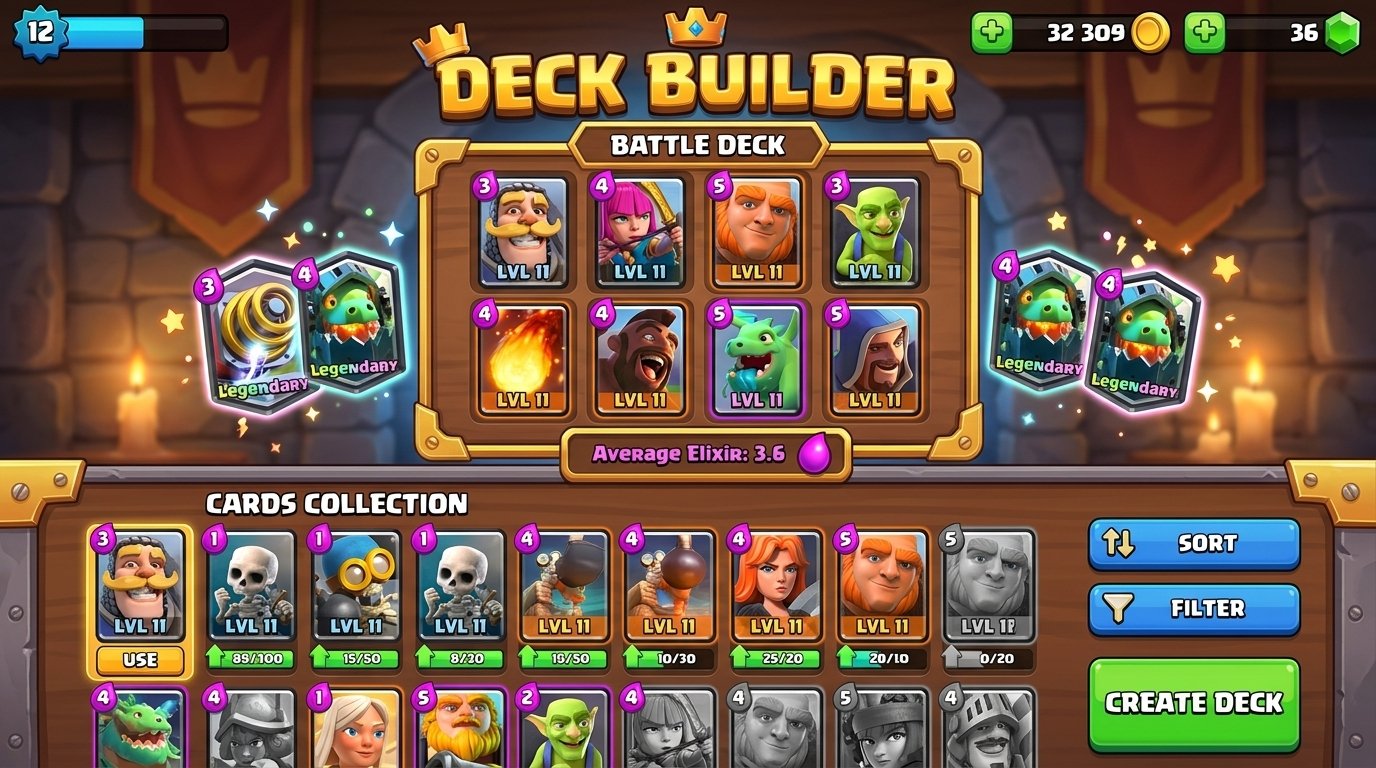
A Clash Royale deck builder helps players select cards, create balanced combinations, and develop strategies for different matchups. Whether you are a beginner learning the basics or an experienced player looking to improve your results, the right deck-building approach can make your battles more manageable.
A good deck needs more than eight powerful cards. It should have a reliable win condition, effective defense, suitable spells, manageable elixir costs, and cards that work well together. A deck builder can help you identify these elements before entering a battle.
In this guide, you will learn how deck-building tools work, how to create a balanced Clash Royale deck, what to look for when comparing tools, and how to improve your lineup when your current strategy is not working.
What Is a Clash Royale Deck Builder?
A Clash Royale deck builder is a tool or planning method that helps players select cards for a battle deck. Depending on its features, it may allow you to choose cards manually, generate a suggested lineup, evaluate card combinations, or find competitive decks that match your collection.
Instead of choosing cards randomly, you can use a structured approach to make sure your deck has a clear offensive strategy and enough defensive options.
Most deck-building tools fall into four categories.
- Deck builder: Lets you select cards individually and create your own lineup.
- Deck generator: Produces a deck automatically, sometimes using specific filters or restrictions.
- Deck finder: Searches for existing decks based on your cards, card levels, or preferred strategy.
- Deck rater: Evaluates a completed deck and highlights potential strengths and weaknesses.
Some tools combine several of these functions.
For example, a beginner might use a generator to discover a starting lineup, a builder to replace unavailable cards, and a rater to check whether the revised deck has obvious weaknesses.
The important distinction is that a tool can suggest a deck, but you still need to understand how to use it effectively in battle.
What Features Should You Look for in a Deck Builder?
Not every deck builder provides the same level of detail. Some focus on simple card selection, while others analyze competitive data or personalize recommendations.
Before choosing a tool, consider the following features.
1. Card Selection and Collection Filters
A useful tool should make it easy to find cards and build a complete deck. Collection-aware features are especially helpful because they can narrow recommendations to cards you own or have unlocked.
Card levels also matter. A theoretically strong deck may perform poorly for you if several of its essential cards are substantially underleveled for the battles you play.
Look for options that help you account for your available cards, upgrades, and unlocked special forms.
2. Average Elixir Cost
Average elixir cost is the average amount of elixir required to play the cards in your deck.
To calculate it, add the elixir costs of all eight cards and divide the total by eight.
For example, if the combined cost of your cards is 28 elixir, your average is 3.5.
A lower average can support faster rotations, while a higher average may suit strategies built around expensive units and powerful pushes. Neither approach is automatically better.
Your average should match your strategy and leave enough flexibility to defend against common threats.
3. Card Synergy and Deck Balance
Card synergy describes how well the cards support one another.
A deck might contain strong individual cards but still struggle because its cards do not form a coherent strategy. For example, several expensive offensive cards can leave you without an affordable response to a fast enemy push.
A deck analysis feature can help identify gaps such as weak air defense, insufficient spell coverage, or too many cards serving the same role.
4. Competitive Deck Data
Some tools use battle statistics to show which decks or card combinations perform well in a particular competitive environment.
This information can help you discover established strategies, but it needs context. Performance may vary by game mode, trophy range, card levels, player skill, and balance changes.
Do not assume that a deck with a high reported win rate will automatically deliver the same results for every player.
5. Deck Sharing and Copying
Deck-sharing features make it easier to move a completed lineup into the game or share it with friends.
Before copying a deck, check whether it contains cards, evolutions, heroes, or other special forms that you have not unlocked. Also make sure the deck is suitable for the game mode you intend to play.
The most useful tool is one that helps you make a better decision, not simply one that produces a deck quickly.
How to Build a Balanced Clash Royale Deck Step by Step
You can build a useful deck manually or use a deck builder to guide your choices. The following process works as a starting point for players who want to understand why their cards belong together.
Step 1: Choose a Win Condition
Start with the main way you intend to damage enemy towers.
Common examples include Hog Rider, Royal Giant, Goblin Barrel, Balloon, and Graveyard. Each supports a different style of play and requires different supporting cards.
Choose a win condition that suits your preferred strategy and the cards you have developed.
Avoid filling your deck with several competing win conditions unless you understand how they complement one another.
Step 2: Add Support Cards
Support cards help your win condition reach the tower or make it more difficult for your opponent to stop your push.
Depending on your strategy, support might come from ranged attackers, splash-damage units, troops that distract defenders, or cards that help eliminate enemy counters.
Ask yourself three questions:
- Which enemy cards can stop my main attack?
- Which supporting cards can help overcome those defenses?
- Can my support cards also contribute defensively?
Cards that perform more than one useful role can give you greater flexibility.
Step 3: Build a Reliable Defense
A strong deck needs to defend against both ground and air threats.
Consider the types of opponents your deck might face. Fast units, swarms, heavy tanks, and air attacks can all create different problems.
Your defensive lineup might include a defensive building, a tank-targeting unit, a ranged attacker, or a card that deals damage to multiple enemies.
You do not necessarily need every defensive option. The goal is to cover important threats without sacrificing your entire offensive strategy.
Step 4: Select Your Spells
Spells help remove enemy troops, damage support units, and create opportunities for your win condition.
A small spell can help handle low-health troops or other specific threats. A larger spell may be useful against clustered units or for delivering additional tower damage, depending on the card.
Choose spells based on the matchups you need to handle and the rest of your deck.
Two spells that serve almost identical purposes may leave you exposed to other threats. On the other hand, some strategies deliberately use overlapping spell coverage for a specific reason.
Step 5: Check Your Elixir Balance
Calculate your deck’s average elixir cost and consider how quickly you can respond to enemy attacks.
A deck with several expensive cards may struggle when an opponent attacks before you have enough elixir to defend. A very cheap deck can rotate quickly, but it may lack the damage or durability needed for certain matchups.
There is no universal average that guarantees success.
Review the cost of your main attack, your emergency defensive options, and the cards you use to cycle back to your win condition.
Step 6: Check Card Synergy
Review your eight cards as a complete system.
Your deck should have a clear offensive plan, enough defensive coverage, and reasonable answers to common threats. Ideally, several cards should support more than one aspect of your strategy.
Look for weaknesses such as:
- No reliable way to pressure enemy towers.
- Limited answers to air units.
- Too many expensive cards.
- Several cards that perform the same role.
- Poor answers to swarm units or heavy tanks.
- A strategy that depends too heavily on one card.
A deck builder or rater can help flag these issues, but use your own battle experience to decide which changes are worthwhile.
Step 7: Test the Deck Before Making Major Changes
Take your completed deck into a suitable game mode and pay attention to how it performs.
Record recurring problems rather than judging the deck after one loss. For example, you might notice that enemy air attacks repeatedly overwhelm your defense or that you cannot get your win condition through a particular counter.
Change one card at a time when possible. This makes it easier to determine whether the adjustment actually improves the deck.
A good deck is not simply one that looks balanced on paper. It should also feel manageable and provide workable answers to the opponents you encounter.
How to Choose the Right Deck for Your Playstyle
The best deck for you depends on your preferred strategy, card collection, and ability to manage different matchups.
Cycle Decks
Cycle decks use relatively inexpensive cards to return to important cards quickly. They often reward careful timing, efficient defense, and repeated pressure.
They can suit players who enjoy making frequent decisions and tracking which cards their opponents have already used.
Beatdown Decks
Beatdown strategies build powerful pushes, often around a durable or expensive unit. Supporting troops help turn that investment into tower pressure.
These decks require careful elixir management because a poorly timed attack can leave you vulnerable to a counterpush.
Control Decks
Control decks focus on defending efficiently, managing threats, and creating opportunities to damage enemy towers.
They often reward patience and an understanding of favorable trades. The exact approach depends on the win condition and supporting cards.
Bait Decks
Bait strategies encourage opponents to spend particular counters before presenting a threat that those counters would normally stop.
These decks work best when you understand your opponent’s available responses and can create pressure at the right moment.
How to Make the Final Choice
When comparing decks, consider these factors:
| Factor | What to check |
|---|---|
| Card availability | Can you build the deck with your unlocked cards? |
| Card levels | Are your important cards developed enough for your chosen mode? |
| Playstyle | Does the deck match your preferred approach? |
| Defensive coverage | Can you handle common ground and air threats? |
| Elixir management | Can you defend without repeatedly overspending? |
| Matchup flexibility | Does the deck have reasonable answers to different strategies? |
A popular competitive deck is a useful starting point, not a universal recommendation. A slightly different deck that matches your collection and skill level may be a better choice.
Deck Builder vs. Deck Generator vs. Deck Rater
These tools serve related but different purposes. Understanding the difference helps you select the right one for your immediate problem.
| Tool | Main purpose | Best use |
|---|---|---|
| Deck builder | Select and organize cards | Creating a custom deck |
| Deck generator | Produce a suggested lineup | Discovering new combinations |
| Deck finder | Locate existing decks | Finding a deck that fits your collection |
| Deck rater | Evaluate a completed lineup | Identifying possible weaknesses |
| Competitive deck tracker | Review battle and deck trends | Researching current strategies |
A new player may benefit from a generator because it reduces the number of decisions required to get started. Someone who already understands deck construction may prefer a builder that gives more control over individual card choices.
Competitive players may also benefit from tools that filter decks by game mode, card levels, or observed battle performance.
When comparing online tools, check whether their data is current, how they explain their ratings, and whether they require a player tag or account connection. Do not share your password with an unofficial deck-building service.
Common Deck-Building Mistakes and How to Fix Them
Even experienced players can create decks that look strong but have predictable weaknesses. Recognizing these mistakes makes improvement easier.
Choosing Only Powerful Cards
A collection of individually strong cards does not necessarily form a strong deck.
How to fix it: Give every card a purpose. Make sure your offensive cards work together and that your defensive options cover different threats.
Ignoring Air Defense
A deck with strong ground troops may still struggle against air-based attacks.
How to fix it: Check whether your deck has reliable air-targeting options and enough support to handle the types of air threats you commonly face.
Using Too Many Expensive Cards
A deck with a high average elixir cost can leave you unable to defend efficiently against rapid attacks.
How to fix it: Review which expensive cards are essential. Replace unnecessary high-cost cards with cheaper options that preserve your main strategy.
Copying a Competitive Deck Without Adjustments
A competitive deck may depend on particular card levels, special forms, or a playstyle you have not mastered.
How to fix it: Check card availability, understand the main strategy, and make substitutions that preserve the roles of the original cards.
Changing Several Cards After Every Loss
Frequent changes make it difficult to identify the real cause of poor performance.
How to fix it: Look for repeated problems over several battles. Adjust one card at a time and observe whether the same weakness continues.
Trusting a Deck Score Too Much
A numerical rating can summarize selected characteristics, but it cannot fully represent your decisions, timing, opponent behavior, or every possible matchup.
How to fix it: Treat scores and statistics as supporting evidence. Test the deck and use your battle results to guide further changes.
How to Test and Improve Your Deck
Once you have built a deck, use a repeatable process to identify what works and what needs attention.
1. Establish a baseline. Play several battles with the same deck and note the situations that cause problems.
2. Identify the main weakness. Determine whether your losses are related to poor defense, difficult matchups, elixir management, or mistakes in execution.
3. Review the relevant cards. Identify which card is failing to perform its intended role or which threat lacks an effective response.
4. Make one targeted change. Select a replacement that addresses the weakness without unnecessarily disrupting the rest of your strategy.
5. Test the revised deck. Play more battles under comparable conditions and evaluate whether the original problem has become less frequent.
6. Keep useful changes. If a replacement introduces a new weakness, reconsider it rather than assuming that every change is an improvement.
You can also review recent competitive decks to learn how experienced players approach the same threats. Compare the roles of the cards, not just their names.
Balance changes may affect card effectiveness over time, so revisit your deck when important updates alter the interactions on which your strategy depends.
Frequently Asked Questions
What is the best Clash Royale deck builder?
The best tool depends on your needs. A manual deck builder is useful for experimenting with card combinations, a deck finder can help identify lineups that fit your collection, and a deck rater can highlight potential weaknesses. Choose a tool that explains its recommendations and provides relevant information for your game mode.
Is a Clash Royale deck builder free to use?
Some online deck-building tools offer free access, while others restrict certain features or provide paid upgrades. Check the individual tool’s current terms before using it. The game also includes built-in deck-management features.
Can a deck builder create a deck using my cards?
Some tools offer collection-aware recommendations based on a player tag or other supported account information. Others require you to select cards manually. Check which data the tool uses and whether it can account for your card levels and unlocked special forms.
What is a good average elixir cost for a Clash Royale deck?
There is no single ideal average for every strategy. Faster cycle decks tend to use cheaper cards, while beatdown strategies may rely on more expensive units. Choose a cost that lets you execute your main strategy and defend efficiently against likely threats.
Why does my Clash Royale deck keep losing?
Common causes include poor card synergy, weak air defense, expensive card combinations, unfavorable matchups, and mistakes in timing or elixir management. Review several battles to identify a recurring problem before changing your lineup.
Are deck-builder ratings always accurate?
No. A rating reflects the factors included in a tool’s scoring method. It may not fully account for your skill, card levels, matchup experience, or the decisions you make during battle. Use ratings as guidance rather than proof that a deck will win.
Can I copy a deck directly into Clash Royale?
Some tools provide deck-sharing or game-opening links that help you transfer a complete lineup. Availability and behavior can vary by tool and platform. Make sure the deck is complete and that you have access to its required cards and special forms.
Should beginners copy professional decks?
Copying an established deck can be a helpful way to learn a proven strategy, but beginners should understand the purpose of each card. Start with a deck you can build, learn how it attacks and defends, and make adjustments only when you understand the weakness you want to solve.
Conclusion
A Clash Royale deck builder can simplify deck creation, help you compare card combinations, and reveal weaknesses that might otherwise go unnoticed. However, the most useful results come from combining tool recommendations with a clear understanding of your strategy.
Start by choosing a win condition, add complementary support and defensive cards, select appropriate spells, and check your average elixir cost. Then test the deck, identify recurring problems, and make focused improvements.
You do not need to copy the most popular deck to improve. You need a lineup that fits your collection, suits your playstyle, and gives you practical answers to the challenges you face in battle.
More to know about Wohnzimmerwand TV: 15+