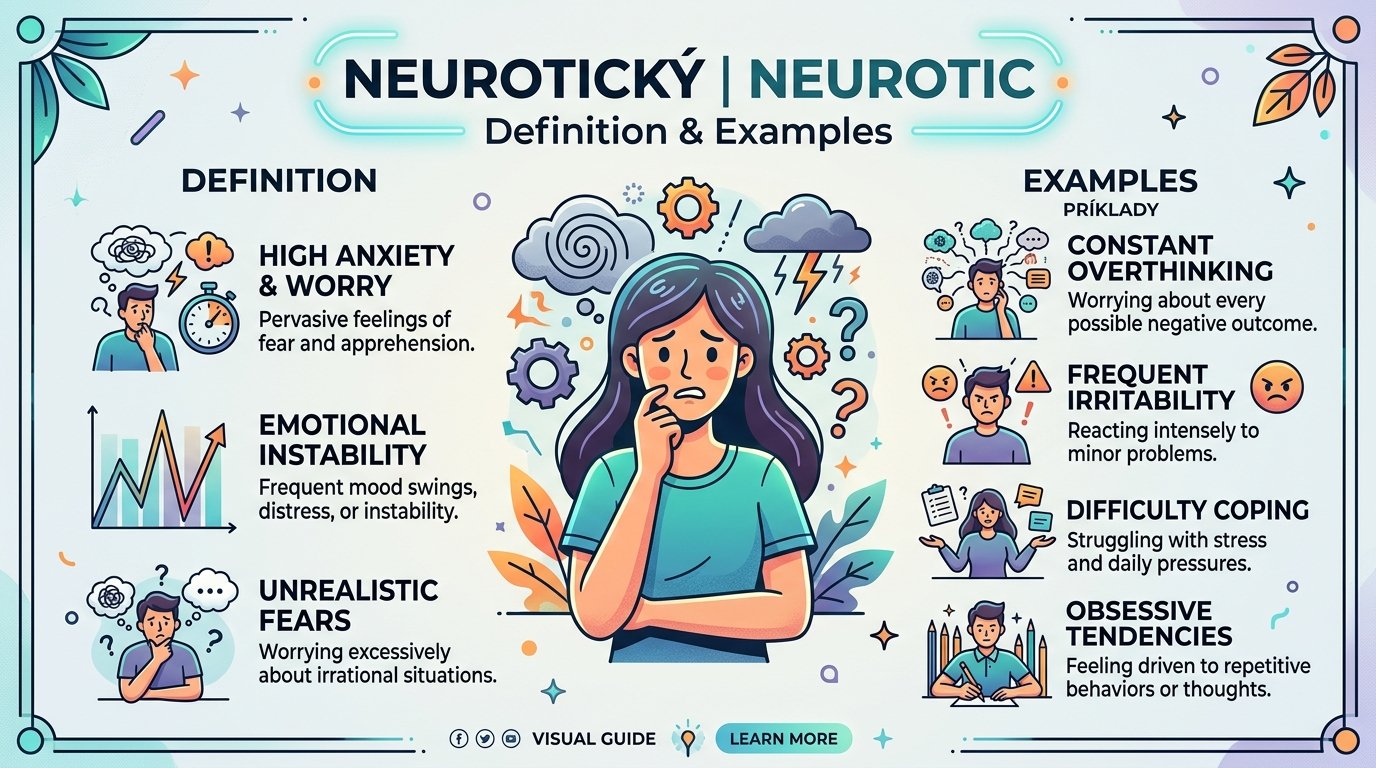
The Czech word neurotický translates into English as “neurotic.” It is generally used to describe someone or something associated with excessive worry, anxiety, nervousness, or emotional distress. In everyday English, neurotic can describe a person who worries excessively or reacts strongly to relatively minor concerns.
The word can also have a more specific meaning in psychology. It is important to distinguish neurotic from neuroticism, because they are related but are not interchangeable terms.
What Does Neurotický Mean in English?
Neurotický means “neurotic” in English.
The Czech adjective neurotický is used in contexts where English would normally use neurotic. The word can describe a person, behavior, reaction, fear, or tendency.
For example:
- neurotický člověk = neurotic person
- neurotické chování = neurotic behavior
- neurotický strach = neurotic fear
- neurotické tendence = neurotic tendencies
The exact translation can depend on the sentence, but neurotic is the standard English equivalent.
Neurotický Translation and Definition
The simplest translation is:
neurotický = neurotic
In English, neurotic is commonly used as an adjective. Cambridge Dictionary describes it in relation to unusually anxious or worried behavior, while Oxford describes it as behavior that is not calm or reasonable because of worry.
The word can have different levels of formality.
In casual conversation, someone might say:
“He’s being neurotic about the meeting.”
This usually means that the person is worrying excessively about the meeting.
In psychology, however, the word may be connected with the broader concept of neuroticism, a recognized personality dimension.
How Do You Pronounce Neurotic?
The American English pronunciation of neurotic is approximately:
noo-ROT-ik
The stress is placed on the middle syllable.
The pronunciation shown by Cambridge Dictionary for American English is approximately /nʊˈrɑː.t̬ɪk/.
What Does Neurotic Mean in Psychology?
In psychology, the everyday word neurotic should not automatically be interpreted as a diagnosis.
A closely related scientific concept is neuroticism.
The American Psychological Association describes neuroticism as one of the dimensions of the five-factor personality model and associates it with emotional instability and a tendency toward psychological distress.
The National Center for Biotechnology Information’s Medical Subject Headings describes neuroticism as a personality trait involving a tendency to respond to threats, frustration, or loss with negative emotions such as anxiety, anger, frustration, embarrassment, or sadness.
This means that psychology generally treats neuroticism as a personality dimension, rather than simply labeling someone as a “neurotic person.”
What Is Neurotic Behavior?
The term neurotic behavior is commonly used to describe patterns involving excessive worry, anxiety, self-doubt, or strong reactions to perceived problems.
Examples can include:
Excessive Worry
A person may spend a great deal of time worrying about possible negative outcomes, even when the situation does not clearly justify that level of concern.
For example:
“She became neurotic about whether she had locked the door.”
The sentence suggests excessive concern about something that may be relatively minor.
Self-Doubt
Someone may repeatedly question their decisions or abilities.
For example:
“He was neurotic about making a mistake at work.”
This suggests that the person is unusually preoccupied with the possibility of failure.
Strong Emotional Reactions
A person may react intensely to situations that other people consider manageable.
This does not necessarily mean the person has a mental disorder. Emotional reactions exist on a spectrum, and the word neurotic is often used informally.
Repeatedly Expecting Negative Outcomes
Someone may constantly anticipate that something will go wrong.
For example:
“Her neurotic worries made every small problem seem much bigger.”
The important idea is the pattern of excessive worry or negative emotional response.
Neurotic vs Neuroticism: What Is the Difference?
Neurotic and neuroticism are related but different.
| Term | Meaning |
|---|---|
| Neurotic | An adjective describing a person, behavior, reaction, or tendency associated with excessive worry or emotional distress |
| Neuroticism | A personality dimension involving a tendency toward negative emotional experiences |
| Neurosis | A historical psychological term that has been used in different ways and is not equivalent to neuroticism |
Neuroticism is one of the commonly recognized dimensions of the Big Five personality model, alongside extraversion, agreeableness, conscientiousness, and openness to experience.
A person can therefore have a relatively high level of neuroticism without that fact alone establishing a psychiatric diagnosis.
Is Being Neurotic a Mental Disorder?
Not necessarily.
Calling someone neurotic does not by itself mean that the person has a mental disorder.
Modern personality psychology uses neuroticism to describe a normal dimension of personality. People vary in how frequently and intensely they experience emotions such as anxiety, sadness, anger, embarrassment, or self-doubt.
Mental health conditions are diagnosed using specific clinical criteria. A personality trait and a mental disorder should therefore not be treated as the same thing.
If anxiety, worry, or emotional distress becomes persistent and significantly interferes with everyday life, relationships, work, sleep, or other important areas, discussing the symptoms with a qualified mental health professional can be appropriate.
Neurotic vs Anxious
The words neurotic and anxious overlap, but they are not identical.
Anxious usually describes a current feeling or state of worry.
Neurotic can describe a broader pattern of excessive worry or emotional reactivity.
For example:
- “I feel anxious before my interview.”
- “He is often neurotic about small mistakes.”
The first sentence describes a specific emotional state. The second describes a broader behavioral tendency.
Research has found a meaningful relationship between neuroticism and anxiety. However, having a higher level of neuroticism does not automatically mean that someone has an anxiety disorder.
Examples of Neurotic in English
Here are several natural examples:
- She became neurotic about keeping everything perfectly organized.
- He is neurotic about missing appointments.
- The character has several neurotic tendencies.
- His neurotic fear of failure made simple decisions difficult.
- She was acting neurotic after receiving the unexpected email.
- The movie portrays him as an anxious and neurotic character.
- Don’t become neurotic over a small mistake.
The meaning can vary slightly depending on context. In casual speech, neurotic can sometimes simply mean overly worried or excessively concerned.
How to Use Neurotic in a Sentence
Neurotic is normally used as an adjective.
Common patterns include:
neurotic + noun
- neurotic behavior
- neurotic fear
- neurotic tendency
- neurotic reaction
- neurotic personality
Subject + be + neurotic
- “He is neurotic about money.”
- “She is extremely neurotic about cleanliness.”
Become + neurotic
- “He became neurotic after repeatedly worrying about the problem.”
When writing professionally, especially in healthcare or psychology, it is usually better to describe the specific behavior rather than casually labeling a person as “neurotic.”
For example, instead of:
“She is neurotic.”
A more precise description might be:
“She experiences frequent and intense worry about everyday situations.”
The second version communicates the observable issue without turning a descriptive term into a personal label.
What Is the Difference Between Neuroticism and Emotional Stability?
Neuroticism is commonly understood as one end of a personality dimension, with emotional stability representing the opposite direction.
People with higher neuroticism tend to experience negative emotions more frequently or intensely. People lower in neuroticism tend to be relatively more emotionally stable and less reactive to stress.
This is a matter of degree rather than a simple category.
Someone does not have to be either completely neurotic or completely emotionally stable. Personality traits generally exist along continua.
Does Neuroticism Relate to Anxiety and Depression?
Research has consistently examined relationships between neuroticism and anxiety or depressive symptoms.
A review published through PubMed describes high neuroticism as a personality characteristic associated with anxiety disorders and discusses several possible relationships between personality traits and anxiety conditions.
Other research has also found associations between neuroticism and depressive and anxiety disorders.
However, an association does not mean that neuroticism alone causes a particular mental health condition.
Many factors can influence mental health, including biology, environment, life experiences, stress, and other individual differences.
What Does Neurotický Mean in a Translation Context?
If you encounter neurotický in Czech text, the most likely English translation is neurotic.
The surrounding sentence still matters.
For example:
Czech concept: neurotický člověk
English: neurotic person
Czech concept: neurotické chování
English: neurotic behavior
Czechs concept: neurotický strach
English: neurotic fear
A translator should therefore consider the grammatical role and context rather than translating isolated words mechanically.
When Should You Avoid Using the Word Neurotic?
Although neurotic is a legitimate English word, it can sound judgmental when used to describe another person.
For example:
“My coworker is neurotic.”
This may sound like a negative personal judgment.
A more neutral alternative could be:
“My coworker worries a lot about small details.”
Other context-dependent alternatives include:
- anxious
- worried
- nervous
- highly concerned
- emotionally reactive
- stressed
- prone to worry
The best alternative depends on what you actually want to communicate.
Is Neurotic the Same as Nervous?
No.
Nervous usually refers to temporary worry, tension, or apprehension.
Neurotic generally suggests a stronger or more persistent pattern of excessive worry or emotional reactivity.
For example:
“I was nervous before my presentation.”
This is completely ordinary.
By contrast:
“He became neurotic about every tiny detail of the presentation.”
This suggests a much stronger pattern of concern.
Is Neurotic the Same as Psychotic?
No. These words describe very different concepts.
Neurotic is associated with worry, anxiety, emotional distress, or a personality dimension involving negative emotionality.
Psychotic relates to a loss of contact with reality, such as certain symptoms involving hallucinations or delusions.
The two terms should not be used interchangeably.
Why the Word Can Be Confusing
The word neurotic has both everyday and psychological associations.
In ordinary conversation, someone might use it casually to mean:
- overly worried
- excessively concerned
- nervous
- obsessive about a small issue
In psychology, however, the related term neuroticism has a more specific meaning as a personality trait.
That distinction is important when reading psychological research or health information.
Key Takeaway
Neurotický means “neurotic” in English.
The word generally describes excessive worry, anxiety, nervousness, or emotional reactivity. In personality psychology, the related term neuroticism refers to a dimension of personality associated with a tendency to experience negative emotions and psychological distress.
Most importantly, being described as neurotic is not automatically the same as having a mental disorder. The meaning depends heavily on context.
FAQ Section
What does neurotický mean in English?
Neurotický is the Czech word for “neurotic” in English. It generally describes excessive worry, anxiety, nervousness, or emotional reactivity.
Is neurotický the same as neurotic?
Yes. Neurotický is the Czech equivalent of the English adjective neurotic.
What does neurotic mean?
Neurotic generally describes someone or something associated with excessive worry, anxiety, or unusual emotional reactions.
What is neuroticism?
Neuroticism is a personality dimension associated with a tendency to experience negative emotions such as anxiety, sadness, anger, and psychological distress. It is one of the Big Five personality dimensions.
Is neuroticism a mental illness?
No. Neuroticism is generally treated as a personality trait or dimension, not a mental illness by itself.
Is being neurotic the same as being anxious?
No. The concepts overlap, but anxious can describe a temporary emotional state, while neurotic may describe a broader tendency toward excessive worry or emotional reactivity.
Can someone be neurotic without having an anxiety disorder?
Yes. A person can have higher neuroticism or display neurotic tendencies without meeting the criteria for an anxiety disorder.
What is the opposite of neurotic?
In personality psychology, emotional stability is commonly used as the opposite pole of neuroticism.
Is “neurotic” a rude word?
It can sound judgmental when used to label another person. In sensitive or professional contexts, describing the specific behavior or symptoms is usually more precise.
See also: French Lavender Solid Leash 5 FT