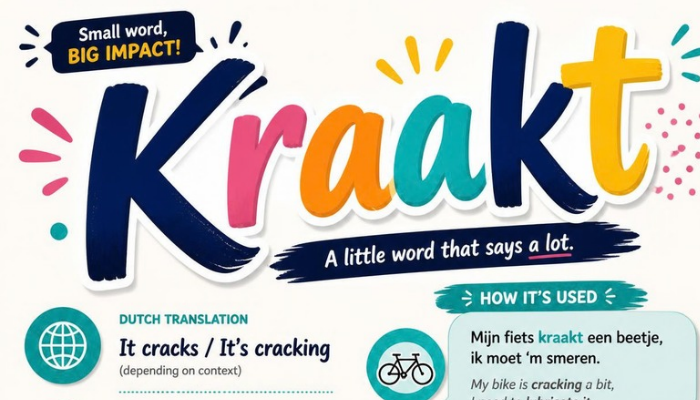
Kraakt is a Dutch word that comes from the verb kraken. Depending on the context, it can translate into English as “creaks,” “cracks,” “crackles,” “crunches,” or, in some contexts, “breaks open.” It is a conjugated verb form rather than the basic dictionary form of the verb.
For example, “de vloer kraakt” means “the floor creaks,” while a sentence about cracking joints can use kraakt to describe the cracking sound or action. Translation sources show that the best English equivalent depends on what is being described.
What Does Kraakt Mean?
The simplest explanation is:
Kraakt = a Dutch present-tense form of “kraken.”
The English translation changes according to context.
| Dutch | Possible English translation |
|---|---|
| kraakt | creaks |
| kraakt | cracks |
| kraakt | crackles |
| kraakt | crunches |
| kraakt | breaks open |
For something such as a wooden floor, “creaks” is usually the natural English choice. For something being opened or broken, “cracks” or “breaks open” may be more appropriate.
Dutch dictionary resources describe kraken as making an irregular cracking or creaking sound and also record other meanings connected with breaking something open.
Is Kraakt a Dutch Word?
Yes. Kraakt is a Dutch verb form.
It is not normally treated as a separate base verb. Instead, it is a conjugated form of kraken.
Wiktionary identifies kraakt as the second- and third-person singular present indicative form of kraken.
The Dutch word can therefore appear in sentences such as:
- De vloer kraakt.
The floor creaks. - Het bed kraakt.
The bed creaks. - De deur kraakt.
The door creaks.
These examples show why translating the word by itself can sometimes be misleading. The surrounding sentence tells you which English verb sounds most natural.
What Is the Base Verb of Kraakt?
The base verb is kraken.
A simplified comparison is:
| Dutch form | Function |
|---|---|
| kraken | infinitive/base form |
| kraak | first-person singular present |
| kraakt | second/third-person singular present |
| kraakte | singular past tense |
| gekraakt | past participle |
The Algemeen Nederlands Woordenboek lists kraakt as both the second-person and third-person singular present form of kraken.
For example:
Ik kraak
= I crack / I creak, depending on context.
Hij kraakt
= He cracks / He creaks.
De vloer kraakt
= The floor creaks.
How Is Kraakt Used in Dutch Grammar?
Kraakt is a present-tense singular form.
It can be used with a second-person subject:
Jij kraakt
= You crack / You creak.
It can also be used with a third-person singular subject:
Hij kraakt
= He cracks / He creaks.
Zij kraakt
= She cracks / She creaks.
Het kraakt
= It cracks / It creaks.
De deur kraakt
= The door creaks.
The important point is that Dutch uses kraakt with singular second- and third-person subjects in the present tense.
Kraakt Translation in English
There is no single English word that works in every situation.
Kraakt = “Creaks”
When something such as a floor, door, bed or staircase makes a repeated sharp or squeaking sound, “creaks” is often the best translation.
Example:
De houten vloer kraakt.
Natural English:
The wooden floor creaks.
Translation resources specifically give examples such as floors and beds using “creaks” in English.
Kraakt = “Cracks”
In another context, kraakt can relate to cracking.
For example, a person may crack their joints, or something may crack under pressure.
The surrounding words determine whether “cracks” is more appropriate than “creaks.”
Kraakt = “Crackles”
A sound made by fire, snow, vegetation or another material can sometimes be translated with “crackles.”
The exact English word depends on the type of sound being described.
Kraakt = “Crunches”
When the sound involves something being crushed or stepped on, “crunches” can sometimes be a natural English equivalent.
Again, this is a context-dependent translation rather than a fixed definition.
Kraakt = “Breaks Open”
The verb kraken also has meanings associated with breaking something open. Dutch dictionary sources give examples such as cracking nuts or opening something by force.
Therefore, kraakt can have a different translation when it describes an action rather than a sound.
Examples of Kraakt in Dutch
Here are some simple examples:
1. De vloer kraakt.
English: The floor creaks.
This is one of the clearest examples because the floor is producing a creaking sound.
2. Het bed kraakt een beetje.
English: The bed creaks a little.
Translation sources provide this type of example for kraakt.
3. De deur kraakt.
English: The door creaks.
Here, kraakt describes the sound made by the door.
4. De trap kraakt.
English: The staircase creaks.
The meaning remains related to a characteristic creaking sound.
5. Hij kraakt zijn gewrichten.
English: He cracks his joints.
In this context, translating kraakt as “creaks” would sound unnatural in English. “Cracks” is more appropriate.
Translation examples show kraakt being used for cracking joints.
What Does “De Vloer Kraakt” Mean?
De vloer kraakt means:
The floor creaks.
Breaking the sentence down:
- de = the
- vloer = floor
- kraakt = creaks
This is a useful example because it demonstrates the most common sound-related interpretation of kraakt.
The Dutch word kraken is associated with producing an irregular sharp sound, and dictionary examples include wooden floors.
What Does “Het Huis Kraakt” Mean?
Het huis kraakt can be translated as:
The house creaks.
The sentence suggests that the house or parts of its structure are making creaking or cracking sounds.
The exact interpretation can depend on context. An old wooden structure, for example, may naturally make creaking noises as materials move or respond to temperature and other conditions.
What Does “Hij Kraakt Zijn Gewrichten” Mean?
Hij kraakt zijn gewrichten can be translated as:
He cracks his joints.
This is different from saying that a floor or door creaks.
The same Dutch verb is being used, but English chooses a different verb because the context is different. Translation examples specifically show kraakt being used for cracking joints.
This is an important lesson for anyone learning Dutch: do not assume that one Dutch verb always has one fixed English translation.
Kraakt vs. Kraken
The main difference is grammatical.
Kraken is the infinitive or dictionary form.
Kraakt is a present-tense singular conjugated form.
For example:
Ik hoor de vloer kraken.
= I hear the floor creaking.
Here, kraken remains in its infinitive form.
De vloer kraakt.
= The floor creaks.
Here, kraakt is the conjugated verb.
A simple way to remember it is:
kraken = to creak / to crack
kraakt = creaks / cracks
The exact English translation depends on the context.
Kraakt vs. Kraakte
These forms refer to different times.
Kraakt is present tense.
Kraakte is past tense.
Compare:
De deur kraakt.
= The door creaks.
De deur kraakte.
= The door creaked.
The change from kraakt to kraakte changes the sentence from present to past.
Dutch dictionary resources list kraakte as the past-tense singular form of kraken.
How Do You Pronounce Kraakt?
Kraakt is a Dutch word with a long aa sound.
The pronunciation is approximately:
KRAAKT
The Dutch infinitive kraken is commonly represented with the pronunciation /ˈkraːkən/ in dictionary resources.
For English speakers, the word can initially sound like a combination of:
“krahkt”
However, Dutch pronunciation is not identical to English pronunciation, so an audio pronunciation from a Dutch dictionary is preferable when learning to say the word accurately.
Why Does the English Translation Change?
Languages do not always map one word directly to one word.
The Dutch verb kraken covers several related ideas. Dutch dictionary sources include the idea of making a sharp or irregular sound, while other uses involve breaking something open.
English separates these ideas more often:
- A floor creaks
- A branch cracks
- Snow may crunch
- A fire crackles
- A nut is cracked
- A safe can be cracked
Therefore, translating kraakt correctly requires looking at the complete sentence.
Common Mistakes With Kraakt
Mistake 1: Treating kraakt as an English word
Kraakt is Dutch. It should generally be analyzed as a form of kraken.
Mistake 2: Always translating it as “cracks”
Although “cracks” can be correct, it is not always the most natural English translation.
De vloer kraakt is better translated as:
The floor creaks.
Mistake 3: Always translating it as “creaks”
That also causes problems.
For example:
Hij kraakt zijn gewrichten
is naturally:
He cracks his joints.
Mistake 4: Confusing kraakt with kraken
Kraken is the infinitive.
Kraakt is a conjugated present-tense form.
Mistake 5: Ignoring the subject
The form kraakt is associated with singular second- and third-person present-tense subjects.
Quick Reference: Kraakt Meaning
| Question | Answer |
|---|---|
| What language is kraakt? | Dutch |
| What is the base verb? | kraken |
| What type of word is it? | Verb form |
| Present tense? | Yes |
| Second person singular? | Yes |
| Third person singular? | Yes |
| Common translation | creaks / cracks |
| Other contextual translations | crackles, crunches, breaks |
| Past-tense equivalent | kraakte |
| Past participle | gekraakt |
When Should You Translate Kraakt as “Creaks”?
Use “creaks” when the subject is making a characteristic structural or mechanical sound.
Examples include:
- floors
- doors
- stairs
- beds
- wooden structures
For example:
De vloer kraakt.
= The floor creaks.
Translation resources give several examples involving floors, beds, doors and other objects where “creaks” is the natural English interpretation.
When Should You Translate Kraakt as “Cracks”?
Use “cracks” when the context involves cracking something or producing a cracking sound.
For example:
Hij kraakt zijn gewrichten.
= He cracks his joints.
The surrounding noun and action determine the most natural English translation.
When Does Kraakt Relate to Breaking Something?
The broader verb kraken has additional meanings beyond producing a sound.
Dutch dictionary resources include uses involving breaking something open, such as cracking nuts, as well as other specialized meanings.
That means a translation based only on the sound-related meaning can be incomplete.
Is Kraakt the Same as “Crack” in English?
Not exactly.
The English word “crack” covers several meanings, and kraakt can correspond to some of them. But kraakt can also correspond to “creaks” or other sound-related verbs.
The best translation should therefore be based on the full Dutch sentence rather than the isolated word.
Final Takeaway
Kraakt is a Dutch present-tense form of kraken. Its English translation depends on context, with “creaks” and “cracks” among the most common possibilities. It can also be translated as “crackles,” “crunches,” or a phrase involving breaking something open when the context calls for it.
If you encountered kraakt in a specific Dutch sentence, translating the whole sentence is the best way to determine its exact meaning.
AQ Section
What does “kraakt” mean in English?
Kraakt is a Dutch verb form that can mean “creaks,” “cracks,” “crackles,” or another related English verb depending on context. It comes from kraken.
Is “kraakt” Dutch?
Yes. Kraakt is a Dutch present-tense form of the verb kraken.
What is the infinitive of kraakt?
The infinitive is kraken.
What does “de vloer kraakt” mean?
It means “the floor creaks.”
What does “hij kraakt zijn gewrichten” mean?
It means “he cracks his joints.”
What is the difference between kraakt and kraakte?
Kraakt is present tense, while kraakte is the singular past tense of kraken.
How do you pronounce kraakt?
It is approximately pronounced “krahkt,” although the Dutch vowel and final consonant sounds are not exactly equivalent to English pronunciation.
Can kraakt mean “creaks”?
Yes. This is especially natural when describing floors, doors, beds, stairs and similar objects making a creaking sound.
Can kraakt mean “cracks”?
Yes. Context can make “cracks” the appropriate English translation, including examples involving joints.
What is the English meaning of kraken?
Depending on context, kraken can refer to making a cracking or creaking sound, cracking something open, and other specialized uses.
See also: Pitami