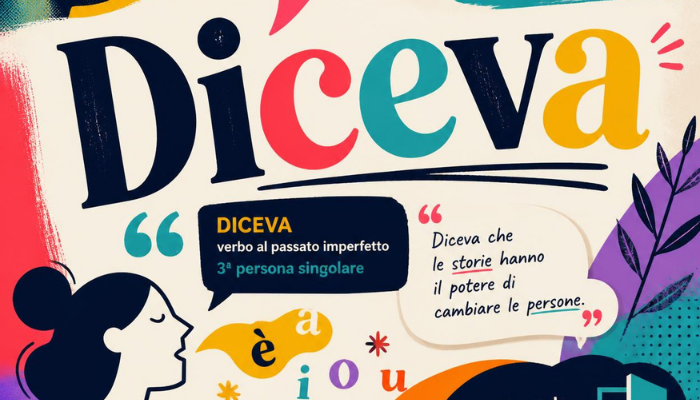
Diceva is an Italian verb form that generally means “he was saying,” “she was saying,” “he used to say,” or “she used to say.” It comes from the Italian verb dire, meaning “to say” or “to tell.” Grammatically, diceva is the third-person singular imperfect indicative form of dire.
The exact English translation depends on context. In some sentences, diceva is naturally translated as “said,” while in others, “was saying,” “used to say,” “told,” or even “read” works better.
What Does Diceva Mean?
The simplest translation of diceva is:
he/she was saying or he/she used to say
It can also be translated as:
- He said
- She said
- He was saying
- She was saying
- He used to say
- She used to say
- He told
- She told
- It said
- It read
The reason for these different translations is that Italian and English do not always express past actions in exactly the same way.
For example:
Mio nonno diceva sempre la verità.
This can be translated as:
“My grandfather always used to tell the truth.”
Here, diceva describes a repeated or habitual action in the past.
Diceva in Italian
In Italian, diceva comes from the verb dire, which means “to say” or “to tell.”
The form diceva identifies a third-person singular subject:
- lui diceva = he was saying / he used to say
- lei diceva = she was saying / she used to say
- Lei diceva = you were saying / you used to say, when Lei is the formal singular “you”
The form can therefore refer to either a male or female third-person subject depending on the surrounding sentence.
The Verb Behind Diceva: Dire
The infinitive form is dire.
Dire = to say / to tell
Its present-tense forms include:
- io dico
- tu dici
- lui/lei dice
- noi diciamo
- voi dite
- loro dicono
The imperfect forms use the stem dice-, producing dicevo, dicevi, diceva, dicevamo, dicevate, and dicevano.
What Tense Is Diceva?
Diceva is the imperfect indicative, known in Italian as the imperfetto indicativo.
The Italian imperfect is commonly used when describing actions that were:
- Ongoing in the past
- Repeated in the past
- Habitual in the past
- Background information in a past situation
- Not presented as a single completed event
This is why diceva often translates naturally as “used to say” or “was saying.”
For example:
Mia madre diceva sempre di studiare.
A natural translation is:
“My mother always used to tell me to study.”
The sentence describes something she repeatedly said rather than one isolated statement.
Diceva English Translation
There is no single English translation that works in every situation.
Consider these examples:
Diceva sempre la stessa cosa.
= He always used to say the same thing.
Cosa diceva?
= What was he saying?
Il cartello diceva di non entrare.
= The sign said not to enter.
The third example is particularly useful because an inanimate subject can use diceva. English commonly translates this as “said,” even though the Italian form is still the imperfect.
A linguistic discussion of Italian aspect gives the example “Il cartello diceva di fare attenzione,” translated as “The poster said to be careful.”
How to Pronounce Diceva
Diceva is pronounced approximately:
dee-CHEH-vah
The Italian pronunciation is /diˈtʃe.va/.
The c before e has a soft sound similar to the “ch” in the English word “cheese.”
You can divide the word into three syllables:
di-ce-va
The stress falls on the middle syllable:
di-CÉ-va
Diceva Conjugation
Here is the imperfect conjugation of dire:
| Person | Italian | English |
|---|---|---|
| Io | dicevo | I was saying / I used to say |
| Tu | dicevi | You were saying / You used to say |
| Lui/Lei | diceva | He/She was saying / used to say |
| Noi | dicevamo | We were saying / We used to say |
| Voi | dicevate | You were saying / You used to say |
| Loro | dicevano | They were saying / They used to say |
The conjugation is confirmed by standard Italian verb tables.
Examples of Diceva in Italian Sentences
Example 1
Lui diceva sempre la verità.
English: He always used to tell the truth.
The imperfect works because the action is presented as habitual.
Example 2
Lei diceva che sarebbe venuta.
English: She said that she would come.
Here, English naturally uses “said,” even though Italian uses the imperfect form diceva.
Example 3
Cosa diceva tuo padre?
English: What was your father saying?
The context focuses on what was being said.
Example 4
Mia nonna diceva sempre che la pazienza è importante.
English: My grandmother always used to say that patience is important.
The phrase describes a repeated statement or piece of advice.
Example 5
Il cartello diceva “Non entrare.”
English: The sign said, “Do not enter.”
Here, diceva refers to what was written on a sign rather than something literally spoken.
Diceva vs. Dicevo
The difference is the grammatical person.
Dicevo means:
I was saying / I used to say
Diceva means:
He was saying / She was saying / He or she used to say
For example:
Dicevo sempre la stessa cosa.
= I always used to say the same thing.
Diceva sempre la stessa cosa.
= He/she always used to say the same thing.
The ending changes according to the subject.
Diceva vs. Dice
These forms are related but use different tenses.
Dice is the present tense:
Lui dice la verità.
= He tells the truth.
Diceva is the imperfect:
Lui diceva la verità.
= He was telling the truth / He used to tell the truth.
The first describes a present situation. The second places the action in the past.
Diceva vs. Disse
This is an important distinction for Italian learners.
Diceva is the imperfect.
Disse is the third-person singular passato remoto, or historical past.
For example:
Diceva sempre la stessa cosa.
= He always used to say the same thing.
Disse la stessa cosa.
= He said the same thing.
The first form can emphasize a repeated or ongoing past action. The second presents a completed event.
Italian verb tables list diceva under the imperfect and disse under the past historic.
Diceva vs. Ha Detto
Another useful comparison is diceva and ha detto.
Ha detto is the third-person singular present perfect of dire.
For example:
Ha detto la verità.
= He/she told the truth.
Diceva la verità.
= He/she was telling the truth / used to tell the truth.
The choice depends on how the speaker views the past event and the surrounding context.
When Do Italians Use Diceva?
Italian speakers use diceva in several common situations.
Repeated past statements
Mio padre diceva sempre questo.
= My father always used to say this.
Ongoing speech
Diceva qualcosa quando sono entrato.
= He was saying something when I entered.
Past background
Diceva che non aveva tempo.
= He was saying that he did not have time.
Written information
Il documento diceva che tutto era pronto.
= The document said that everything was ready.
The important point is that the imperfect does not necessarily have one fixed English equivalent. Context determines the most natural translation.
Does Diceva Have Another Meaning?
Yes. The word can also appear in Interlingua, where diceva is listed as the past form of dicer.
However, for most searches involving diceva, the Italian grammatical meaning is the most important interpretation because Italian dictionaries and language resources identify it as the third-person singular imperfect form of dire.
Common Mistakes With Diceva
Mistake 1: Treating diceva as a present-tense form
Diceva is not the normal present-tense third-person form.
Present: dice
Imperfect: diceva
Mistake 2: Assuming it always means “said”
“Was saying” and “used to say” can sometimes be more accurate depending on context.
Mistake 3: Confusing diceva with dicevo
Dicevo refers to I, while diceva normally refers to he/she or the formal Lei.
Mistake 4: Confusing diceva with disse
Both can refer to past speech, but they belong to different past-tense forms and can present the action differently.
Why the Word Diceva Can Be Confusing
The main difficulty is that Italian’s imperfect does not map neatly onto one English tense.
The Italian form diceva can communicate an ongoing action, a repeated action, a habitual statement, or past background. English chooses among “was saying,” “used to say,” “said,” and related expressions according to context.
That is why translating diceva word-for-word without considering the whole sentence can produce an unnatural English result.
Final Takeaway
Diceva is primarily an Italian verb form from dire, meaning “to say” or “to tell.” It is the third-person singular imperfect indicative form and can mean “he/she was saying,” “he/she used to say,” or simply “he/she said,” depending on context.
If you encounter diceva in an Italian sentence, look at the subject and the surrounding context before choosing an English translation. That is the easiest way to understand what the speaker or writer actually means.
FAQ Section
What does “diceva” mean in English?
Diceva usually means “he was saying,” “she was saying,” “he used to say,” or “she used to say.” Depending on context, it can also simply translate as “said” or “told.”
What verb does diceva come from?
Diceva comes from the Italian verb dire, which means “to say” or “to tell.”
What tense is diceva?
Diceva is the third-person singular imperfect indicative of dire.
How do you pronounce diceva?
It is approximately pronounced dee-CHEH-vah, with the stress on the middle syllable. Its Italian IPA pronunciation is /diˈtʃe.va/.
What is the difference between diceva and disse?
Diceva is the imperfect and often describes an ongoing or repeated past action. Disse is the third-person singular historical past form and generally presents a completed past event.
What is the difference between diceva and dicevo?
Diceva normally means “he/she was saying” or “he/she used to say,” while dicevo means “I was saying” or “I used to say.”
Can diceva refer to something written?
Yes. Italian can use diceva for written information, such as a sign, document, or letter. In that context, English may translate it as “said” or “read.”
Is diceva an Italian word?
Yes. In Italian, diceva is a grammatical form of dire. The word also has a separate listing in Interlingua as a past form of dicer.
See also: Margie Willett


![louis vuitton skin: architecture of luxury. new york cover [book]](https://fentomagazines.com/wp-content/uploads/2026/09/louis-vuitton-skin-350x250.jpg)