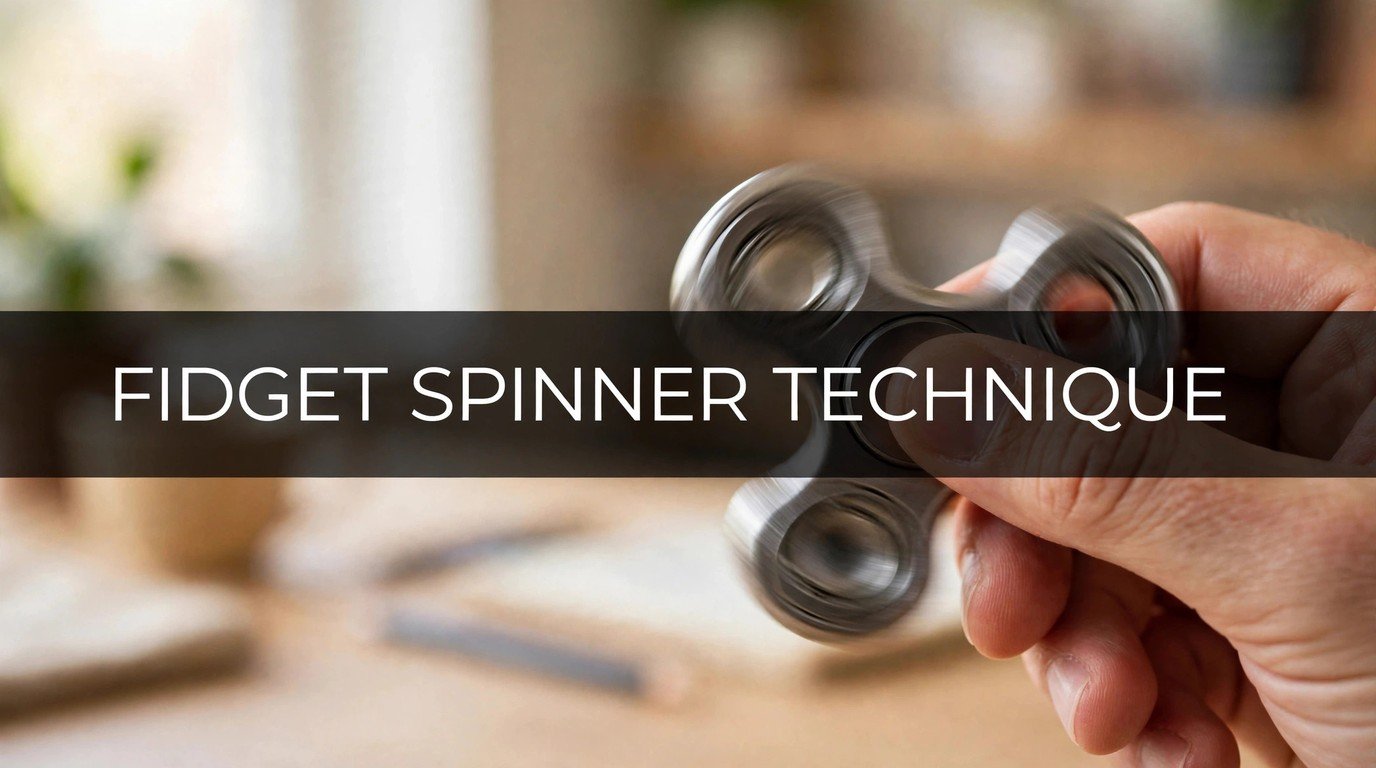
A good fidget spinner technique starts with something simple: a relaxed grip, a smooth flick, and a spinner that is allowed to do the work. Most people pick up a spinner, flick it hard, and watch it wobble, slow down quickly, or fly out of their hand. The problem is rarely the spinner. It is usually the grip, the flick, or the rush to try a trick before the basic spin feels steady.
This article explains fidget spinner technique from the beginning. You will learn how a spinner works, how to hold it, how to get a long and stable spin, and how to move on to finger transfers, table spins, and a handful of beginner tricks. Everything here is practical. You can practise each step at a desk, on a sofa, or while waiting for something, and you do not need an expensive spinner to learn any of it.
What Is Fidget Spinner Technique?
Fidget spinner technique is the set of small skills that turn random flicking into a controlled spin. It covers how you hold the centre, how you start the spin, how you keep it balanced, and how you move the spinner between fingers or hands without stopping it.
Good technique has three signs. First, the spin looks smooth rather than shaky. Second, the spinner stays in your hand instead of drifting or tipping over. Third, you can repeat the same move several times in a row. Speed is not the goal. Control is. A slow, steady spin that you can hold and move around is better technique than a fast spin that falls apart after two seconds.
Most beginners improve quickly once they slow down. The spinner is a small toy with a simple job, and the techniques in this article build on each other in order. Learn the basic spin first, then add one new move at a time.
How a Fidget Spinner Works
A fidget spinner has a centre bearing and two or three weighted arms, often called lobes. You hold the centre still with one hand and flick one of the arms with a finger from the other hand. The bearing lets the outer part rotate around the centre with very little friction, so a single flick can keep the spinner turning for a while.
The balance of the spinner matters more than its price. A well-made spinner has arms of equal weight, so it spins in a flat plane without wobbling. If one arm is heavier or the bearing is dirty, the spin will tilt and slow down sooner. You do not need to understand bearings in detail to use a spinner well, but it helps to know that a clean, smooth spin comes from a level spinner and a flick that pushes in the direction of rotation rather than up or down.
Spin time also depends on how you start it. A short, sharp flick in the right place gives a cleaner start than a long push. Think of it like pushing a door: a push at the edge, in the direction the door swings, works best. A push near the hinge, or at an angle, wastes effort.
Choosing the Right Spinner for Learning Tricks
Any standard three-lobed spinner is a good place to start. It is balanced, easy to hold, and easy to catch. Two-lobed spinners spin well too, but they can feel less stable in the hand when you are learning transfers. Very small spinners look neat, but they can be harder to grip. A medium-sized spinner, roughly the width of your palm, gives you room to hold the centre comfortably while a finger flicks an arm.
Weight is a matter of preference. A heavier metal spinner feels solid and tends to spin smoothly, while a lighter plastic spinner is easier to carry and gentler if it drops. For learning technique, either one works. What matters most is that the bearing turns freely and the spinner does not wobble when it spins on a flat surface.
Before you practise, give the spinner a quick check. Spin it on a table and watch it from the side. If it stays flat and level, it is ready. If it leans to one side or rattles, check that nothing is stuck to it and that the centre cap is seated properly. A spinner that wobbles on a table will wobble in your hand too.
How to Hold a Fidget Spinner
The grip is the foundation of every fidget spinner technique. Hold the centre bearing between the thumb and index finger of your main hand. Your thumb goes on one side of the centre and your index finger on the other. Grip firmly enough to keep the centre still, but not so tightly that your fingers press into the spinning arms.
Your other fingers should stay relaxed and slightly curled out of the way. Beginners often spread all their fingers wide, which looks dramatic but makes it easier for a spinning arm to hit a fingertip and knock the spinner off balance. Keep the spare fingers tucked in, away from the path of the arms.
Hold your hand level, with the spinner flat like a small plate. If your hand tilts, the spinner will tilt with it, and the spin will slow down. This takes a little attention at first, because your hand naturally wants to angle itself. Check your hand position in a mirror or by looking at the spinner from the side. Once a level hold feels natural, every other technique becomes easier.
The Pinch Grip
The pinch grip is the standard starting position. Pinch the centre caps between thumb and index finger, keeping your fingertips on the caps and not on the arms. This grip gives you the most control, and it is the grip you will use for most spins and transfers.
Practise holding the spinner still in this grip for a few seconds before you flick it. If your fingers slip, adjust your grip slightly until the centre feels secure. A little dryness on your fingertips helps; if your hands are damp, wipe them first.
The Table Hold
For table spins, you hold the spinner differently. Place one fingertip lightly on the top centre cap while the spinner rests on the table, then flick an arm with a finger from your other hand. Your fingertip acts as a post that the spinner turns around. Press down only lightly. Too much pressure creates friction and slows the spin, while too little lets the spinner wander across the table.
The Basic Spin: Step by Step
The basic spin is the first fidget spinner technique to learn, and it is worth practising until it feels easy. Here is how to do it.
- Hold the centre. Pinch the centre bearing between the thumb and index finger of your main hand, with the spinner level.
- Position your flicking finger. Bring the index finger of your other hand to the end of one arm, resting lightly against it.
- Flick, do not push. Give the arm a short, quick flick in the direction you want it to turn. The motion comes from your finger, not your wrist or arm.
- Pull your finger away. As soon as the arm moves, lift your flicking finger clear so it does not drag against the spinning arms.
- Hold steady. Keep your holding hand level and still. Watch the spinner turn and feel for any wobble.
Repeat this a few times, flicking in the same direction each time. Try flicking gently first, then a little harder, and notice how the spin changes. A gentle flick gives a short, calm spin that is easy to control. A harder flick gives a longer spin but needs a steadier hand to keep it level.
Most people find one direction easier than the other. That is normal. Practise your easier direction first, then try the other direction once the first feels smooth. Spinning both ways is useful later, because some tricks need a spin in a particular direction.
How to Get a Longer Spin
A long spin comes from a clean start and a steady hold, not from flicking as hard as you can. Three small changes usually add the most spin time.
First, flick at the tip of the arm rather than near the centre. The tip travels further with the same flick, so it picks up more speed. Second, keep your flick in the flat plane of the spinner. A flick that pushes slightly upward or downward wastes energy and tilts the spinner. Third, keep your holding hand still once the spin starts. Even small movements of your hand add wobble and friction.
If your spin still feels short, check the spinner itself. Dust or lint in the bearing can slow it down. Wipe the spinner clean and try again. Avoid oiling a spinner unless you know it is designed for it, because the wrong lubricant can attract dust and make things worse.
Stopping the Spin Safely
To stop a spinner, touch one arm lightly with a fingertip from your free hand, or press the arms gently between your thumb and fingers. Do not grab a fast-spinning spinner with a closed fist. Let your fingertip slow it gradually, then close your hand around it once it has slowed. This protects your fingers and keeps the spinner from flying off.
Fidget Spinner Technique: 7 Moves to Learn in Order
The moves below are arranged from easiest to hardest. Learn each one until it feels comfortable before moving to the next. Rushing ahead usually means going back to fix the basics later.
1. The Single-Hand Spin
The single-hand spin is the first step toward doing everything with one hand. Hold the centre between your thumb and middle finger instead of your index finger. Then flick an arm with your index finger of the same hand. Your index finger reaches across, gives the arm a flick, and pulls back out of the way.
This feels awkward at first because your index finger has two jobs: it helps hold the centre, then it flicks. Practise slowly. Start by holding the spinner in the new grip without flicking, just to get used to the feeling. Then add a gentle flick. Once you can start a spin with one hand, you have freed your other hand for transfers and catches.
2. The Finger Transfer
The finger transfer moves the spinner from one finger to another while it is still spinning. Start with a normal spin in your main hand. While it turns, bring the index finger of your other hand to the centre, pinch the centre caps between that finger and your thumb, and let go with your first hand.
The key is timing. Do the transfer while the spinner is still spinning steadily, not when it is slowing down and wobbling. Move your receiving hand in smoothly, take the centre gently, and then move your first hand away. At first, the spinner may dip or tilt during the transfer. That is normal. Keep both hands level and move slowly, and the transfer will get cleaner with practice.
Once you can transfer between hands, try transferring between fingers on the same hand. Hold the centre between thumb and index finger, then move your middle finger into place and shift the pinch to thumb and middle finger. Small, careful movements work better than quick grabs.
3. The Table Spin
The table spin is a good trick to learn because it removes the problem of holding the spinner steady. Place the spinner flat on a table or desk. Put one fingertip lightly on the top centre cap. Flick an arm with a finger from your other hand, then lift your flicking finger away.
A table spin often lasts longer than a hand spin because your fingertip is the only contact point and the table keeps everything level. It is also a useful way to show someone a spinner, since they can watch it turn without you holding it. Try spinning it on different surfaces. A smooth, hard surface works best. A soft surface, like a bed or a sofa cushion, will slow the spinner down quickly.
You can also practise stopping and restarting a table spin. Touch an arm lightly to slow it, then flick it again without lifting your fingertip from the centre. This builds the light touch that every other technique needs.
4. The Thumb Roll
The thumb roll moves the spinner around your thumb while it spins. Start with a normal spin held between thumb and index finger. Loosen your index finger slightly and let the spinner roll around the tip of your thumb, then bring your index finger back to take the centre again.
The movement is small. Your thumb stays mostly still while the spinner shifts around it. Think of it as the spinner making a short trip around your thumb and coming home. If the spinner slips, you are probably loosening your grip too much or moving your hand. Keep the movement tiny and slow until it feels safe, then let it get smoother.
The thumb roll teaches you to control the spinner while your grip changes. That skill carries over to almost every other trick, because most tricks involve a moment where your grip is loose and the spinner is moving.
5. The Orbit
The orbit is a showy but simple move. Start a spin, then move your whole hand in a slow, wide circle while the spinner keeps turning. The spinner orbits around an invisible point in the air, like a small planet going around the sun. Keep your hand level and move smoothly.
The trick is to move your arm, not your wrist. Your wrist should stay steady so the spinner stays flat. Start with small circles and make them wider as you get comfortable. If the spinner starts to wobble, slow the circle down or make it smaller. Speed makes the orbit look impressive, but a slow, controlled orbit shows better technique.
The orbit is a good move to practise in an open space, away from anything you might knock over. It also teaches you to keep the spinner level while your hand is moving, which is exactly the skill you need for more advanced tricks.
6. The Finger Pass
The finger pass moves the spinning spinner from one finger to the next across the same hand, like passing a small object along your fingertips. Start with the spinner held between thumb and index finger. Bring your middle finger up to the centre, take the pinch with thumb and middle finger, and release your index finger. Then do the same with your ring finger.
Go slowly. Each pass should be a clean handover, with the spinner never fully loose. If you try to pass too quickly, the spinner will drop or tilt. Practise the first pass until it is reliable, then add the second. Some people can pass a spinner across all four fingers and back again, but that takes time. Two clean passes are better than four messy ones.
The finger pass looks simple to an observer, but it is a real test of control. It shows that you can change your grip without disturbing the spin, which is the heart of good fidget spinner technique.
7. The Toss and Catch
The toss and catch is the most advanced move in this list, and it should be learned last. Start a spin, toss the spinner a short distance straight up with a gentle underhand motion, and catch it by the centre as it comes down.
Keep the toss low at first. A toss of just a few centimetres is enough to learn the timing. Watch the centre of the spinner, not the arms, and keep your catching hand under it. Catch with your thumb and index finger on the centre caps, the same pinch grip you started with. If you catch an arm instead of the centre, the spin will stop and the spinner may sting your fingers, so aim for the middle.
Practise over a soft surface, such as a bed or a carpet, so a dropped spinner does not get damaged or roll away. Do not try to catch a spinner behind your back or with your eyes closed until the basic toss and catch is completely reliable. A calm, low toss that you catch cleanly is far better than a high toss that you drop.
Building a Simple Practice Routine
Short, regular practice beats long, occasional sessions. Ten minutes a day is enough to build solid fidget spinner technique, and it keeps your hands from getting tired. Here is a simple routine you can follow.
Start with two minutes of basic spins. Flick the spinner in your easier direction, then in your harder direction, focusing on a level hold and a clean flick. Then spend three minutes on the one move you are currently learning. Repeat it slowly, rest your hand when it feels tired, and try again. Finish with three minutes of free play, combining the moves you already know. End by practising stopping the spinner cleanly.
Keep a small note of what you practised and what felt hard. You do not need a formal log. A sentence or two after each session is enough. Over a week or two, you will see which moves are improving and which ones need more time. That is more useful than trying to learn everything in one sitting.
Practice in short bursts also helps your hands. Spinning uses small muscles in your fingers that tire quickly when you are learning. If your hand starts to ache, put the spinner down and rest. Technique learned with tired hands is usually sloppy technique, and it is better to stop early than to practise bad habits.
Common Mistakes and How to Fix Them
Most fidget spinner problems come from a small list of mistakes. Here are the ones beginners make most often, and how to fix each one.
Gripping too tightly. A tight grip presses your fingers into the arms and slows the spin. Loosen your hold until the centre feels secure but your fingers are relaxed. If your fingertips turn white, you are gripping too hard.
Flicking too hard. A very hard flick makes the spinner wobble and can knock it out of your hand. Use a short, controlled flick instead. A moderate flick with good aim beats a hard flick with poor aim.
Tilting your hand. A tilted hand tilts the spinner, and a tilted spinner slows down fast. Check your hand position often. Keeping your palm facing down and level is the simplest fix.
Chasing tricks too soon. Tricks look easy when someone else does them, but they depend on a steady basic spin. If a trick keeps failing, go back to the basic spin for a few minutes. The trick usually works better after that.
Practising with a dirty spinner. Dust, lint, and pocket fluff slow a bearing down. Wipe the spinner with a dry cloth before practice. If it still feels rough, check whether anything is caught between the arms and the centre.
Ignoring your weaker hand. Most people favour one hand. Spend a little time each session using your other hand, even if it feels clumsy. It improves your overall control and makes transfers much easier.
Safety, Care and Looking After Your Spinner
Fidget spinners are simple toys, but a few habits keep them safe and working well. Do not spin a spinner near your face or eyes, and do not toss it toward other people. The arms are small and hard, and even a light spinner can hurt if it hits someone at speed.
Keep your spinner away from very young children, because small parts can come loose on some models. Check the centre caps now and then to make sure they are secure. If a cap is loose, press it back into place or set the spinner aside until it is fixed.
Store your spinner in a pocket, a small pouch, or a drawer rather than loose in a bag with keys and coins, which can scratch it and push dirt into the bearing. Clean it with a dry or slightly damp cloth. Avoid dropping it on hard floors when you can, especially if it is made of metal or glass, because a hard drop can bend an arm and throw the spinner off balance.
If your spinner starts to rattle or wobble after a drop, spin it on a table and watch it from the side. A small wobble may settle with cleaning, but a bent arm usually means the spinner will never spin as smoothly as it did. That is a good reason to keep a spare spinner for practice and save a favourite one for showing off.
How Long Does It Take to Learn Fidget Spinner Tricks?
There is no fixed timetable, because everyone starts with different hand coordination. Most people can learn a smooth basic spin in a single short session. The single-hand spin and the finger transfer usually take a few days of short practice. The thumb roll, orbit, and finger pass take longer, often a week or two of regular practice each. The toss and catch can take several weeks before it feels reliable.
That pace is normal. Learning a physical skill is different from reading about one. Your fingers need time to learn the movements, and that learning happens between sessions as much as during them. If a move is not working today, put the spinner down and try again tomorrow. It often feels easier after a rest.
Do not compare your progress with videos of people doing fast, complicated tricks. Those videos usually show the result of long practice, not a first attempt. Your goal is steady progress, not instant skill. A clean basic spin that you can repeat every time is a real achievement, and it is the base that every other trick stands on.
When to Use a Fidget Spinner
People use fidget spinners in different ways. Some use them while thinking, reading, or waiting, because the motion gives their hands something to do. Others use them as a short break between tasks, a minute or two of spinning before going back to work. Some people simply enjoy learning the tricks and showing them to friends.
There is no single right way to use one. If you are using a spinner while doing something else, keep the movements small and quiet so you do not disturb people nearby. If you are practising tricks, find a space where a dropped spinner will not cause a problem. A desk, a table, or an open floor works well.
A spinner is at its best as a small, simple break. A few minutes of focused spinning can be a pleasant pause in a busy day, and practising a new move gives you a small, clear goal to work toward.
FAQ — Fidget Spinner Technique
How do you spin a fidget spinner for beginners?
Hold the centre between your thumb and index finger, keep your hand level, and flick the tip of one arm with the index finger of your other hand. Use a short, quick flick, then pull your finger away so it does not drag on the arms. Practise the same direction several times until the spin feels smooth and steady.
What is the easiest fidget spinner trick to learn?
The table spin is usually the easiest trick after the basic spin. Place the spinner on a flat surface, hold the centre lightly with one fingertip, and flick an arm with your other hand. The table keeps the spinner level, so the spin lasts longer and you can focus on the flick without worrying about your grip.
How can I make my fidget spinner spin longer?
Flick at the tip of an arm rather than near the centre, keep your flick in the flat plane of the spinner, and hold your hand still and level once the spin starts. Keep the spinner clean, because dust in the bearing slows it down. A moderate, well-aimed flick usually gives a longer spin than a very hard flick.
Why does my fidget spinner wobble?
A spinner usually wobbles because the hand holding it is tilted, the grip is too tight, or the flick pushed at an angle. Check that your hand is level and your fingers are relaxed, and flick in the direction the spinner turns. If it still wobbles on a flat table, the spinner itself may be dirty or damaged.
Can you do fidget spinner tricks with one hand?
Yes. The single-hand spin is the starting point: hold the centre between thumb and middle finger and flick an arm with the index finger of the same hand. From there you can learn one-handed transfers and rolls. It feels awkward at first, so practise slowly and build up the movement a little at a time.
How do I stop a fidget spinner safely?
Touch one arm lightly with a fingertip to slow it down, then close your hand around it once it has slowed. Do not grab a fast-spinning spinner with a closed fist. Slowing it gradually protects your fingers and keeps the spinner from flying out of your hand.
Conclusion
Fidget spinner technique is not about speed or expensive equipment. It is about a relaxed grip, a level hand, a clean flick, and patient practice. Learn the basic spin until it feels easy, then add one move at a time: the single-hand spin, the finger transfer, the table spin, the thumb roll, the orbit, the finger pass, and finally the toss and catch. Practise in short sessions, fix small mistakes early, and look after your spinner so it stays smooth and balanced. With steady practice, the moves that feel awkward today will become the easy warm-up you do without thinking.
Read Also: Ultrasound Tech Salary: Pay, Benefits and Career Outlook