Technisches Gymnasium offers an interesting opportunity for young people who have an interest in technology, engineering, science, mathematics, and practical problem-solving. It combines general academic education with specialized technical subjects, allowing students to develop both theoretical knowledge and practical skills.
Unlike a traditional academic upper secondary school that primarily focuses on general subjects, a Technisches Gymnasium places additional emphasis on technical disciplines. Students explore subjects connected to modern industries, engineering principles, information technology, electronics, and other technical fields. This approach helps them understand how scientific concepts are applied in real-world situations.
One of the most important features of this educational route is that it can lead to the general higher education entrance qualification, known as the Abitur. This qualification allows graduates to apply for university programs across a wide range of academic disciplines, subject to the relevant admission requirements.
For students who enjoy understanding how things work, developing solutions, and exploring modern technology, a Technisches Gymnasium can provide a valuable foundation for further education and professional development.
What Is a Technisches Gymnasium?
A Technisches Gymnasium is a technical-focused upper secondary educational institution or school program in Germany. It combines the academic requirements of upper secondary education with specialized instruction in technical and scientific subjects.
The main objective is to prepare students for university-level education while giving them a deeper understanding of technology and its practical applications. Students generally study core academic subjects alongside technical specialization courses.
The exact structure, admission requirements, school designation, and curriculum can vary depending on the German federal state and the individual educational institution. In some regions, the program is offered as a technical profile within a vocational upper secondary school.
A typical program includes:
- Mathematics and advanced scientific concepts
- German language and communication
- English and additional languages
- Physics and technical sciences
- Information technology and computer-related subjects
- Engineering and technology fundamentals
- Specialized technical coursework
- Social sciences and general education
This combination ensures that students do not receive a purely technical education. Instead, they develop a balanced academic foundation that supports both university studies and future professional opportunities.
How Does a Technisches Gymnasium Work?
A Technisches Gymnasium generally follows an upper secondary education structure. Students enter after completing the required lower secondary education and meeting the admission conditions established by their state or school.
The program usually lasts three years, although the exact duration and structure can differ depending on the educational system and the student’s previous qualifications.
During their studies, students complete general education subjects and technical specialization courses. As they progress, technical subjects become increasingly important, allowing them to explore their chosen academic interests in greater depth.
The Initial Learning Stage
The first stage focuses on strengthening the knowledge students have gained during previous schooling. Mathematics, languages, science, and introductory technical subjects help establish a strong foundation.
Students become familiar with technical terminology, scientific methods, basic engineering concepts, and analytical approaches to problem-solving.
The Advanced Learning Stage
In the following stages, students explore more advanced concepts related to their chosen technical specialization.
Depending on the school, this may involve programming, electrical systems, mechanical engineering, technical design, manufacturing processes, or applied scientific research.
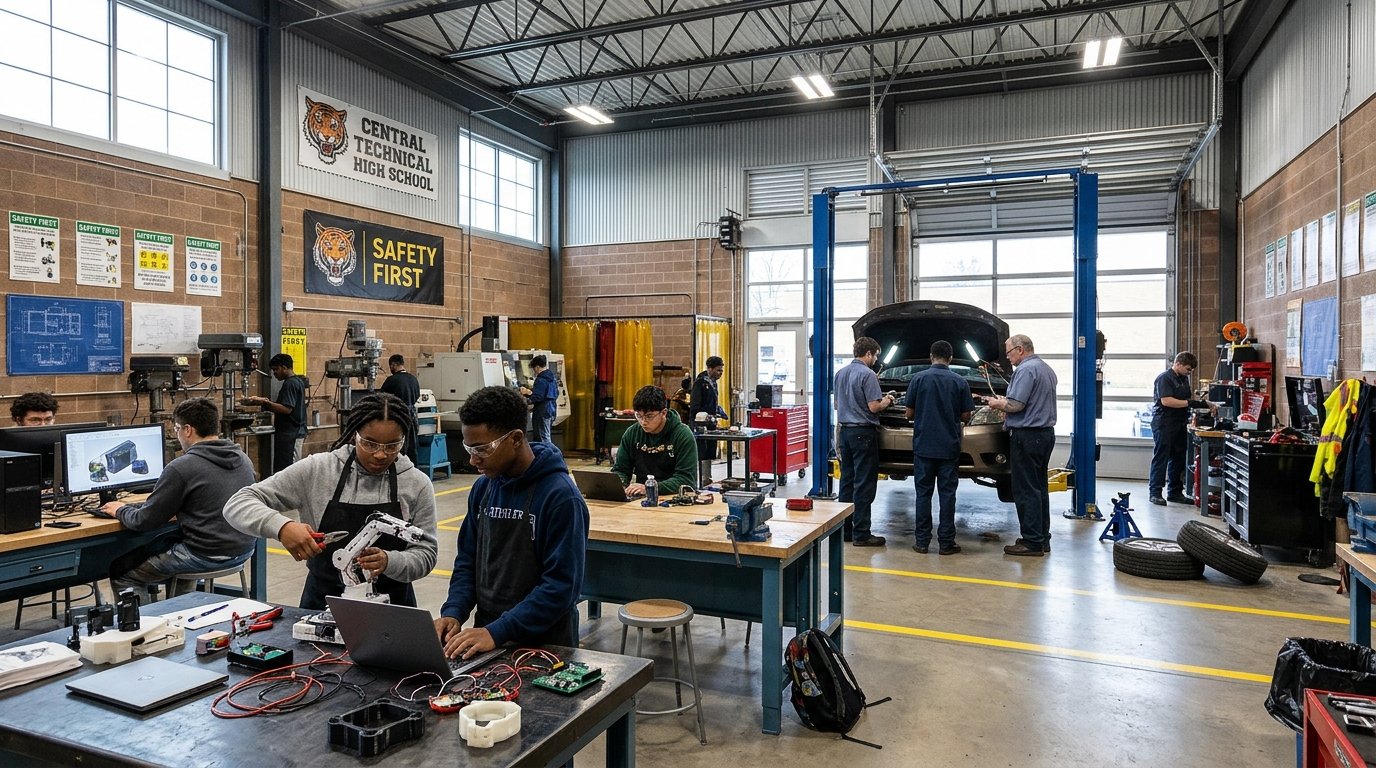
Students may also participate in practical assignments, laboratory activities, technical projects, and presentations.
The Final Examination Stage
The final stage focuses on preparing students for their Abitur examinations. Students demonstrate their knowledge through written and, where applicable, oral examinations.
Successful completion can provide the general higher education entrance qualification, giving graduates access to a broad range of university programs.
Main Specializations at a Technisches Gymnasium
One of the biggest advantages of a Technisches Gymnasium is the opportunity to explore different areas of technology before choosing a university degree or professional direction.
Available specializations depend on the individual school. Some common technical profiles include the following.
1. Mechanical Engineering
Mechanical engineering is one of the traditional areas of technical education. It focuses on machines, mechanical systems, materials, manufacturing, and the principles behind industrial equipment.
Students may learn about:
- Basic mechanical engineering principles
- Technical drawings and design
- Materials and their properties
- Machine components
- Manufacturing processes
- Mechanical systems and energy conversion
This specialization can be particularly interesting for students who enjoy designing, building, and understanding machines.
2. Electrical Engineering
Electrical engineering focuses on electricity, electronic components, circuits, and electrical systems.
Students explore how electrical energy is generated, distributed, controlled, and used in everyday technology and industrial applications.
Typical learning areas include electrical circuits, electronic components, measurement techniques, control systems, and fundamental electrical engineering concepts.
This subject provides useful preparation for future studies in electrical engineering, automation, electronics, and related technical disciplines.
3. Information Technology and Computer Science
Information technology has become an essential part of modern education and industry. Many technical schools offer specializations connected to computers, software, and digital systems.
Students may study:
- Programming fundamentals
- Computer architecture
- Algorithms and logical thinking
- Database concepts
- Digital communication
- Software development
- Information systems
This area is suitable for students interested in computers, software engineering, cybersecurity, artificial intelligence, and other digital technologies.
4. Mechatronics
Mechatronics combines mechanical engineering, electronics, and computer-based control systems. It is particularly relevant to modern manufacturing, robotics, and automated industrial processes.
Students learn how different technical components work together to create intelligent machines and automated equipment.
Possible topics include sensors, actuators, control technology, mechanical systems, and basic automation principles.
5. Construction and Civil Engineering
Some schools offer technical profiles connected to construction and building technology.
Students may explore structural design, construction materials, technical planning, building systems, and the scientific principles used in modern construction.
This specialization can provide a useful introduction to civil engineering, architecture-related studies, and construction management.
Important Subjects at a Technisches Gymnasium
The curriculum combines general education with advanced technical learning. Although subjects differ between schools, several disciplines are commonly important.
Mathematics
Mathematics is one of the most important subjects in technical education. Students use mathematical principles to understand engineering problems, calculate measurements, analyze relationships, and develop logical solutions.
Topics may include algebra, functions, geometry, calculus, probability, and statistics.
Physics
Physics helps students understand the natural principles behind machines, electrical systems, energy, motion, and materials.
It provides the scientific foundation needed to understand many technical applications.
Computer Science
Computer science develops logical thinking and introduces students to digital technologies. Depending on the school, students may learn programming, algorithms, data processing, and computer systems.
Technical Sciences
Technical subjects are central to the educational experience. They connect scientific theory with practical applications and help students understand how products, machines, and systems are designed and operated.
Languages and Communication
Technical knowledge alone is not enough for academic and professional success. Students also develop communication skills through German, English, and other general education subjects.
These skills are important for writing reports, explaining technical ideas, participating in discussions, and working with international teams.
Admission Requirements for a Technisches Gymnasium
Admission requirements depend on the federal state, school type, and individual institution. Students should always check the official information provided by their preferred school.
In many cases, applicants need an intermediate school-leaving qualification, such as the Mittlerer Schulabschluss, or an equivalent educational certificate.
Some schools also consider previous academic performance, particularly grades in mathematics, German, and English.
Common admission considerations include:
- Completion of the required secondary education level
- An accepted school-leaving certificate
- Meeting minimum academic performance requirements, where applicable
- Submission of application documents before the deadline
- Compliance with any state-specific admission regulations
Students who have completed another educational pathway may also qualify, depending on the applicable regulations.
It is important to understand that admission is not necessarily based on identical conditions throughout Germany. Requirements in Baden-Württemberg, Bavaria, and other federal states may differ.
What Qualification Can Students Receive?
A major reason students choose a Technisches Gymnasium is the opportunity to obtain the Abitur.
The Abitur is Germany’s general higher education entrance qualification. It allows graduates to apply for degree programs at universities and other higher education institutions, subject to specific admission conditions.
This is an important distinction because the technical specialization does not automatically restrict students to engineering or technology-related university courses.
For example, a graduate with a technical profile may consider studying:
- Mechanical engineering
- Electrical engineering
- Computer science
- Information technology
- Business administration
- Physics
- Mathematics
- Architecture
- Environmental sciences
- Other academic disciplines
The actual university admission process may also involve additional requirements, such as numerus clausus restrictions, aptitude assessments, or language qualifications.
Difference Between a Technisches Gymnasium and a Traditional Gymnasium
Students comparing different educational pathways often want to understand how a Technisches Gymnasium differs from a traditional Gymnasium.
Both can lead to the Abitur, but their academic emphasis is different.
A traditional Gymnasium generally provides a broad academic curriculum, with students studying languages, mathematics, sciences, humanities, and social sciences.
A Technisches Gymnasium offers a similar general education foundation but gives greater attention to technical and scientific disciplines.
The main differences include:
Technical specialization: A Technisches Gymnasium includes a dedicated technical profile that allows students to study a particular area of technology in greater depth.
Practical learning: Depending on the institution, students may participate in laboratory work, technical projects, programming assignments, and applied scientific activities.
Academic preparation: Both pathways can prepare students for university, but the technical pathway provides additional exposure to engineering and technology-related concepts.
Career exploration: Students can gain an earlier understanding of technical industries and the academic disciplines associated with them.
Neither pathway is automatically better than the other. The right choice depends on a student’s interests, strengths, and future plans.
Benefits of Attending a Technisches Gymnasium
A Technisches Gymnasium can offer several advantages to students who are interested in science and technology.
Strong Academic Foundation
Students develop knowledge in mathematics, physics, languages, and other academic subjects. This balanced education helps them prepare for university-level learning.
Early Exposure to Technology
Instead of waiting until university to explore engineering concepts, students can begin developing technical knowledge during upper secondary education.
Development of Problem-Solving Skills
Technical subjects encourage students to identify problems, evaluate information, test ideas, and develop practical solutions.
Preparation for University
The opportunity to earn the Abitur is one of the most valuable aspects of this educational route. It gives students the flexibility to consider a wide variety of university programs.
Understanding Modern Industries
Students become familiar with areas such as automation, computer systems, manufacturing, electronics, and engineering.
This exposure can help them make more informed decisions about their future academic and professional direction.
Improved Technical Confidence
Working with technical concepts, projects, and scientific methods can help students become more confident when approaching unfamiliar challenges.
Challenges Students May Face
Although a Technisches Gymnasium offers many opportunities, students should also understand the challenges involved.
Demanding Mathematics and Science Subjects
Technical education requires a good understanding of mathematical and scientific concepts. Students who struggle with these subjects may need additional practice and support.
A Combination of Academic and Technical Work
Students must manage general education subjects alongside specialized technical coursework. This requires organization, consistency, and effective study habits.
Complex Technical Concepts
Some topics, particularly programming, electronics, and engineering mathematics, can initially seem difficult.
However, regular practice and a willingness to ask questions can make these subjects easier to understand.
Time Management
Assignments, examinations, projects, and practical activities can create a busy academic schedule. Students benefit from planning their work and maintaining a consistent study routine.
Understanding these challenges before applying can help students make a more confident and informed decision.
Career Opportunities After a Technisches Gymnasium
Graduating from a Technisches Gymnasium can create several opportunities, but it is important to understand that the qualification primarily prepares students for higher education rather than automatically providing a professional technical license.
Many graduates continue their education at universities or universities of applied sciences.
Depending on their interests, they may pursue careers in different industries after completing the necessary degree or professional training.
Engineering
Students interested in machines, structures, electronics, or industrial systems may pursue engineering degrees.
Possible career directions include mechanical engineering, electrical engineering, civil engineering, and mechatronics.
Information Technology
Graduates interested in computers and digital systems may choose computer science, software engineering, data science, or information technology.
These fields offer opportunities in software development, IT infrastructure, system administration, and digital innovation.
Automation and Robotics
Automation is increasingly important in manufacturing, logistics, and industrial production.
Students can continue studying automation technology, robotics, control engineering, or related subjects.
Research and Development
Students with a strong interest in scientific discovery may pursue university studies that lead toward research and development.
This can involve developing new materials, improving technical systems, testing products, or exploring innovative engineering solutions.
Technical Management
Some graduates eventually combine technical education with business studies.
This can open pathways into project management, technical consulting, operations, and industrial management.
Is a Technisches Gymnasium Suitable for Everyone?
A Technisches Gymnasium is particularly suitable for students who enjoy mathematics, science, technology, and analytical thinking.
However, students do not need to have complete knowledge of engineering or computer science before applying.
Interest, curiosity, motivation, and a willingness to learn are often more important than already possessing advanced technical skills.
Students who enjoy understanding how machines operate, how software works, or how scientific principles influence everyday life may find this educational pathway rewarding.
On the other hand, students who strongly prefer a curriculum focused on languages, literature, history, or humanities may find a traditional academic pathway more suitable.
The most important consideration is choosing an educational environment that matches individual interests and long-term goals.
How to Choose the Right Technisches Gymnasium
Not all technical upper secondary schools offer the same specializations, facilities, or learning experiences. Students should compare several institutions before making a final decision.
The following factors can help with the selection process.
Check Available Specializations
First, identify the technical subjects offered by each school. A student interested in software development may prefer a school with a strong computer science profile, while someone interested in machines may prefer mechanical engineering.
Review the Admission Requirements
Check the required qualifications, academic grades, application deadlines, and any additional conditions.
Explore Practical Learning Opportunities
Find out whether the school offers laboratories, workshops, technical projects, or partnerships with local companies and universities.
Consider Location and Transportation
Daily travel can affect a student’s routine and academic performance. A conveniently located school may make it easier to maintain a balanced schedule.
Ask About University Preparation
Students should understand how the school prepares learners for Abitur examinations and higher education.
Visiting the institution, attending an information session, or speaking with current students can also provide valuable insights.
The Role of Technology in Modern Education
Technology is changing how people study, work, communicate, and solve problems. Modern industries increasingly depend on digital systems, automation, data analysis, and engineering innovation.
This makes technical education particularly relevant for students preparing for the future.
A Technisches Gymnasium can introduce students to these developments through subjects that connect scientific principles with practical applications.
For example, programming helps students understand how digital systems operate. Electrical engineering introduces the fundamentals behind electronic devices, while mechanical engineering explains the design and operation of machines.
Students may also develop an understanding of sustainability, energy efficiency, renewable energy systems, and environmentally responsible engineering.
These topics are important because future technical professionals will need to consider not only performance and cost but also environmental and social responsibilities.
Frequently Asked Questions About Technisches Gymnasium
1. What does Technisches Gymnasium mean in English?
Technisches Gymnasium can be translated as Technical Gymnasium or Technical Upper Secondary School. It describes a German educational pathway that combines general academic education with specialized technical subjects.
2. Does a Technisches Gymnasium lead to the Abitur?
Yes. Many Technisches Gymnasium programs are designed to lead to the general Abitur, provided students successfully complete the required coursework and examinations.
3. How long does a Technisches Gymnasium take?
In many German states, the program lasts three years. However, the exact duration depends on the school structure, previous qualifications, and regional education regulations.
4. Which subjects are taught at a Technisches Gymnasium?
Students commonly study mathematics, German, English, physics, computer science, and specialized technical subjects. The exact curriculum depends on the school’s technical profile.
5. Can students study computer science after a Technisches Gymnasium?
Yes. Students who obtain the general Abitur can generally apply for computer science and other university programs, subject to the institution’s admission requirements.
6. Is a Technisches Gymnasium harder than a traditional Gymnasium?
Difficulty depends on individual strengths and interests. Students who enjoy technical subjects may find the specialization motivating, while others may find advanced mathematics and technical coursework challenging.
7. Can students attend university after graduating?
Yes. The general Abitur provides access to a wide range of university programs in Germany, subject to applicable admission requirements.
8. Is a Technisches Gymnasium suitable for students without technical experience?
Yes. Students generally develop their technical knowledge through the curriculum. A genuine interest in science and technology, together with a willingness to learn, can be a good starting point.
9. What is the difference between a Technisches Gymnasium and a Berufsschule?
A Technisches Gymnasium is an upper secondary academic pathway that can lead to the Abitur. A Berufsschule is generally part of Germany’s vocational education system, often combining classroom learning with workplace-based apprenticeship training.
10. Can students choose non-technical university subjects afterward?
Yes. When the program leads to the general Abitur, graduates can apply for a broad range of academic disciplines, not just technical degrees.
Conclusion
A Technisches Gymnasium offers an educational pathway for students who want to combine general academic learning with a deeper understanding of technology and engineering. Through subjects such as mathematics, physics, computer science, electrical engineering, and mechanical engineering, students develop valuable analytical and technical skills.
One of its most important advantages is the opportunity to obtain the general Abitur, which can provide access to universities and a wide range of academic disciplines. Whether a student eventually chooses engineering, computer science, scientific research, business, or another field, the knowledge gained through technical education can provide a useful foundation.
Before applying, students should carefully compare available specializations, admission requirements, and school facilities. Choosing the right institution can make a meaningful difference to the overall learning experience.
For students with curiosity about technology and a desire to understand the world through science and practical problem-solving, a Technisches Gymnasium can be an excellent starting point for future academic and professional growth.
Explore More: Hannah Lin Raleigh: A Guide to Finding Information