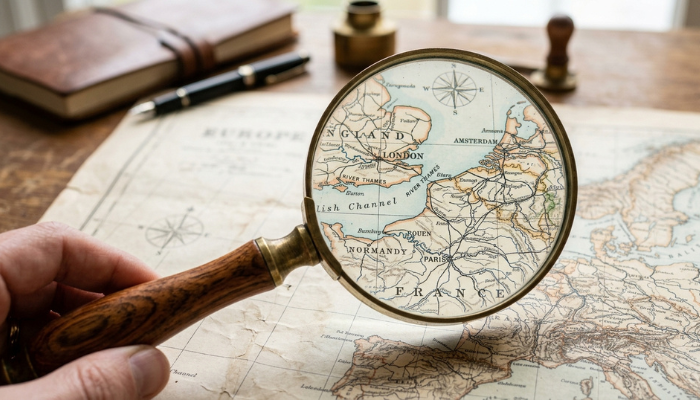
A magnifying glass is used to make small, nearby details appear larger and easier to see. People commonly use one for reading fine print, examining jewelry, inspecting coins and stamps, studying insects and plants, working on crafts, and checking tiny parts or markings.
A typical magnifying glass uses a convex lens, which bends light in a way that allows the eye to see an enlarged virtual image of an object. The same basic optical principle makes a magnifying glass useful in education, hobbies, inspection, repair work, and some low-vision activities.
What Is a Magnifying Glass Used For?
A magnifying glass is primarily used to enlarge the appearance of small objects or details that are difficult to see clearly with the naked eye.
Common uses include:
| Use | Example |
|---|---|
| Reading | Small print, labels, menus, maps, instructions |
| Collecting | Coins, stamps, cards and other collectibles |
| Jewelry | Gemstones, settings, scratches and markings |
| Nature study | Insects, leaves, flowers and small specimens |
| Crafts | Needlework, miniature painting and model building |
| Electronics | Small components, markings and solder joints |
| Repair | Watches, small mechanical parts and precision work |
| Inspection | Surface defects, cracks, fibers and tiny markings |
| Education | Demonstrating basic optics and observing specimens |
| Low-vision support | Reading and other close-up activities |
The key benefit is simple: a magnifying glass lets you see details that are too small or difficult to inspect comfortably without magnification.
Common Uses of a Magnifying Glass
1. Reading Small Print
One of the most familiar uses is reading text that is too small to see comfortably.
A magnifying glass can help with:
- Product labels
- Maps
- Menus
- Receipts
- Instruction manuals
- Small printed notes
- Appliance labels
- Packaging
- Serial numbers
An illuminated magnifier can be particularly useful when poor lighting makes small text harder to distinguish.
For people with low vision, the National Eye Institute lists magnifying lenses among the tools that can help with reading and other close-up activities.
2. Examining Jewelry and Gemstones
Jewelry often contains details that are difficult to inspect with the naked eye.
A magnifying glass can help you look more closely at:
- Gemstone surfaces
- Jewelry settings
- Small markings
- Scratches
- Engraving
- Metalwork
- Fine decorative details
Professionals may use specialized magnifiers or loupes when they need greater precision than an ordinary handheld magnifying glass provides.
3. Inspecting Coins and Stamps
Collectors frequently need to examine small details.
For coins, magnification can make features such as lettering, mint marks, surface wear and small scratches easier to inspect.
For stamps, a magnifying glass can help reveal printing details, perforations, small markings and signs of wear.
The goal is not always to make an object dramatically larger. Often, a clear view with minimal distortion is more useful than extremely high magnification.
4. Studying Plants and Insects
A magnifying glass can turn an ordinary nature walk into a closer examination of the world.
You can use one to inspect:
- Leaf surfaces
- Flower structures
- Insect bodies
- Wings
- Small patterns
- Bark
- Seeds
- Soil particles
Educational activities sometimes use magnifiers to help students observe details that are difficult to see without optical assistance. The University of Florida’s IFAS Extension, for example, describes using a magnifying glass for nature observation and examining living and nonliving details in a small study area.
5. Crafts and Hobbies
Small-scale hobbies can benefit from magnification because many tasks involve details that require precision.
Examples include:
- Needlework
- Embroidery
- Model building
- Miniature painting
- Jewelry making
- Small-scale carving
- Paper crafts
- Painting tiny details
For activities requiring both hands, a stand-mounted or wearable magnifier may be more practical than a traditional handheld model.
6. Electronics and Small Parts
Magnifying glasses can help when inspecting small electronic components and markings.
They may be useful for checking:
- Component labels
- Circuit-board details
- Small connectors
- Solder joints
- Tiny screws
- Wires
- Surface damage
For detailed electronics repair, however, a magnifying glass has limitations. A microscope or specialized inspection system may be better when very small features need to be examined.
7. Watches and Precision Work
Watch repair involves very small components, so magnification can make individual parts easier to see.
Similar applications can include:
- Small mechanical parts
- Model components
- Fine assembly work
- Tiny fasteners
- Precision inspection
Professionals often use specialized optical equipment rather than relying on a basic household magnifying glass.
8. Checking Labels, Numbers and Markings
Small identification numbers can be difficult to read.
A magnifying glass can help inspect:
- Serial numbers
- Model numbers
- Product markings
- Small labels
- Engraved numbers
- Manufacturing marks
This is especially useful when the task involves finding or identifying one small area rather than reading an entire document.
How Does a Magnifying Glass Work?
A standard magnifying glass uses a convex lens, also called a converging lens.
A convex lens is thicker around the center than near its edges. When light passes through the lens, refraction changes the direction of the light rays.
When an object is positioned closer to a convex lens than the lens’s focal length, the lens forms a virtual, upright and enlarged image. Your eye then views that enlarged image, making the object appear bigger.
In simple terms:
Object → convex lens → refracted light → enlarged virtual image → eye
The lens does not physically enlarge the object. Instead, it changes the path of light entering your eye so that the object appears larger.
Why Does a Magnifying Glass Make Things Look Bigger?
The human eye has limits on how closely it can focus on an object.
If you move a small object closer to your eye, it can appear larger because it occupies a greater angle in your field of view. However, move it too close and it becomes difficult for the eye to focus.
A magnifying glass helps by changing the direction of the light rays before they enter the eye. This allows the eye to view the object as an enlarged image while maintaining focus.
OpenStax describes this in terms of angular magnification. A convex lens increases the angle that the image subtends at the eye, making the object appear larger.
What Is Focal Length?
Focal length is the distance from the center of a lens to its focal point.
The focal point is where incoming rays that are approximately parallel to the lens’s optical axis converge after passing through a converging lens.
Focal length is important because it affects the magnifying power of a simple magnifier.
For a given simple magnifier, a shorter focal length generally produces greater angular magnification. OpenStax gives the relationship between focal length and angular magnification for a simple magnifier.
Can a Magnifying Glass Help With Reading and Low Vision?
Yes. A magnifying lens can help some people with low vision perform close-up activities such as reading.
The National Eye Institute specifically lists magnifying lenses as one possible aid for people with low vision who need help with reading and other up-close activities. It also notes that vision rehabilitation can include training on how to use magnifying devices.
However, a basic magnifying glass is not automatically the best solution for every person with vision difficulties.
Depending on the individual’s needs, other options can include:
- Illuminated magnifiers
- Stand magnifiers
- Electronic magnifiers
- Larger digital text
- Screen magnification
- Other vision-rehabilitation aids
If vision problems are interfering with everyday activities, an eye-care professional can help determine which type of aid is appropriate.
Magnifying Glass vs. Microscope
A magnifying glass and a microscope both use lenses to make small details easier to see, but they are designed for different levels of magnification and different tasks.
| Feature | Magnifying Glass | Microscope |
| Basic design | Usually one main lens | Usually multiple lenses |
| Best for | Everyday close inspection | Very small specimens and structures |
| Portability | Usually very portable | Generally less portable |
| Setup | Simple | More involved |
| Typical use | Reading, hobbies, inspection | Biology, research, laboratory work |
| Magnification | Limited compared with microscopes | Much higher potential magnification |
A magnifying glass is essentially a simple magnifier. A compound microscope combines multiple lenses to achieve much greater magnification. OpenStax notes that achieving high magnification with a single simple lens is difficult without distortion, which is why microscopes use multiple lenses.
What Can You See With a Magnifying Glass?
The exact level of detail depends on the lens, lighting, object and viewing distance.
You may be able to see details such as:
- Fine print
- Coin markings
- Stamp perforations
- Jewelry details
- Insect features
- Plant structures
- Fabric fibers
- Small scratches
- Tiny labels
- Electronics components
- Craft details
A magnifying glass is most useful when the details are small but still within the general range of what an optical magnifier can resolve.
It is not a replacement for a microscope when the object contains structures that are far too small for a simple magnifier.
How to Use a Magnifying Glass Properly
For general close-up viewing, start with these steps:
- Hold the object in a well-lit position.
- Place the magnifying glass between your eye and the object.
- Move the lens gradually until the image becomes clear.
- Adjust the distance between the lens and object to find the sharpest view.
- Move the object or lens rather than forcing your eyes to focus at an uncomfortable distance.
- Use a stand or hands-free magnifier when you need both hands for a task.
The ideal position depends on the lens and how it is being used. The basic principle is to find the position where the enlarged image is clear and comfortable to view.
What Is a Magnifying Glass Not Good For?
A magnifying glass has practical limitations.
It is not ideal for:
- Viewing extremely tiny structures
- High-precision scientific microscopy
- Examining cells in detail
- Replacing professional inspection equipment
- Reading large amounts of text continuously when another visual aid would be more comfortable
- Viewing distant objects
More magnification is not automatically better. Increasing magnification can reduce the field of view and make it harder to keep an object steady and focused.
For some applications, a lower-power lens with a wider, clearer viewing area can be more useful.
Can a Magnifying Glass Concentrate Sunlight?
Yes. A convex magnifying lens can concentrate sunlight into a small area.
Sunlight reaching Earth is approximately composed of parallel rays. A converging lens can bring those rays together near its focal point. OpenStax demonstrates this principle with a magnifying glass focusing sunlight and explains that lens power is related to focal length.
This also creates an important safety issue.
Never leave a magnifying glass positioned so that it can concentrate sunlight onto dry leaves, paper, fabric or another flammable material.
A concentrated beam of sunlight can create significant heat at the focal point.
For the same reason, children should only perform demonstrations involving concentrated sunlight with appropriate adult supervision.
Types of Magnifying Glasses
Magnifying glasses come in several designs.
Handheld Magnifying Glass
This is the traditional type with a handle.
It is useful for:
- Quick reading
- Inspection
- Collecting
- Hobbies
- General household use
Lighted Magnifying Glass
This version combines magnification with built-in illumination.
It can be useful when:
- The object is poorly lit
- Small print has low contrast
- Both magnification and extra light are helpful
Stand Magnifier
A stand keeps the lens at a relatively fixed position.
This can be useful for longer tasks because you do not have to hold the magnifier continuously.
Wearable Magnifier
Some magnification systems are designed to be worn, leaving both hands free.
These can be useful for detailed crafts and other tasks that require continuous close-up work.
Loupe
A loupe is a compact high-magnification optical device commonly associated with jewelry, watches and other precision applications.
It is generally designed for close inspection rather than broad everyday reading.
How to Choose the Right Magnifying Glass
The best magnifying glass depends on the task rather than simply the highest magnification number.
Consider these factors:
Magnification
Higher magnification can reveal smaller details, but it generally gives you a smaller viewing area and may require more careful positioning.
Lens Size
A larger lens can provide a wider viewing area, which may be more comfortable for reading or general inspection.
Lighting
If you frequently work in poor lighting, an illuminated model can be useful.
Hands-Free Design
For crafts, repairs or other tasks requiring both hands, consider a stand or wearable design.
Optical Quality
Clear optics with low distortion can be more useful than simply choosing the strongest available lens.
Purpose
Think about what you actually need to inspect.
A magnifier for reading a label may be very different from one used for jewelry, electronics or precision repair.
What Is the Main Purpose of a Magnifying Glass?
The main purpose of a magnifying glass is to make small, nearby details appear larger so they can be examined more easily.
Its applications range from simple household tasks to specialized inspection. Students can use magnifiers for nature study, collectors can inspect coins and stamps, hobbyists can work on miniature projects, and people with low vision may use magnifying lenses for close-up activities.
The basic technology is simple, but the optical principle behind it is important: a convex lens changes the path of light so the eye can perceive an enlarged virtual image.
Frequently Asked Questions
What is a magnifying glass used for?
A magnifying glass is used to make small, nearby objects and details appear larger. Common uses include reading small print, inspecting jewelry, examining coins and stamps, studying plants and insects, doing crafts, and checking small parts or markings.
What type of lens is used in a magnifying glass?
A standard magnifying glass uses a convex, or converging, lens. When used as a simple magnifier, the lens can produce an upright, enlarged virtual image when the object is positioned within the lens’s focal length.
How does a magnifying glass make things look bigger?
It refracts light before the light enters your eye. This allows the eye to view an enlarged virtual image and increases the apparent angular size of the object.
Can a magnifying glass help you read small print?
Yes. A magnifying glass can make small text appear larger and easier to inspect. Magnifying lenses are also among the visual aids that may help people with low vision perform close-up activities such as reading.
Is a magnifying glass the same as a microscope?
No. A magnifying glass is a simple magnifier, usually based on a single convex lens. A compound microscope uses multiple lenses and can provide much greater magnification for very small objects and structures.
Can a magnifying glass burn things?
A convex magnifying glass can concentrate sunlight into a small, hot area. Because of this, it should never be left where it can focus sunlight on flammable materials.
What can you see with a magnifying glass?
You can inspect small details on coins, stamps, jewelry, insects, leaves, fabric, labels, electronic components and many other objects. The amount of detail visible depends on the lens, lighting, magnification and the size of the feature being examined.
Is stronger magnification always better?
No. Higher magnification can provide more detail, but it can also reduce the viewing area and make focusing more difficult. The best magnification depends on the task.
Conclusion
A magnifying glass is primarily used to make small, nearby details easier to see. Its applications include reading fine print, examining collectibles and jewelry, studying nature, completing crafts, inspecting small parts and supporting some close-up activities for people with low vision.
The science behind it is straightforward. A convex lens refracts light and creates an enlarged virtual image when used in the appropriate position. That simple optical principle makes the magnifying glass useful for everything from everyday reading to detailed inspection.
For ordinary close-up tasks, the right magnifier is not necessarily the one with the highest magnification. Lens clarity, viewing area, lighting and whether you need your hands free can be just as important.
See also: Endeavor Mentorship Program Structure